
Most people still look at OpenLedger and see “just another AI + crypto project.”
I think that’s a fundamental misunderstanding.
What pulled me in wasn’t models, agents, or hype narratives. It was attribution.
Proof of who contributed what, when, and why and getting paid for it forever.
That’s not a feature. That’s infrastructure.
@OpenLedger isn’t trying to win the AI arms race by building the biggest model. It’s trying to solve the $500B problem nobody likes to talk about: data ownership, provenance, and coordination in a world where AI systems are becoming economic actors.
From Static AI to Living Economic Systems
Traditional AI treats data like fuel. Burn it once, discard the source, move on.
OpenLedger flips that entirely.
Here, data becomes alive.
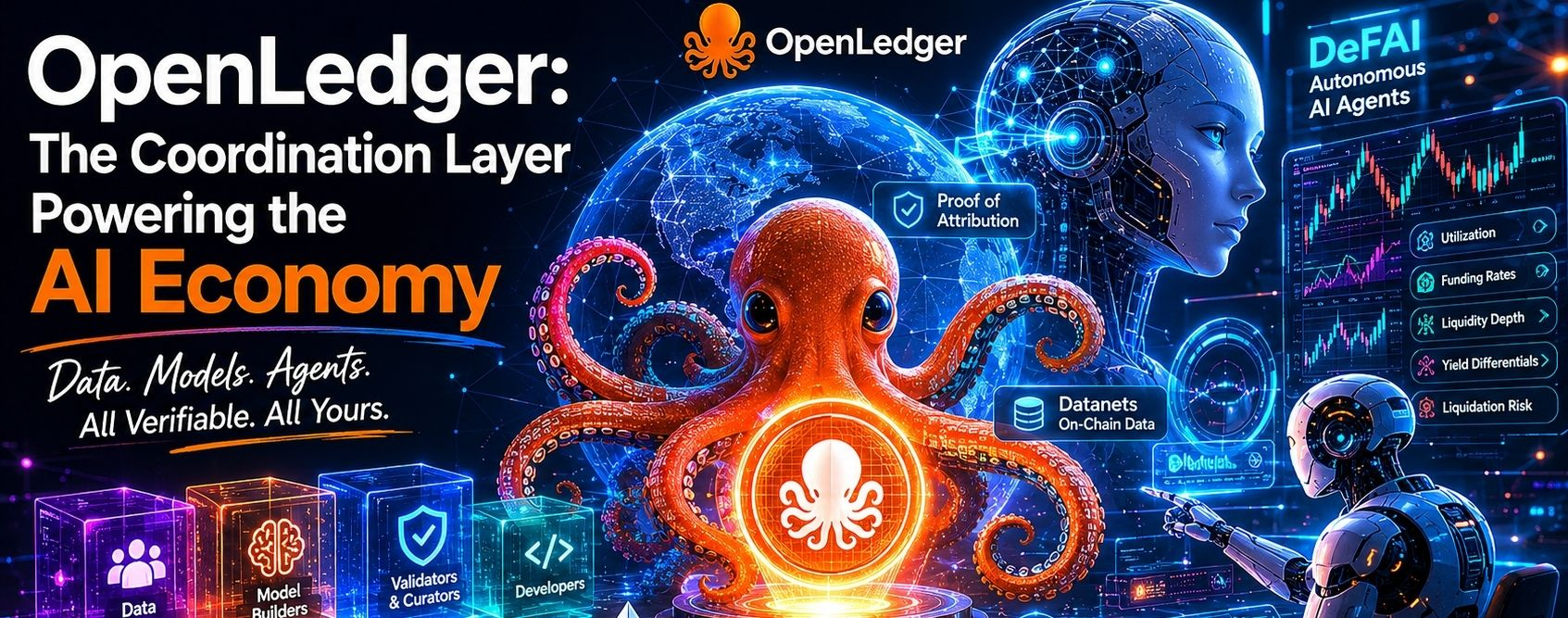
Through Datanets, datasets are structured as ongoing, on-chain economic networks. Contributors upload data. Curators validate it. Developers consume it. Every interaction is tracked, attributed, and rewarded over time.
That’s the mental shift most people miss.
OpenLedger isn’t a marketplace it’s a behavior coordination layer for AI.
It forces long-term alignment between everyone involved instead of extractive one-off value capture.
This is why the “AI Ethereum + GitHub” analogy actually works. Ethereum coordinated capital. GitHub coordinated code. OpenLedger coordinates intelligence inputs.
Proof of Attribution Is the Real Breakthrough
The most important innovation here isn’t OpenLoRA or agents it’s Zero-Knowledge Proof of Attribution.
AI regulation is no longer theoretical. Lawsuits over training data, copyright, and privacy are accelerating. The future winner isn’t the biggest model it’s the one that can prove compliance.
OpenLedger allows a model to cryptographically prove what data influenced its outputs without exposing the raw data itself. That’s enormous.
It means models trained on OpenLedger can move across ecosystems Ethereum, Base, Hedera while carrying verifiable provenance with them. That’s an on-chain compliance shield, not a marketing bullet.
Partnerships around programmable IP (like Story-style registries) make this even stronger. In my view, this is how AI survives regulatory pressure without collapsing into centralized gatekeepers.
Why DeFAI Changes the Game
Here’s where things get really interesting.
TradFi charges AUM fees for strategies that are now trivial for autonomous agents.
DeFi made capital programmable. DeFAI makes it self-executing.
On OpenLedger, autonomous AI agents can dynamically coordinate collateral across protocols. They don’t rely on static ratios. They monitor utilization, funding rates, liquidity depth, liquidation thresholds, and yield spreads in real time.
The goal isn’t max APY.
It’s capital efficiency under changing risk conditions.
This is the endgame: strategies that adapt before markets break, not after.
And because attribution is native, the data providers, model builders, and validators powering those agents get paid automatically. No intermediaries. No opaque funds. No rent extraction.

Infrastructure Over Hype
Technically, OpenLedger made the right trade-offs.
Built on OP Stack, secured via EigenLayer-style shared security, and EVM-compatible by default this isn’t a science experiment. It plugs directly into existing wallets, liquidity, and tooling.
The worker-node model (browser, Windows, Linux) also matters more than people realize. It decentralizes participation at the edge while keeping verification tight at the core.
That said, this isn’t risk-free.
Attribution at scale is expensive. Telemetry is massive. If incentives fail, data farming and spam become real threats. OpenLedger’s success depends entirely on whether its cryptoeconomics can filter signal from noise.
That’s the real test not token price.
Why $OPEN Has Real Mindshare Potential
The OPEN token isn’t cosmetic. It sits at the center of gas, governance, staking for AI agents, and automated rewards. Listing on Binance gave it distribution, but distribution alone doesn’t create durability.
What creates durability is necessity.
If AI keeps moving toward autonomous systems, regulators keep tightening the screws, and data creators keep demanding ownership then something like OpenLedger isn’t optional. It’s inevitable.
Backers like Polychain Capital didn’t fund a meme. They funded a bet that AI coordination becomes on-chain by default.
I agree with that bet.
Final Take
#OpenLedger isn’t trying to be loud. It’s trying to be unavoidable.
It’s not selling AI magic. It’s selling accountability, coordination, and survivability in an AI-native economy. Most people won’t notice until they need it.
By then, the infrastructure will Already be there quietly settling attribution, payments, and trust at machine speed.
That’s why I’m paying attention.
