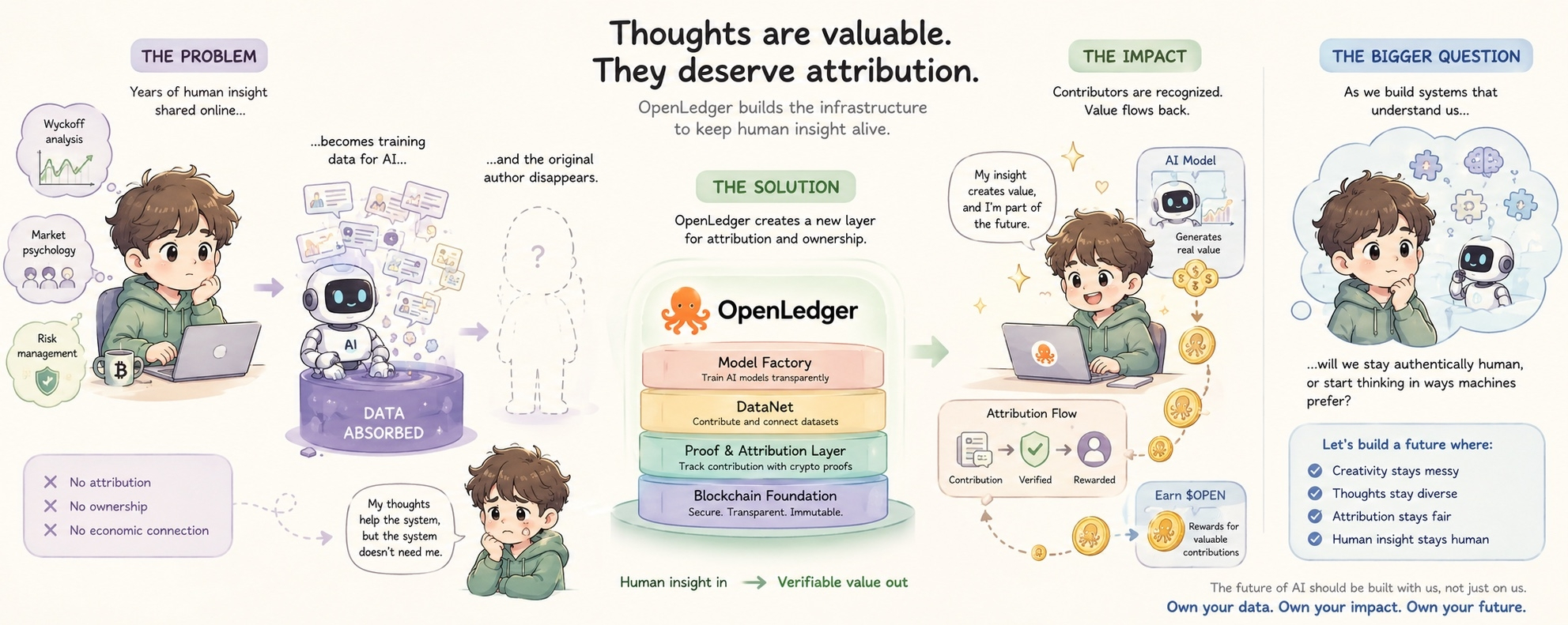
What started bothering me recently wasn’t AI itself. It was how familiar it suddenly sounded.
Yesterday I was scrolling through some old market analysis posts I wrote a while back. Mostly Wyckoff stuff. Liquidity sweeps, accumulation ranges, fake breakdowns on BTC around major support zones. The usual trader obsession. I used to enjoy rereading those posts because they reminded me of how much time goes into building market intuition. You spend years staring at charts before certain behaviors start feeling obvious.
A few days ago, Bitcoin was hovering around the $82k area and I asked a language model for its opinion on the structure.
The response honestly caught me off guard.
Not because it was smarter than human traders. It wasn’t. But the tone felt weirdly close to conversations I’ve had with experienced people in private trading groups over the years. Same detached reasoning. Same pattern recognition. Same way of framing crowd psychology without emotional attachment.
It felt less like the machine was generating an answer and more like it had absorbed thousands of traders slowly thinking out loud for years.
And maybe that sounds obvious. Of course it did. That’s literally what these systems are trained on.
But for some reason, that realization feels different when you see your own world reflected back at you through a machine.
I think most people still imagine posting online as a social activity. You share ideas, build reputation, meet people who think similarly. That part is real. But underneath that, there’s another layer most of us rarely think about.
Every explanation. Every thread. Every niche insight written publicly over the last decade is gradually turning into training material for systems that no longer need the original author attached to the idea.
And the strange part is nobody really forced this process.
We volunteered for it because the internet trained us to equate visibility with relevance. The more useful your thoughts were, the more you posted. The more you posted, the more valuable data you created for systems you didn’t own.
I don’t even mean this emotionally. I’m not trying to argue that AI companies are “stealing” from people in some dramatic sense. The internet has always worked like this to some degree. Information spreads. Ideas get reused.
But AI changes the scale of it.
Before, your posts helped other humans learn. Now they help create systems that can replicate the functional shape of your reasoning without needing you anymore.
That’s the part I can’t stop thinking about.
And honestly, the deeper I looked into it, the less I thought the real issue was model intelligence or compute power. Those things matter, obviously, but they don’t feel like the core problem anymore.
The real issue feels closer to infrastructure.
The internet was built to move information around cheaply and efficiently. It was never really designed to preserve attribution once information became useful at scale. The second an idea gets absorbed into a model, the relationship between the person who produced the insight and the value created from it mostly disappears.
Not because it’s impossible to track. Mostly because nobody had a reason to track it before.
That’s actually why projects like OpenLedger started becoming more interesting to me recently.
At first I dismissed it pretty quickly. I’ve been around crypto long enough to become skeptical whenever people combine blockchain with whatever technology is trending at the moment. Usually it’s just narrative layering.
But after spending more time reading about Datanets and their Model Factory idea, I realized they were trying to solve something different.
Not “How do we make AI smarter?”
More like: “How do we stop human contribution from disappearing inside machine systems?”
That distinction matters.
If someone contributes specialized market knowledge to train a trading model, and that model later generates value, systems like this attempt to route attribution back to the original contributors instead of treating all cognition as free raw material.
And honestly, part of me immediately liked the idea.
Because if you’ve spent years publishing research, analysis, writing, or niche expertise online, there’s something emotionally satisfying about the idea that thought itself could retain economic ownership after distribution instead of becoming disposable the second it gets posted publicly.
But the more excited I got about the idea, the more uncomfortable it started becoming too.
Because every system that measures behavior eventually changes behavior.
Social media changed communication because attention became measurable. Financial markets changed corporate decision-making because quarterly performance became measurable. Once metrics appear, people adapt to the metrics whether they intend to or not.
I don’t see why cognition would be any different.
If creators know they get rewarded when their ideas are useful to AI systems, they’ll naturally start shaping ideas in ways AI systems can easily process, attribute, and validate.
Not because people suddenly become fake.
Just because incentives slowly pressure behavior over time.
And that’s where something about this starts feeling strange to me.
A lot of genuinely important ideas begin as messy thoughts. Incomplete thoughts. Intuitions that don’t fully make sense yet. Sometimes the most valuable insights initially sound irrational or badly articulated because the person thinking them hasn’t fully processed them themselves.
Human creativity is usually ugly before it becomes clean.
But machine systems generally reward clarity, structure, consistency, legibility. They reward information that can be measured confidently.
So what happens to forms of thinking that are:
contradictory
emotional
nonlinear
half-formed
difficult to score
impossible to immediately categorize
Do those ideas slowly become economically invisible?
And if they do, people eventually adapt.
Not through censorship. Not because anyone forces them to.
People simply learn, over time, which kinds of thoughts are rewarded and which kinds quietly disappear.
Writers explain things more cleanly because clean explanations perform better inside attribution systems. Analysts organize reasoning into machine-friendly structures because structured reasoning is easier to verify and monetize.
Eventually you may end up with a strange feedback loop where humans begin optimizing their thinking for machine readability without consciously realizing they’re doing it.
That possibility feels much darker to me than the original AI ownership problem.
Because at that point, the issue is no longer whether creators are compensated fairly.
The issue becomes whether economic systems slowly reshape the texture of human thought itself.
And honestly, I’m still not sure if systems like this represent a solution to digital exploitation or the beginning of a much more subtle form of cognitive standardization.
Maybe both are true at the same time.
#openledger $OPEN @OpenLedger $EDEN $BSB