
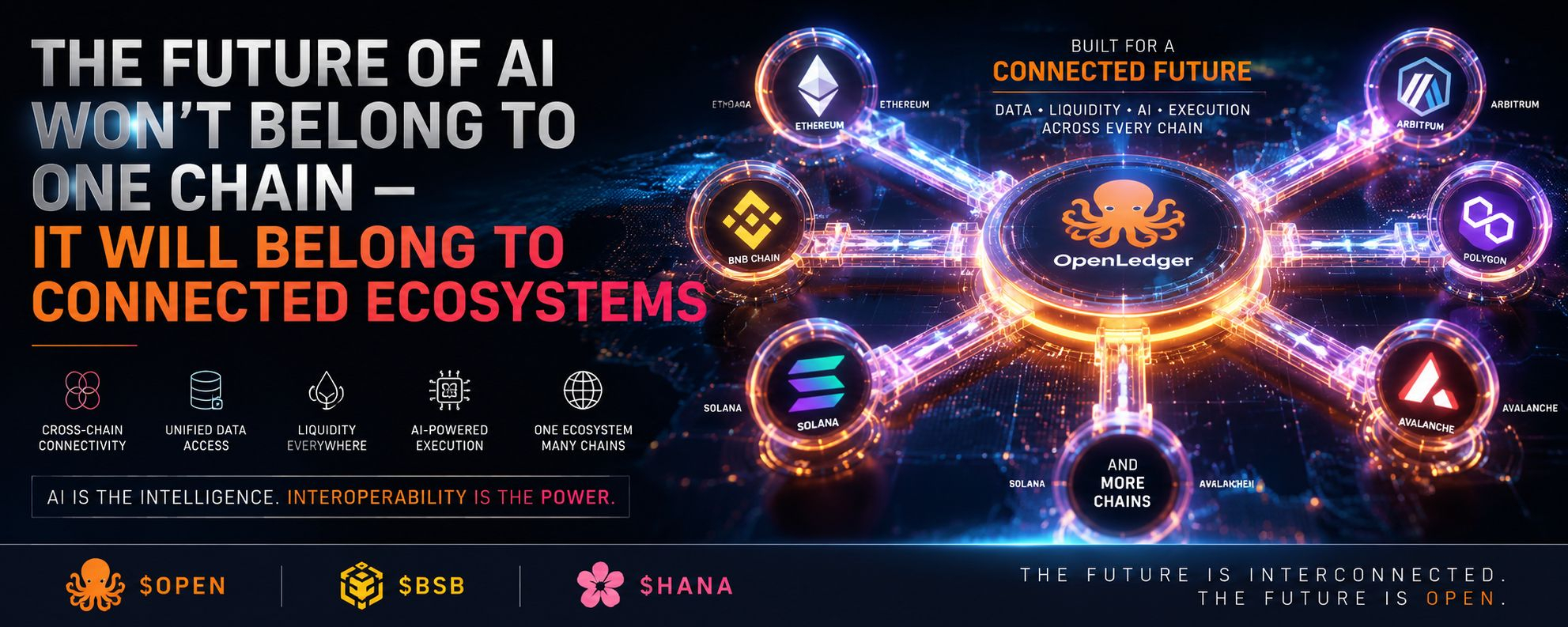
Most AI ideas sound revolutionary at first. Better models. Faster inference. Smarter agents. Autonomous workflows. But there’s a limitation that keeps showing up beneath the surface: isolation.
A powerful AI system means very little if it cannot interact with the broader digital economy around it.
Right now, many AI ecosystems still behave like closed environments. One chain holds the liquidity. Another chain hosts the users. A different network specializes in computation. Another becomes the home of data storage or identity. The result is fragmentation, and fragmentation slows adoption.
That’s why cross-chain connectivity is becoming one of the most important layers in the next phase of both crypto and AI.
The future probably does not belong to a single dominant blockchain. It belongs to the systems that can coordinate across many of them without friction.
Projects like OpenLedger are interesting because they are approaching AI infrastructure with this reality in mind. Instead of treating AI as a standalone product sitting on one network, the idea shifts toward AI economies that can move across chains, access liquidity wherever it exists, pull data from multiple ecosystems, and execute actions without being trapped inside isolated silos.
That changes the conversation completely.
Because once AI becomes interoperable, it stops behaving like a tool and starts behaving like an economy.
The difference matters.
An isolated AI application can generate outputs. An interconnected AI ecosystem can generate value flows.
And in crypto, value flows are everything.
We are entering a phase where the market is slowly realizing that AI infrastructure without interoperability may eventually hit a ceiling. The same thing happened in earlier blockchain cycles. Networks that could not communicate with broader ecosystems struggled to maintain relevance, while protocols focused on composability and liquidity access gained stronger long-term positioning.
Cross-chain architecture solves several major problems at once.
First, it unlocks liquidity mobility.
Liquidity in crypto is fragmented across ecosystems. Ethereum, Solana, BNB Chain, Base, Arbitrum, Avalanche, and many others all hold different pools of capital and users. If an AI protocol is trapped inside one environment, its economic activity becomes restricted by the limitations of that chain alone.
But when systems become chain-agnostic, they can interact with liquidity wherever it exists.
That creates stronger network effects.
An AI agent operating across ecosystems could theoretically execute strategies, access markets, retrieve data, or coordinate assets without users needing to constantly bridge manually between chains. That’s a major shift in usability.
Second, interoperability expands the quality of data itself.
AI models become stronger when they can access broader datasets and more diverse sources of activity. On-chain behavior across ecosystems contains enormous amounts of information: trading activity, governance participation, liquidity movement, user behavior, NFT interactions, and application usage.
When AI systems can interpret signals across multiple chains instead of one isolated environment, intelligence becomes richer and more adaptive.
That matters especially in crypto markets, where narratives rotate quickly and liquidity migrates fast.
A model trained only inside one ecosystem may miss the broader picture.
A cross-chain AI system has a wider lens.
Third, execution becomes more meaningful.
The next generation of AI agents will not simply answer questions. They will perform actions.
That is where things become far more disruptive.
Imagine AI agents capable of moving assets, optimizing yields, analyzing sentiment, executing trades, interacting with protocols, managing treasury strategies, or coordinating decentralized workflows across chains simultaneously.
At that point, AI is no longer just an assistant layer sitting above crypto.
It becomes part of crypto infrastructure itself.
And infrastructure tends to capture the deepest long-term value.
This is why the conversation around interoperability is becoming increasingly important in projects connected to AI and decentralized coordination. The market is starting to understand that intelligence alone is not enough. Connectivity matters just as much.
A smart system trapped in isolation is still limited.
A connected system scales exponentially.
The interesting part is that this trend aligns with how crypto has evolved historically.
Every major cycle pushed toward greater composability.
Bitcoin introduced decentralized value storage.
Ethereum introduced programmable assets.
DeFi connected protocols into financial Lego blocks.
Now AI is beginning to connect intelligence itself into programmable economic systems.
Cross-chain infrastructure may become the layer that allows those systems to function at global scale.
That is why narratives around interoperable AI ecosystems continue gaining attention even during uncertain market conditions.
And market conditions right now are important to understand clearly.
The current environment still feels transitional.
Liquidity is selective. Capital rotates aggressively between narratives. AI remains one of the strongest attention sectors in crypto, but the market is no longer rewarding weak ideas automatically. Earlier phases allowed almost any AI-related token to gain momentum through hype alone. That phase appears to be cooling.
Now the market is becoming more demanding.
Investors are starting to look deeper at infrastructure quality, ecosystem growth, utility, developer activity, token design, and long-term sustainability.
That shift is healthy.
Because it separates temporary narratives from projects actually building durable systems.
Cross-chain AI infrastructure sits in an interesting position within this environment because it touches multiple high-conviction narratives at once:
AI growth
Modular blockchain architecture
Interoperability
Decentralized data economies
Autonomous agents
Real on-chain utility
Narratives with overlapping relevance tend to survive market rotations better than isolated trends.
That does not mean every project succeeds.
Execution still matters more than narrative alone.
But it explains why ecosystems attempting to combine AI coordination with interoperability are attracting attention despite broader volatility.
The market increasingly wants systems that can integrate rather than isolate.
And this may become even more important as AI agents evolve from passive interfaces into active economic participants.
Once autonomous agents begin interacting with decentralized systems at scale, they will require:
access to liquidity,
access to computation,
access to identity layers,
access to data,
and access to execution environments across multiple chains.
No single blockchain will likely dominate all of those categories simultaneously.
Interoperability becomes unavoidable.
That is the larger signal many people are beginning to notice.
The future of crypto may not belong to the biggest isolated ecosystem.
It may belong to the ecosystems that connect everything else together.
And the future of AI inside crypto may follow the exact same path.
Projects exploring these ideas early are effectively betting on a world where intelligence is portable, composable, and economically connected across networks instead of confined within them.
If that vision plays out, cross-chain AI infrastructure will not be a niche category.
It will become foundational.
Because in the end, the next evolution of AI is probably not just about becoming smarter.
It is about becoming connected.