
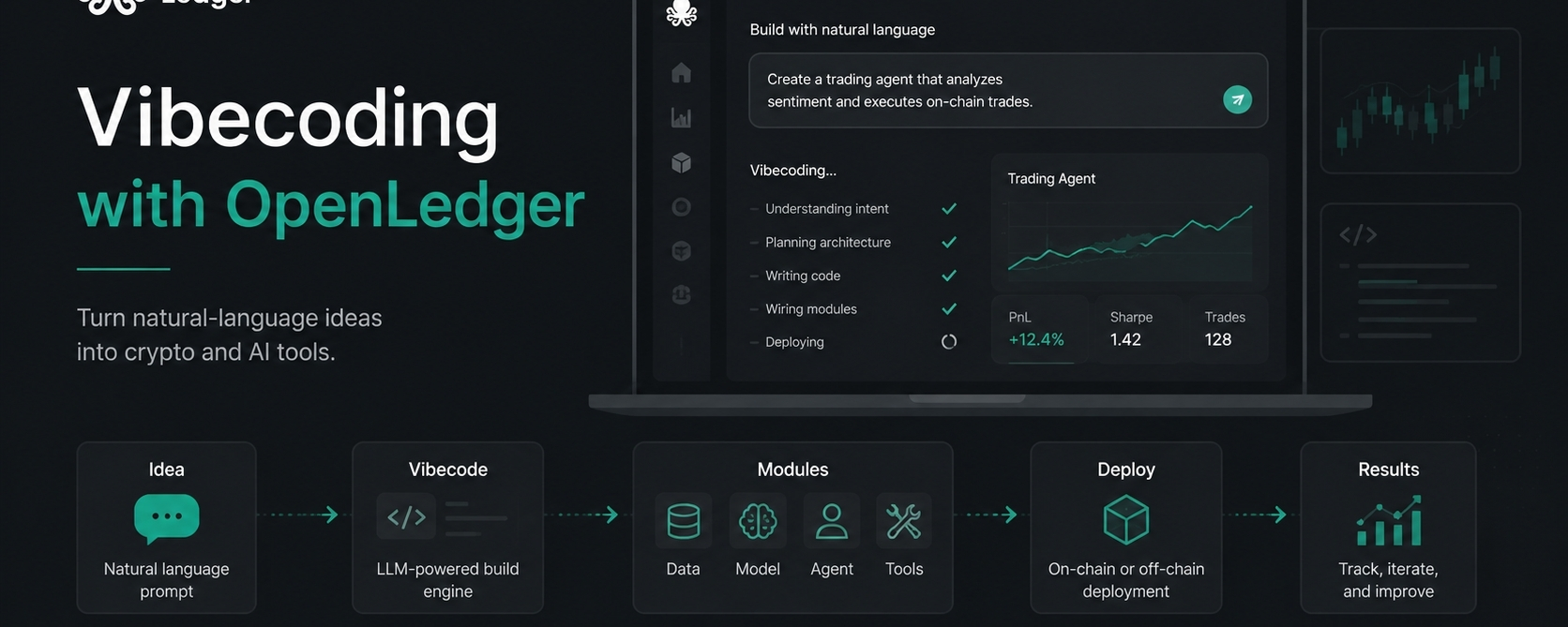

I still remember staring at a half-built trading dashboard on my laptop and realizing the idea wasn’t the hard part. The hard part was turning it into something usable before the market mood changed. I had the logic in my head. Track token unlocks, volume shifts, wallet behavior, maybe plug in alerts for weird activity. Simple idea. But after two hours of fighting templates, APIs, and broken code snippets, I closed the tab and went back to manually checking charts like everyone else. That’s why this whole “vibecoding with OpenLedger” idea caught me off guard. Not because it sounds fancy. It caught me because it touches a frustration traders rarely admit: most of us have better product ideas than our technical ability allows us to build.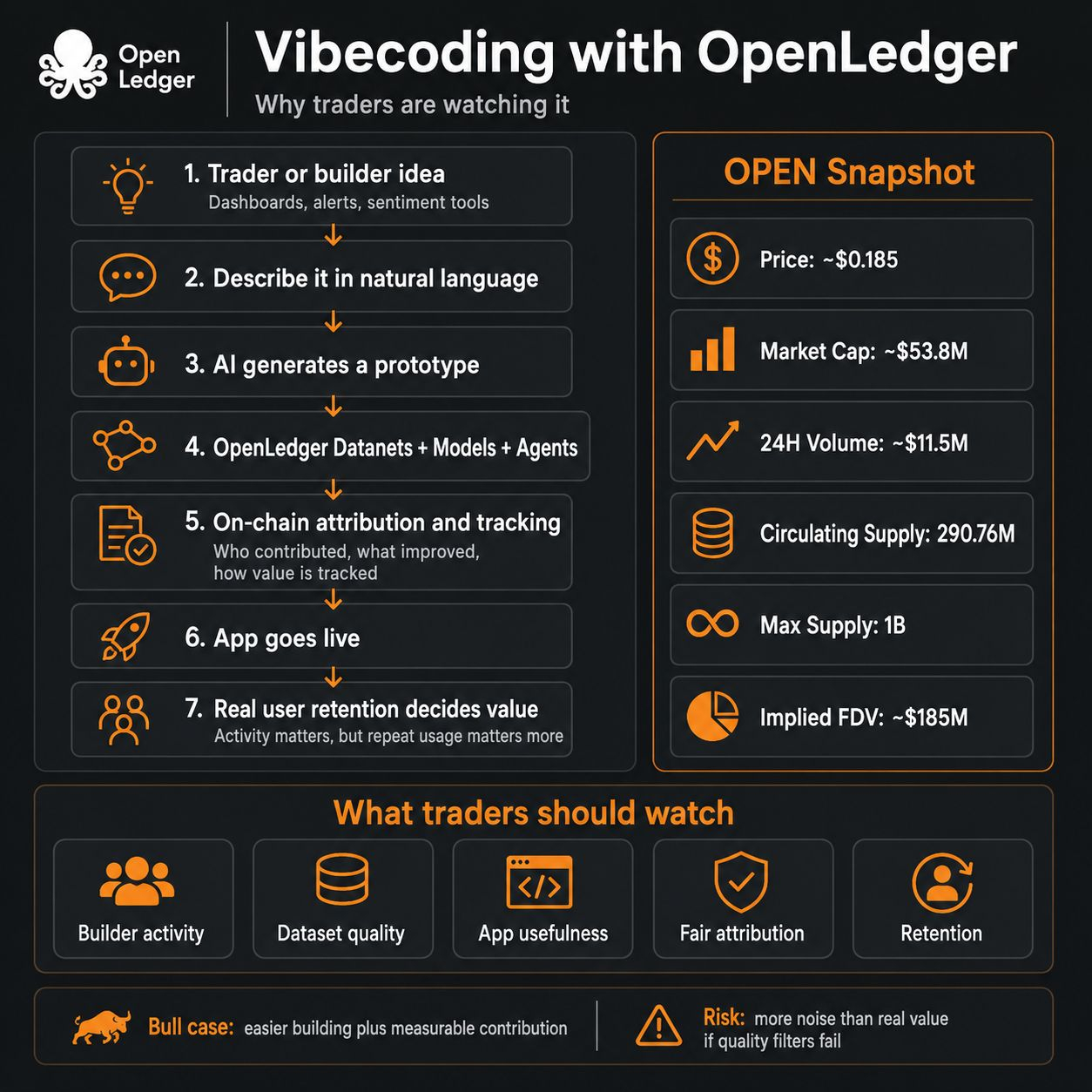
Now here’s the thing. Vibecoding by itself isn’t magic. The basic idea is using natural language to describe what you want an app or tool to do, then letting AI generate a working version that you can adjust. That trend is already bigger than OpenLedger, and hackathon platforms are openly describing it as a way to turn plain language into code faster than traditional building workflows. But OpenLedger’s angle matters because it isn’t only about writing code faster. OpenLedger is positioning itself as an AI blockchain where data, models, applications, and agents can be monetized, tracked, and verified. Binance Research describes it as infrastructure for training, deployment, and on-chain tracking of specialized AI models and datasets, with transparency and attribution sitting at the center of the design.
That’s where I think traders should slow down and think. A normal vibecoding tool helps someone build a small app. Useful, yes. But if OpenLedger can connect that building process to traceable datasets, models, agents, and reward mechanics, then the value proposition becomes different. Imagine a trader building a market sentiment tool using community datasets. The question is not only “Does the tool work?” The deeper question is “Who contributed the data, which model improved it, how is value tracked, and can rewards flow back to the right participants?” That’s the part that makes OpenLedger more interesting than another AI app builder story.
The current numbers make the setup worth watching, but not blindly chasing. As of today, CoinMarketCap shows OPEN around $0.185, with a market cap near $53.8 million, 24 hour volume around $11.47 million, circulating supply of about 290.76 million OPEN, and max supply of 1 billion OPEN. Binance’s live page is in the same zone, showing roughly $0.185 with market cap near $53.9 million and 24 hour volume around $13.2 million. That means daily trading volume is roughly one fifth to one quarter of the listed market cap, depending on which feed you use. For a trader, that’s not dead liquidity. It means there’s still active attention. But it also means price can move sharply if sentiment turns, because this is not a massive cap asset with deep defensive liquidity.
The realistic bull case is not “everyone will vibecode on OpenLedger tomorrow.” That’s lazy thinking. The real bull case is narrower and more useful. OPEN has a max supply of 1 billion, so at roughly $0.185, the simple fully diluted value sits around $185 million if you multiply current price by max supply. For an AI infrastructure token trying to connect data, models, agents, and on-chain attribution, that’s still small enough for traders to care if real builder activity grows. OpenLedger’s GitBook says users can create Datanets, contribute to public ones, build models, publish them, and have actions like dataset uploads, model training, reward credits, and governance participation executed on-chain. If vibecoding becomes a front door for non-hardcore developers to create tools on top of that structure, then the chain could move from “interesting AI narrative” to actual usage.
But I’m cautious for a reason. The bear case is simple: vibecoding can produce noise faster than value. Anyone who has used AI coding tools knows this. You can generate something that looks impressive in minutes, then spend days fixing the hidden mess underneath. In crypto, that problem gets worse because incentives attract farmers. If OpenLedger makes building too easy without strong quality filters, the network could fill with low-effort apps, weak datasets, duplicated agents, and reward hunters pretending to contribute. That would hurt the exact thing OpenLedger is trying to protect: attribution.
This is where the Retention Problem comes in. Traders love first-week activity, but long-term value comes from repeat behavior. Do builders return after the first experiment? Do contributors keep adding useful data when rewards change? Do users actually rely on vibe-coded tools, or do they test once and disappear? A chain can show wallet activity and still fail at retention. I’ve seen this pattern too many times. The dashboard looks alive, the community sounds excited, and then three months later the only people left are reward farmers and price watchers.
My honest frustration with OpenLedger is that the idea is easier to respect than to measure right now. The network information is concrete, with Openledger Mainnet listed under Chain ID 1612, OPEN as the native symbol, plus its own RPC, explorer, and bridge. That tells me the infrastructure side is real enough to track. But the trader in me still wants cleaner evidence of sticky app usage, builder retention, and attribution payouts that normal users can understand without reading five docs.
So I’m not treating vibecoding with OpenLedger like a guaranteed winner. I’m treating it like a serious experiment sitting at the intersection of AI building, ownership, and measurable contribution. That’s rare enough to watch, but early enough to question.
Don’t just watch the OPEN chart. Watch what people build, what survives, who returns, and whether attribution still feels fair when real money is involved. Because if OpenLedger gets that part right, vibecoding won’t just help people ship faster. It’ll expose who actually creates value.
