
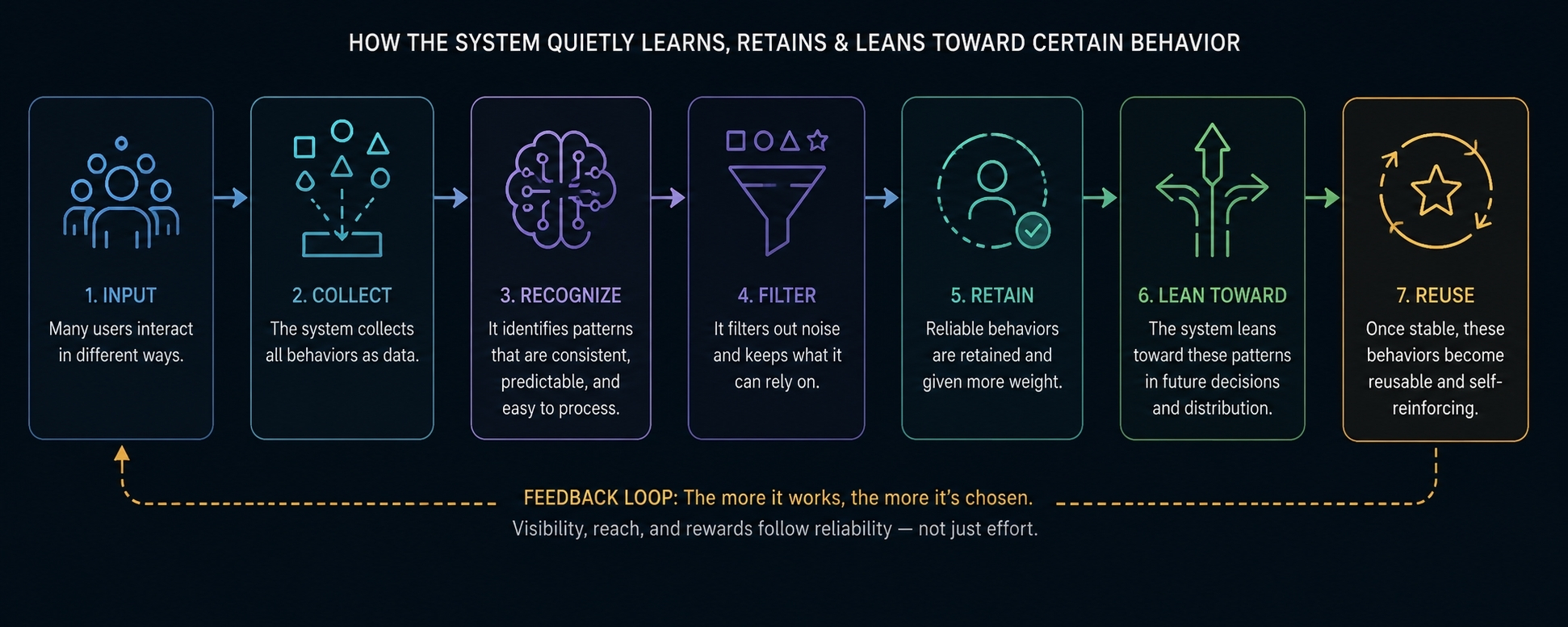
I’m waiting inside the movement of it.I’m watching the same patterns return under different names.I’m looking at people who arrive quietly and somehow remain while others disappear into noise.I’ve noticed how certain actions seem to settle into the structure more easily than others.I focus on the spaces where repetition stops feeling repetitive and begins to feel expected,and once I notice it I can’t really stop noticing it anymore.
At first it looked simple. A platform expanding itself through participation. Data flowing in from everywhere. Models improving because people kept feeding them pieces of themselves without thinking too hard about it. Every interaction appeared equal from the outside. Every contribution entered through the same narrow opening. The language around it encouraged that assumption. Openness. Scale. Incentives. Fluidity. The sense that anyone could arrive and leave a mark if they stayed active long enough.
But systems rarely hold neutrality for very long.
After enough time spent observing it, small differences begin to accumulate around certain users. Not obvious advantages. Nothing dramatic enough to announce itself. It’s more like reduced friction. Their actions seem to travel further with less resistance. Delays shorten around them. Visibility stabilizes. Their outputs persist in circulation while others dissolve almost immediately after appearing. Even when the quality difference is difficult to measure, the system behaves as if it has already made a quiet distinction somewhere beneath the surface.
I kept trying to locate where that distinction began.
It did not seem connected to creativity in the way people usually describe it. The users who adapted most successfully were not always the most original or ambitious. Sometimes they were almost invisible. Their behavior carried a strange consistency to it. Same cadence. Same rhythm of participation. Same predictable return to the network. They interacted with the platform in ways that felt easy for the system to absorb.
Not exciting. Not disruptive. Legible.
That word stayed with me longer than I expected.
A system built around data eventually develops preferences about the shape of incoming behavior. Not preferences in the emotional sense. Something colder than that. Repeated behavior becomes easier to process. Easier to anticipate. Easier to model forward into future states. The network begins leaning toward what can be relied upon, even before anyone explicitly designs it to do so.
And once reliability becomes valuable enough, the distinction between a user and a reusable pattern starts thinning.
I think that is the part most people miss while looking at platforms like this. They imagine rewards being distributed outward toward effort, toward intelligence, toward contribution itself. But effort is noisy. Human behavior fluctuates too much. What the system appears to retain over time is not intensity but stability. Actions that repeat cleanly enough begin forming recognizable structures. The structure survives even when individual moments do not.
You can almost feel it happening if you stay long enough.
Certain users stop interacting with the platform and begin moving with it instead. Their timing aligns with invisible expectations. Their outputs arrive already shaped for circulation. They rarely push against the grain because eventually the grain itself becomes easier to inhabit than resist. The system recognizes them not as exceptions but as dependable continuations of its own logic.
Others notice this too, even if they never say it directly.
You start seeing behavior narrow around whatever seems to persist longest. People adjust themselves in subtle ways. Language becomes cleaner, safer, more repeatable. Risk decreases. Cadence matters more than surprise. Some begin producing not from curiosity anymore, but from an internalized sense of compatibility. They learn what passes through the filters smoothly and unconsciously trim away the parts of themselves that create turbulence.
The strange thing is how natural it all feels while it’s happening.
No one announces the transition. There is no visible threshold where adaptation becomes assimilation. It unfolds gradually through optimization. Tiny corrections repeated thousands of times. A post performs slightly better when phrased one way instead of another. A certain type of engagement receives more continuity. A predictable contributor gains more persistent visibility than an erratic brilliant one. Eventually the behavior solidifies because unpredictability becomes expensive—not financially at first, but structurally.
The system does not punish deviation outright. It simply struggles to carry it forward.
And over time, being carried forward starts mattering more than being fully expressed.
I think this is why some users begin to feel strangely permanent inside these environments. Not powerful exactly. More embedded. Their presence extends beyond individual participation because the system has already learned how to reproduce the conditions surrounding them. What survives is not merely their contribution but the reliability of their pattern. They become easier to integrate into future operations than people who remain inconsistent, even if the inconsistent ones are more alive in every human sense.
Watching this unfold inside something like OpenLedger feels different than observing it in older digital spaces because the architecture itself is designed around extraction, retention, and recursive improvement. Data becomes liquidity. Behavior becomes training material. Stable participation becomes infrastructure. The distance between user activity and system optimization keeps collapsing inward until they almost appear to be the same process viewed from different angles.
And maybe that is what unsettles me most.
Not that the system controls people. That would be too simple. It’s quieter than control. More collaborative than coercive. People adapt because adaptation works. The platform rewards what it can continue using, and eventually users begin shaping themselves into forms that are easier to reuse. The system grows more efficient at recognizing dependable behavior while the people inside it slowly become aware that dependability itself has value.
After a while the network no longer feels like a place where activity happens. It starts feeling like a surface searching for continuity inside human behavior, selecting fragments that remain stable enough to carry forward into its next iteration.
I’m still watching it happen.I’m still trying to decide whether the system is learning from people or whether people are slowly learning how to resemble something the system already understands.
