
Over the past few months, I’ve spent a lot of time watching AI-focused blockchain projects evolve, and honestly, very few of them have managed to keep my attention the way OpenLedger has. Most AI tokens in crypto tend to follow the same pattern. They rally hard because of hype around artificial intelligence, traders rush in expecting exponential gains, and then the excitement fades once people realize there isn’t much real infrastructure behind the narrative.
OpenLedger feels different to me.
That doesn’t mean it’s guaranteed to succeed. It definitely carries major risks, and I’ll get into those later. But after following the project closely, reading through ecosystem updates, tracking community discussions, and studying how the team is positioning the network, I think OpenLedger is trying to solve a much bigger problem than most people currently understand.
The project isn’t just building another AI token.
It’s trying to build an accountability layer for artificial intelligence itself.
And in my opinion, that’s exactly why OPEN continues attracting attention even during volatile market conditions.
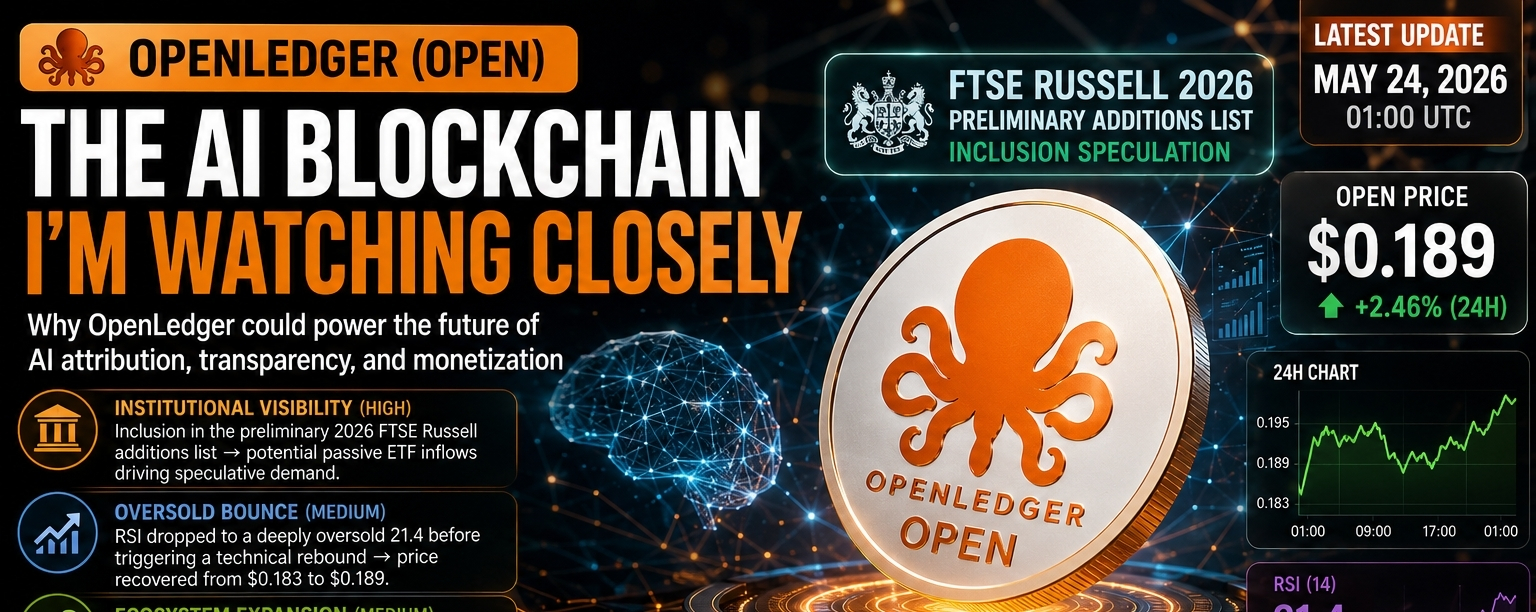
Over the last 24 hours, OPEN experienced another sharp but fascinating trading cycle. The token initially slipped into deeply oversold territory before rebounding back toward the $0.189 area. What stood out to me wasn’t only the bounce itself, but the reason sentiment changed so quickly. Traders suddenly began speculating about OpenLedger’s possible inclusion in the preliminary FTSE Russell additions list for 2026, creating expectations around institutional visibility and potential passive inflows from index-related products.
In crypto markets, perception often moves faster than confirmation.
Even though the FTSE process still requires final review stages, the mere possibility of institutional exposure shifted momentum dramatically. I’ve seen this happen before with projects transitioning from retail speculation toward broader financial recognition. The psychology changes. Traders stop looking at the project purely as a short-term momentum play and begin viewing it as a potential infrastructure asset with longer-term relevance.
That shift matters.
At the same time, the technical setup around OPEN also became interesting from a trading perspective. RSI conditions collapsed into extremely oversold territory before buyers stepped in aggressively. Personally, whenever I see a project maintain strong community attention while simultaneously entering oversold conditions, I pay closer attention because those setups often produce powerful relief rallies.
But price action alone isn’t why I’m watching OpenLedger.
The real reason is the narrative the project is building around decentralized AI attribution.
Artificial intelligence is entering a phase where questions about ownership, transparency, monetization, and accountability are becoming impossible to ignore. Every week there are new debates around copyrighted training data, AI-generated content ownership, model accountability, and the ethics of black-box decision systems. Governments are paying attention. Enterprises are paying attention. Developers are paying attention.
Most blockchain AI projects focus on compute.
OpenLedger focuses on attribution.
That difference is huge.
The entire idea behind the ecosystem is based on creating a transparent infrastructure where datasets, AI models, and autonomous agents can be tracked, verified, and monetized on-chain. Instead of contributors losing visibility after submitting data or training resources, OpenLedger wants attribution to remain permanently measurable.
I think this idea has much larger implications than many traders currently realize.
Right now, AI development is dominated by centralized systems where contributors often receive little recognition once their data enters large training environments. OpenLedger is attempting to redesign that relationship entirely. The project’s “Proof of Attribution” framework aims to determine which contributors actually influence model performance and then reward them accordingly.
If the system eventually works at scale, it could fundamentally reshape the economics surrounding AI creation.
Imagine a future where datasets, model improvements, prompts, fine-tuning layers, and autonomous agents all generate measurable on-chain value tied directly to contributors. That’s the long-term vision OpenLedger appears to be pursuing.
And honestly, that’s a much more ambitious goal than simply launching another AI trading token.
One of the reasons I’ve remained interested in the project is because the team continues expanding infrastructure instead of relying purely on hype cycles. The recent ecosystem developments around EVM bridge integration are particularly important in my opinion.
Interoperability matters enormously in crypto now.
Projects isolated from broader ecosystems often struggle to maintain developer momentum over time. OpenLedger’s EVM compatibility allows it to integrate more naturally with Ethereum-based infrastructure, applications, and liquidity systems. The bridge architecture built around OP Stack standards could eventually make OPEN more accessible across multiple ecosystems rather than trapping activity inside a single network environment.
That matters because developers usually build where liquidity and interoperability already exist.
The stronger OpenLedger’s cross-chain infrastructure becomes, the easier it may be for AI developers to integrate applications without rebuilding entire frameworks from scratch.
I’ve also been watching the development of OpenLoRA closely.
Personally, I think OpenLoRA could become one of the ecosystem’s most underrated components.
One of the biggest barriers in artificial intelligence development is the cost and complexity of training fully customized models from zero. OpenLoRA appears designed to simplify modular AI fine-tuning, allowing developers to adapt models more efficiently for specialized tasks while maintaining integration within the OpenLedger ecosystem.
This creates a potentially powerful network effect.
More developers building specialized AI applications means more datasets, more attribution tracking, more staking participation, more ecosystem activity, and potentially greater demand for the network itself.
That’s the kind of infrastructure flywheel many successful crypto ecosystems eventually rely on.
Another reason I’m paying attention to OpenLedger is because the project seems increasingly aligned with global regulatory trends surrounding AI transparency.
Right now, regulators worldwide are becoming more aggressive regarding artificial intelligence oversight. Governments are demanding greater transparency around training data, algorithmic accountability, and AI-generated outputs. Black-box AI systems are facing increasing scrutiny because users, regulators, and enterprises want to know where information originates and how decisions are being made.
This is where OpenLedger’s positioning becomes extremely interesting.
The project isn’t simply saying “AI is the future.”
It’s saying AI needs attribution, accountability, and monetization infrastructure.
That narrative could become much stronger over the next several years if transparency regulations continue expanding globally.
Of course, none of this guarantees success.
In fact, OpenLedger still faces several major risks that I think investors absolutely need to take seriously.
The first major concern is tokenomics.
There’s a looming supply unlock scheduled for September 2026 involving investor and team allocations. Large unlock events can become brutal for market structure if demand growth fails to keep pace with new circulating supply. I’ve watched many promising crypto projects lose momentum not because the technology failed, but because token emissions overwhelmed organic buying pressure.
That risk remains very real here.
If OpenLedger’s ecosystem growth accelerates fast enough, the market may absorb future supply increases without major disruption. But if adoption slows or broader crypto sentiment weakens, the unlock schedule could create heavy downward pressure.
Another issue I’m monitoring carefully is governance concentration.
The current gOPEN staking system does not fully implement quadratic voting protections, which means large holders can still exert outsized influence over governance outcomes. For ordinary DeFi projects, that’s already a concern. But for a network positioning itself as foundational infrastructure for accountable AI systems, governance credibility becomes even more important.
If users begin feeling that critical ecosystem decisions are controlled primarily by whales, institutional actors, or early insiders, trust could weaken over time.
And in projects centered around attribution and transparency, trust is everything.
The largest technical challenge, however, is probably Proof of Attribution itself.
This is where things become extremely complicated.
Attributing influence inside neural networks is not a solved problem at industry scale. AI systems are enormously complex, and determining exactly how individual datasets or contributors affect model behavior remains an active area of research. OpenLedger’s vision depends heavily on solving these attribution challenges in a scalable and secure way.
That creates enormous upside potential if successful.
But it also creates major technical risk.
Bad actors may eventually attempt to exploit attribution systems using synthetic data, spam contributions, manipulated training inputs, or behavioral gaming strategies. If attribution quality weakens, ecosystem trust could suffer significantly.
So while I’m optimistic about the long-term concept, I also understand why some analysts remain skeptical.
Still, despite those concerns, I believe the broader market environment increasingly favors infrastructure-focused AI projects.
The speculative phase around “AI meme narratives” is slowly evolving into a more serious infrastructure race. Investors are beginning to ask tougher questions now. Which projects actually solve real problems? Which ecosystems have scalable utility? Which networks could integrate into enterprise or regulatory frameworks?
OpenLedger at least appears to be thinking in those directions.
That’s one reason the community remains surprisingly resilient even during volatile corrections.
Over the last several weeks, I’ve noticed ongoing discussions around AI accountability, decentralized monetization, and institutional visibility continuing to drive engagement across crypto communities. While hype alone never guarantees sustainability, active community participation does matter because ecosystems thrive on builders, developers, and users staying engaged during difficult market periods.
I also think the AI sector itself remains one of the strongest long-term narratives in crypto.
Every major technology cycle eventually creates supporting infrastructure layers. The internet created cloud infrastructure. Mobile adoption created app ecosystems. Artificial intelligence will likely create entirely new decentralized data and attribution economies over time.
Projects positioning themselves early around those systems could benefit enormously if adoption accelerates.
That’s why I don’t view OPEN purely as a short-term trading asset anymore.
I’m starting to see it more as a speculative infrastructure bet on the future relationship between blockchain networks and artificial intelligence accountability systems.
Of course, timing still matters.
Crypto markets remain extremely volatile, and OPEN is no exception. Traders should absolutely expect sharp swings, aggressive corrections, liquidity shocks, and emotionally driven market behavior. AI-related assets tend to amplify volatility because narratives shift quickly and speculative capital rotates aggressively.
But from my perspective, the bigger story here is whether OpenLedger can continue converting narrative momentum into actual infrastructure adoption.
That’s the key question.
Can developers build meaningful AI applications within the ecosystem?
Can attribution systems function securely at scale?
Can OpenLoRA attract real builders?
Can the EVM bridge architecture strengthen interoperability enough to expand liquidity and user activity?
Can the network survive future token unlock pressure without damaging long-term confidence?
Those are the factors I’m watching most closely now.
What I personally find encouraging is that OpenLedger’s roadmap appears more focused on long-term ecosystem positioning than short-term marketing cycles. The project continues emphasizing infrastructure expansion, attribution systems, interoperability, and AI monetization rather than relying entirely on price speculation.
That doesn’t remove risk.
But it does create a stronger foundation than many purely narrative-driven AI tokens currently trading in the market.
As the broader crypto ecosystem matures, I think investors will increasingly separate speculative hype from actual infrastructure relevance. If that happens, projects capable of solving meaningful technological and economic problems could outperform over longer cycles.
OpenLedger still has a long way to go before proving itself fully.
The project needs adoption.
It needs technical execution.
It needs stronger governance decentralization.
It needs sustainable tokenomics.
And it needs to demonstrate that Proof of Attribution can work reliably under real-world conditions.
But despite all those hurdles, I can honestly say it remains one of the more intellectually interesting AI blockchain ecosystems I’ve followed recently.
Most crypto projects chase attention.
OpenLedger seems to be chasing infrastructure.
And in the long run, infrastructure is usually where the real value gets built.
For now, I’m continuing to watch OPEN closely because the next several months could become extremely important for the project’s future trajectory. Institutional visibility speculation, ecosystem expansion, AI transparency narratives, and growing developer interest are all converging at the same time.
Whether OpenLedger ultimately becomes a foundational AI infrastructure layer or simply another ambitious crypto experiment will depend on execution from here.
But either way, I think OPEN has officially become a project the broader market can no longer ignore.
You can explore the ecosystem directly through the official OpenLedger platform at OpenLedger Official Website.