
I’m starting to think that assumption may be incomplete.
Because the real battle might not be about intelligence anymore…
It might be about ownership.
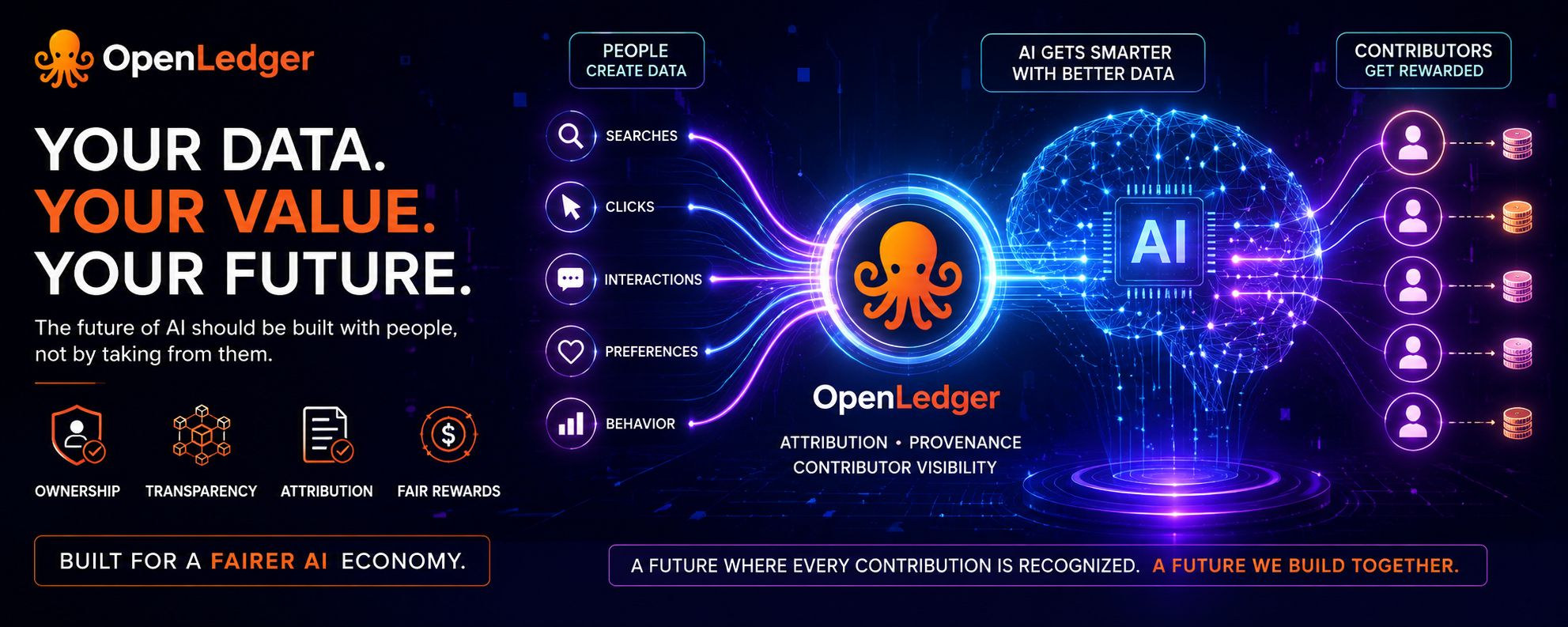
Every day, billions of people are already feeding digital systems without even noticing it.
Searches.
Clicks.
Conversations.
Preferences.
Behavior patterns.
Most of them are never rewarded for it.
AI absorbs all of it continuously.
Quietly. Constantly.
And honestly… this is where things start becoming uncomfortable.
The internet was designed in a way where users generate massive amounts of value, while platforms usually keep most of the control around the data itself.
That model worked for years.
But AI changes the scale completely.
Because once data becomes fuel for intelligence, contributor value suddenly becomes much harder to ignore.
This is probably why decentralized AI conversations have started becoming much larger recently.
And this is also where @OpenLedger started standing out to me from a different angle.
Not because of flashy AI demos.
Not because of temporary hype.
But because the project seems more focused on the infrastructure layer behind AI itself.
That difference matters.
Most people focus on outputs.
OpenLedger appears to focus more on attribution, provenance, contributor visibility, and how value moves across AI networks.
At first, those ideas sound technical.
But if AI economies continue growing, they may eventually become one of the most important parts of the entire system.
Because here’s the bigger question nobody fully answers yet:
If human activity helps train AI at massive scale…
then who should actually benefit from that value?
Platforms?
Companies?
Or contributors themselves?
This is where blockchain and AI suddenly begin colliding in a much deeper way.
Web3 already introduced concepts like:
digital ownership,
transparent coordination,
open networks,
and permissionless participation.
Now AI is forcing the internet to revisit those same ideas again from a completely different direction.
And honestly…
I don’t think most people fully realize how important this shift could become later.
The interesting part is that OpenLedger doesn’t seem to frame the problem as “building smarter AI.”
The framing looks closer to:
building fairer AI infrastructure.
That’s a much bigger narrative.
Especially as discussions around Proof of Attribution, data provenance, transparency, and contributor compensation continue getting stronger globally.
Because eventually…
people may stop asking only:
“How powerful is the AI?”
And start asking:
“Where did the intelligence come from?”
Still early obviously.
But the more I observe this space, the more it feels like the next major AI conversation won’t only revolve around intelligence itself…
It will revolve around trust, ownership, and who captures value inside the systems humans are already helping build every day.
And if that shift truly happens…
then data may stop being something users unknowingly give away —
and become something they finally start owning.