
Everyone’s comparing AI crypto projects like they’re different flavors of the same thing. They’re not. They’re not even playing the same game.
I used to lump @OpenLedger in with Bittensor, Fetch.ai, and SingularityNET. One big bucket labeled “AI + Crypto.” But after weeks of diving deep into each, I realized that bucket is intellectual laziness. These projects represent fundamentally different philosophies about how AI should be built, owned, and rewarded. And if you’re betting on the wrong philosophy, you’re not investing—you’re gambling.
I realized most people compare AI projects incorrectly.
They line up token prices, market caps, and partnership announcements like it’s a beauty pageant. But that’s surface-level noise. The real question is: what problem does each project believe is the most important to solve? Because that belief shapes their entire architecture, tokenomics, and community.
So I stopped comparing specs. I started comparing worldviews. And that changed everything.
The weird thing is…
the deeper I went down this rabbit hole, the less AI crypto started feeling like a technology sector to me.
It started feeling more like competing visions of how future digital economies should function. 👁️
Each project represents a different AI philosophy:
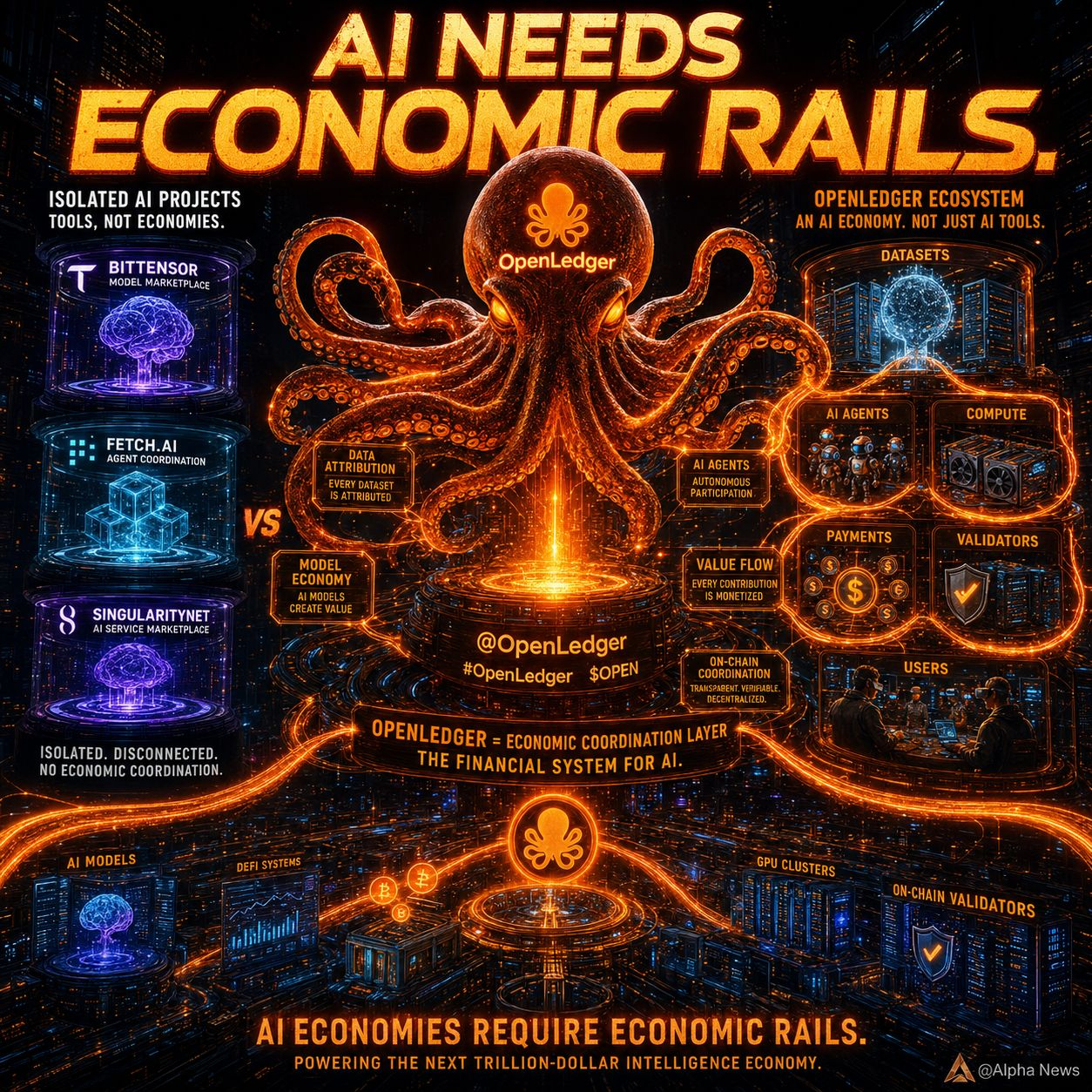
• Bittensor: The open market for machine learning. Its core belief? AI should be a permissionless commodity. Anyone can contribute models, and the market decides which ones deserve reward. It’s elegant, competitive, and very good at what it does. But it focuses on model output—not data provenance.
• Fetch.ai: The autonomous economy. Its belief? AI agents should negotiate, trade, and coordinate on behalf of humans. It’s building a world where agents book your flights, optimize your energy usage, and manage your supply chain. Agent-centric. Transaction-centric.
• SingularityNET: The AI service marketplace. Its belief? AI should be modular, interoperable, and accessible to anyone. A decentralized app store for AI algorithms. Powerful vision, but still largely about access to AI—not ownership of the data that feeds it.

Now here’s where @OpenLedger diverges completely.
OpenLedger doesn’t compete on models. It doesn’t compete on agents. It competes on economic coordination.
Its core belief? The AI economy cannot be fair, sustainable, or trustworthy unless every contribution—every dataset, every label, every training run—is attributable, verifiable, and monetizable on-chain. Without that, AI is just an extraction machine wearing a friendly mask.
This isn’t about building better AI. It’s about building the economic layer that ensures AI pays the people who made it possible.
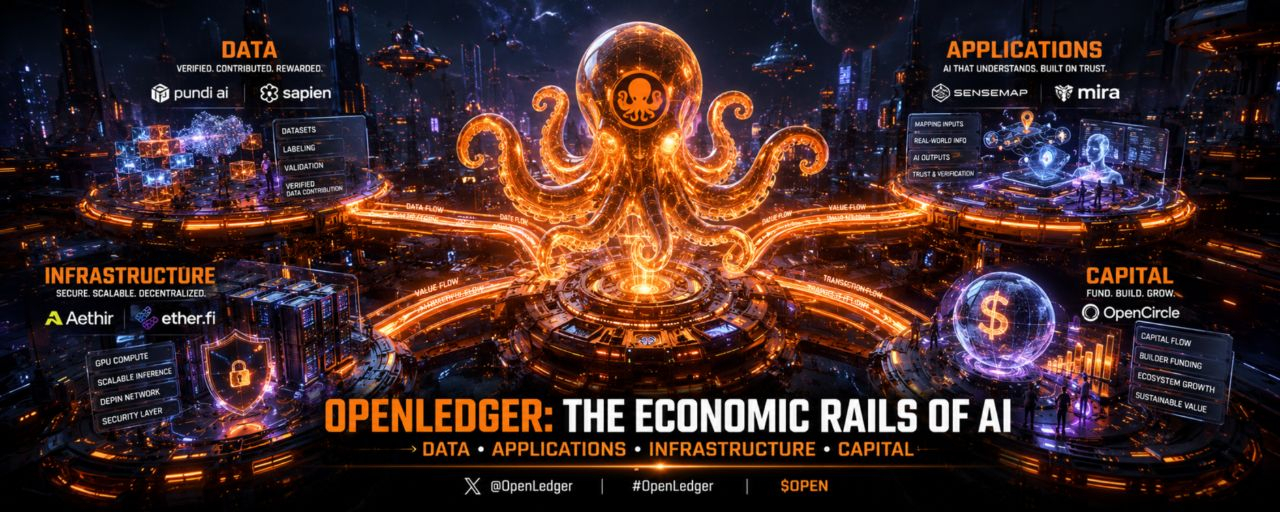
When Pundi AI creates a dataset, it’s tokenized as a real asset. When Sapien verifies it, the contribution is recorded. When a model trains on it, revenue flows back—automatically, transparently, governed by token holders. That’s not a marketplace. At some point, this stopped feeling like “AI infrastructure” to me.
It started feeling more like an attempt to redesign how value moves around intelligence itself. ⚡
Here’s the scenario that keeps me up at night (in a good way):
In 5 years, millions of AI agents will be trading, negotiating, creating content, and making decisions on-chain. They’ll consume data continuously. They’ll generate value constantly. And they’ll need a native system to pay for what they consume and get paid for what they produce.
Bittensor will provide the models. Fetch.ai will provide the agent coordination. SingularityNET will provide the service discovery.
But OpenLedger? OpenLedger could be the rails those economic flows run on. The attribution, the payment, the revenue split—all happening on a single, verifiable substrate where every participant gets exactly what they earned.No black boxes.
At least in theory, every contribution can finally be traced instead of disappearing into invisible systems. 👁️
That’s not just another AI project. That’s infrastructure for an AI-native economy.
Am I certain this plays out? Of course not.
The market is brutally early. Bittensor has a massive head start in mindshare and liquidity. Fetch.ai has deep enterprise partnerships. SingularityNET has a charismatic founder and years of community building. OpenLedger is still young—SenseMap is in testnet, OpenCircle just launched, and adoption metrics are still small.
And maybe the market doesn’t care about attribution. Maybe “good enough” AI with centralized data pipelines wins because it’s faster and cheaper. That’s a real risk, and I’m not dismissing it.
But I’ve learned that in crypto, betting on the infrastructure layer before the application layer explodes is usually the asymmetric opportunity. The picks and shovels, not the gold.
Everyone’s racing to build the smartest AI. OpenLedger is building the economy that makes sure the people who feed that AI don’t get left behind.
If that vision plays out, it won’t matter who has the best model or the most agents. What will matter is who owns the economic rails those models and agents run on. And right now, @OpenLedger is quietly laying those tracks while the rest of the market is busy comparing engine horsepower.
Is this the infrastructure layer the AI economy actually needs—or just another narrative waiting to be tested?
Do you think AI economies eventually need attribution + economic coordination to scale fairly… Do you think attribution eventually becomes necessary for AI economies to scale fairly…
or will people always choose convenience over transparency? 👇
$OPEN #OpenLedger $ETH @OpenLedger

