
Before this year, I honestly thought most AI crypto projects were basically chasing the same story.
A flashy AI narrative. A token launch. A few partnerships. And then endless promises about “the future of intelligent agents.”
But the more time I spend researching projects like @OpenLedger OpenLedger, the more I feel like the real opportunity might be sitting much deeper underneath the surface.
Not inside the hype itself.
Inside the infrastructure quietly being built around AI.
And I think a lot of people are still underestimating how important that difference could become.
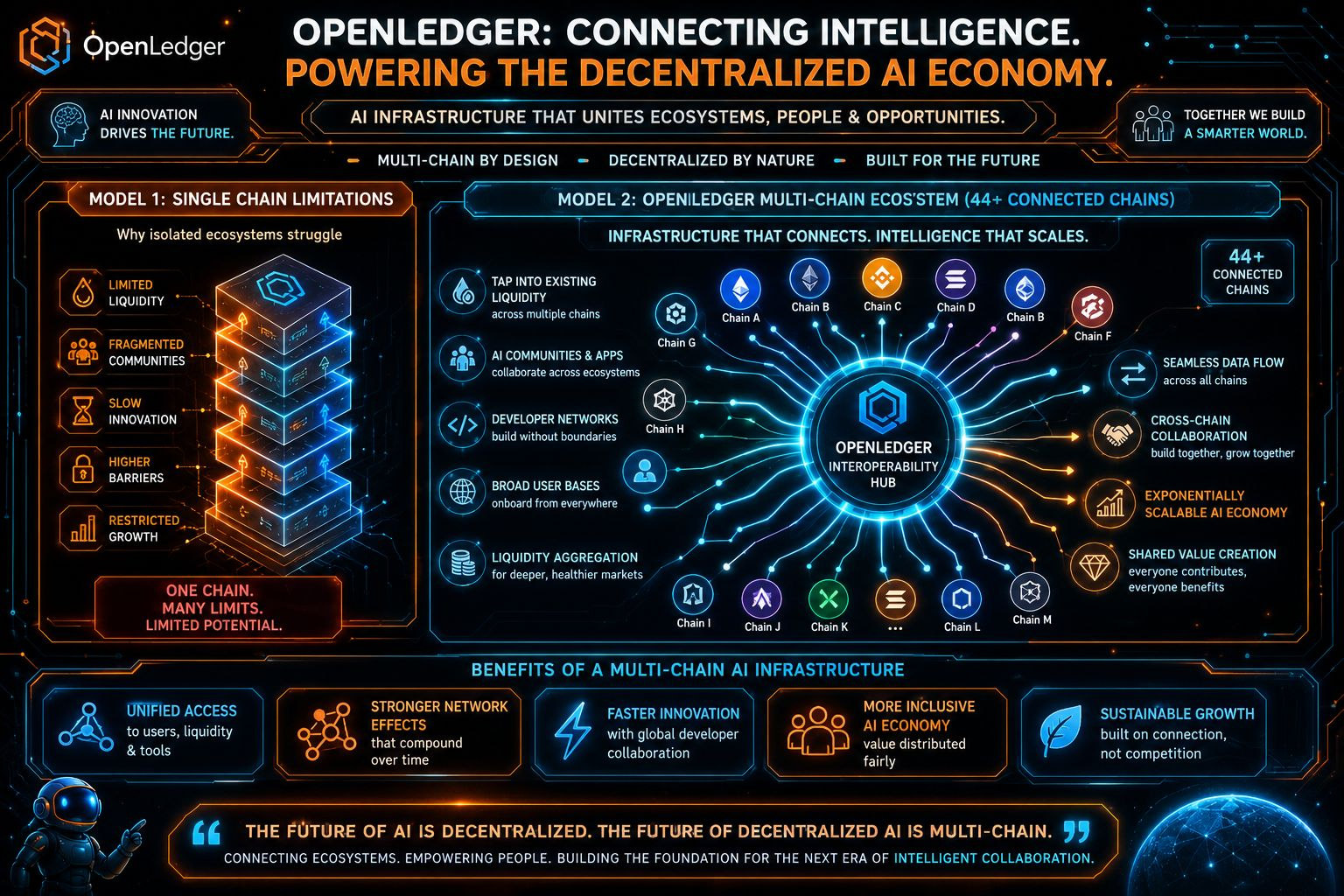
At first, I did not fully understand why people kept mentioning OpenLedger’s multi-chain ecosystem and the whole “44 connected chains” idea.
Honestly, I thought it sounded like one of those technical details crypto projects throw into presentations to appear bigger than they really are.
But after spending more time studying how different blockchain ecosystems grow, something started clicking for me.
AI economies probably cannot scale efficiently inside isolated ecosystems forever.
One chain alone eventually hits limitations.
Liquidity becomes fragmented. Users stay separated.
Communities become tribal. Developers are forced to choose sides instead of building openly across ecosystems.
And that creates friction for growth.
But when a project starts connecting across dozens of chains, the strategy becomes completely different.
It stops looking like a single ecosystem competing for attention.
And starts looking more like infrastructure trying to connect multiple ecosystems together.
That is what really changed my perspective on OpenLedger.
Because every blockchain already has something valuable: users, liquidity, developers, applications, communities, attention.
Most projects spend years trying to build these things from zero.
But a multi-chain AI infrastructure approach can tap into ecosystems that already exist instead of waiting for one isolated chain to carry all the growth alone.
That is where network effects can become very powerful very quickly.
And honestly, I think many people in crypto still underestimate how important infrastructure becomes during the later stages of technological shifts.
The market usually gets distracted by applications first.
That happened during DeFi. That happened during NFTs. And now it is happening again with AI.
People naturally focus on the visible layer: the chatbots, the AI agents, the consumer applications, the viral tools.
But eventually the market starts paying attention to the systems underneath everything.
Who controls te data? Who verifies the outputs? Who distributes value? Who owns the contribution layer? Who gets rewarded when models improve?
These questions may end up becoming much bigger than people expect.
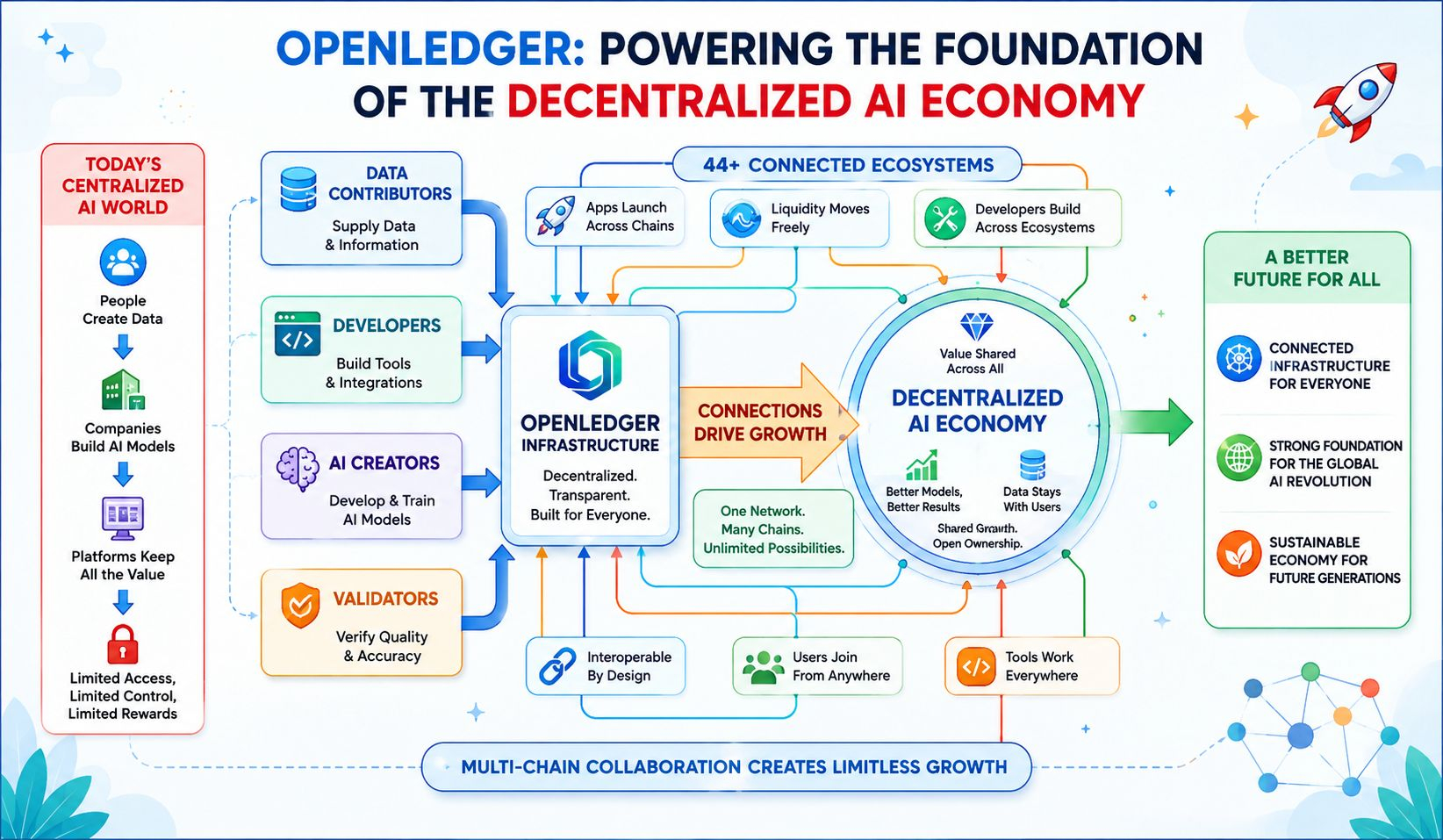
Because right now, most of the AI industry is still extremely centralized.
Users generate the data. Platforms train the models. Large companies capture most of the economic value.
The contributors usually receive almost nothing compared to the value they help create.
And I think this is one of the reasons decentralized AI infrastructure feels so interesting right now.
Projects like @OpenLedger appear to be exploring a structure where developers, users, data providers, validators, and AI builders can all participate more directly inside the ecosystem itself.
That changes the incentive structure completely.
Instead of AI being controlled by a small number of centralized platforms, value creation can potentially become more distributed across participants.
And when that infrastructure operates across multiple chains, the scale potential becomes much larger than most people initially realize.
Imagine an AI application launching on one blockchain.
Liquidity enters from another ecosystem. Developers build complementary tools somewhere else.
Users arrive from completely different communities. Data contributors participate from multiple networks.
Everything becomes connected instead of isolated.
That creates a much larger flywheel effect.
And crypto history repeatedly shows something important:
The projects that scale the hardest are usually the ones that become accessible everywhere.
Ethereum expanded because developers globally could build around it.
Binance scaled because it connected liquidity and users across regions.
Even major internet companies historically became dominant by building infrastructure layers rather than isolated products.
That is partly why @OpenLedger keeps standing out to me.
Because the project increasingly feels less like a normal AI token chasing temporary narratives…
and more like infrastructure positioning itself underneath a future AI economy before most people fully notice what is happening.
Of course, none of this guarantees success.
The AI sector is still early. Competition will become intense. Execution matters more than narratives long term.
But I genuinely think the market may still be valuing many AI projects mostly through
short term hype cycles while overlooking the infrastructure layer quietly forming underneath.
And historically, infrastructure tends to become extremely valuable once adoption starts scaling.
Maybe I am overthinking it.
But sometimes the biggest opportunities are the areas people initially dismiss as “too technical” or “not exciting enough.”
Then years later everyone suddenly realizes those systems were quietly powering everything in the background all along.
That is the feeling I keep getting when I look deeper into OpenLedger’s ecosystem strategy.
Not just another AI narrative.
But potentially part of the infrastructure layer connecting the next phase of decentralized AI itself.
