

Most people still talk about AI and blockchain as if they are separate layers.
One creates intelligence. The other moves value.
That division feels clean at first. Models generate outputs, blockchains handle ownership, and somewhere in between, markets form naturally around useful systems.

For a while, I saw it that way too.
But the more I watch how people actually behave around AI products, the less stable that distinction feels.
The interesting part is usually not the model itself.
It is what happens after the output appears.
Who trusts it first. Who acts on it quickly. Who keeps feeding it better data even before rewards become obvious. Over time, the system starts depending less on isolated intelligence and more on ongoing participation.
That changes the role of infrastructure entirely.
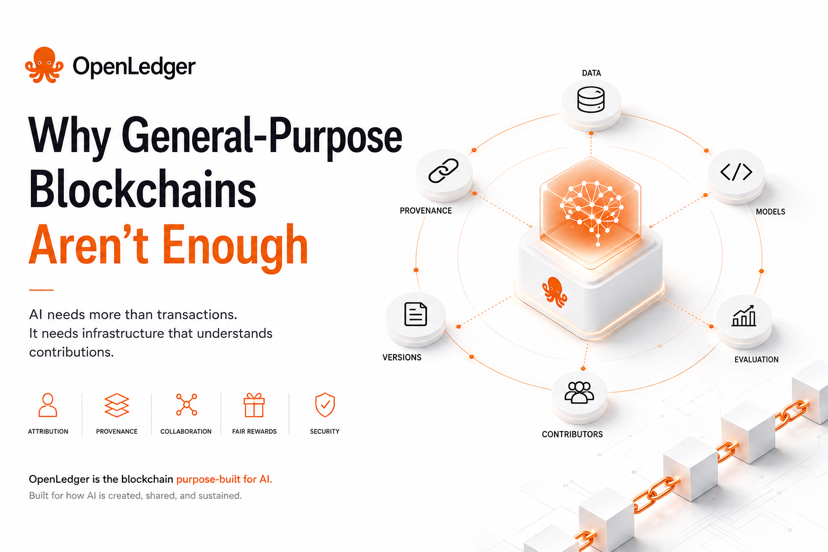
Reading about #OpenLedger , I kept noticing how much of the conversation revolves around liquidity for data, models, and agents. At first, that sounds mostly financial. Tokenization. Incentives. Onchain value.
But underneath that, there is another layer forming quietly.
The system is trying to make contribution itself measurable.
Not just the final model. The process around it.
Who supplied useful data. Which agent generated value consistently. Which models influenced downstream actions. Which participants improved the network over time instead of simply extracting from it.
That creates a different kind of behavior.
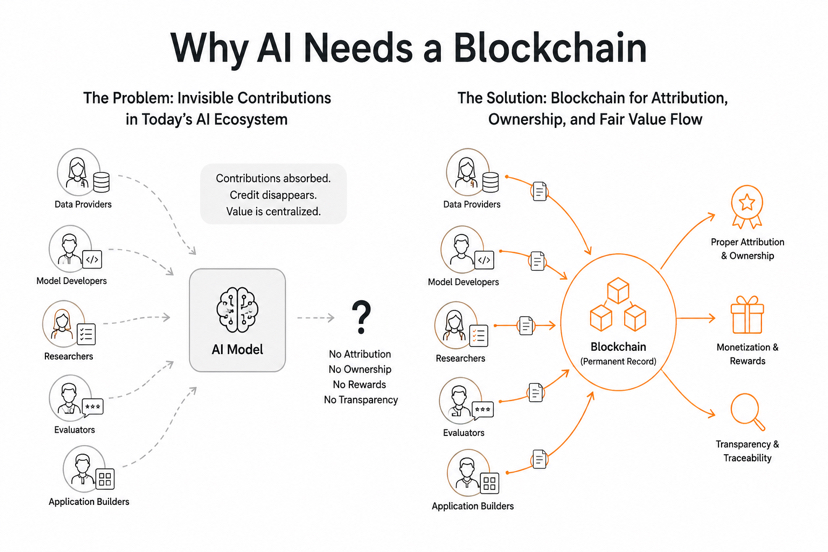
People begin optimizing not only for ownership, but for participation history. Small repeated actions start mattering more. Feeding cleaner data. Improving outputs incrementally. Allowing agents to interact continuously instead of appearing only during moments of speculation.
And strangely, the market side reacts to this too.
Demand no longer comes only from belief in a token or protocol. It comes from usefulness becoming habitual. A model gets used repeatedly. An agent saves someone time every day. A dataset becomes difficult to replace once enough systems depend on it.
The value accumulates slowly, almost invisibly.
I think that is the part many people still underestimate about AI infrastructure. They assume the breakthrough will look dramatic.
But most systems become important through repetition.
A user checks one signal daily. Another automates a small workflow. Someone else contributes data because the attribution feels fair enough to continue. Tiny behaviors compound quietly until the network begins to feel alive on its own.
That may be what projects like OpenLedger are really trying to capture.
Not just AI activity, but the long chain of interactions surrounding intelligence itself.
I’m still not sure whether markets fully understand how different that is from traditional crypto cycles.
Most blockchains were built to record transactions.
Systems built around AI may end up recording participation, memory, and behavioral feedback loops instead.
And those are harder things to price while they are still forming.@OpenLedger $OPEN