
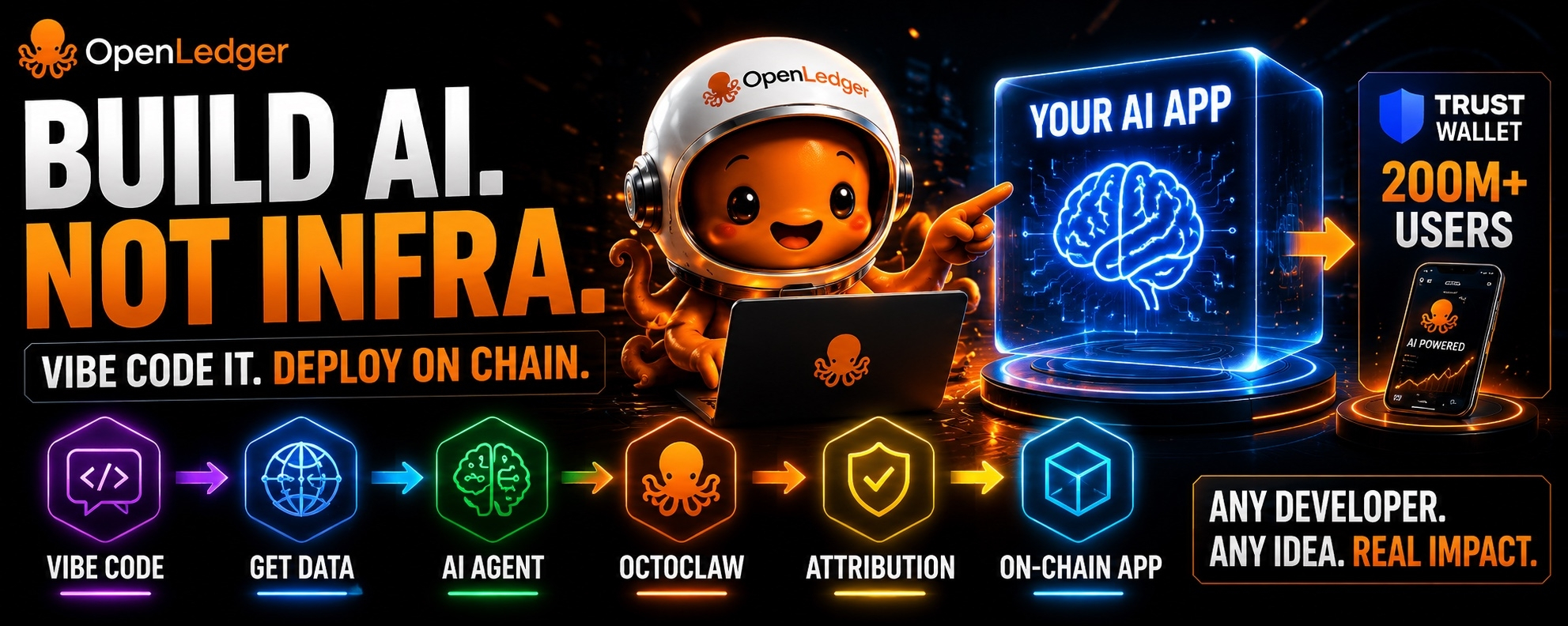
Something I noticed while reviewing developer documentation across several AI blockchain projects: almost all of them are built for researchers and engineers. The tooling assumes familiarity with model training pipelines, weight management, and inference serving. The developer surface area is narrow by design.
@OpenLedger is making a different bet on who builds on their platform.
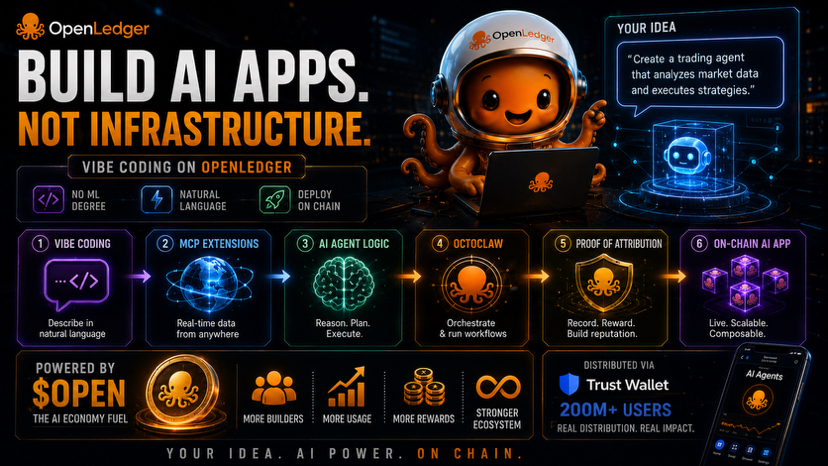
OpenLedger has introduced Vibe Coding, a development approach where builders create and deploy AI applications without managing the underlying model infrastructure directly. The concept draws from AI-assisted development where natural language descriptions translate into functional applications. On OpenLedger, this maps to creating agents, data pipelines, and AI workflows running on the chain’s attribution-aware infrastructure.
The practical implication for the developer ecosystem is significant. A smart contract developer who understands EVM tooling but has limited ML background can build on OpenLedger without needing to understand the full model training stack. The abstraction layer handles inference, data sourcing via the RAG extensions, and attribution recording. The developer interacts with the outcome rather than the underlying mechanics.
This is relevant beyond just accessibility. OpenLedger’s economic model depends on a broad contributor base to generate the transaction volume and data diversity that sustains the attribution reward system. If the developer entry point requires a machine learning background, the potential contributor pool stays narrow. Vibe Coding is partly a strategy for widening that pool.
The MCP extensions sit underneath this developer experience. Model Context Protocol allows OpenLedger applications to access real-time external data in a structured, auditable way. For a developer building a trading agent or data pipeline, MCP handles data retrieval without custom API integrations. The agent calls the extension, gets structured data, and the result is recorded as part of the agent’s on-chain activity.
OctoClaw sits above this as the execution layer. When a developer has built an application through the Vibe Coding interface or programmatically, OctoClaw handles the orchestration and execution of the resulting workflows. The combination of MCP for data access, Proof of Attribution for contribution recording, and OctoClaw for execution represents the full developer stack on OpenLedger. Each layer serves a distinct function rather than overlapping.
I spent time reviewing documentation and activity coming out of OpenLedger’s developer community. The pattern so far is that early builders are working primarily on trading agents and data aggregation tools. Those are the highest-value short-term use cases, and the tooling supports them. Longer-horizon applications around collaborative model training are mentioned but less represented in what is actually shipping.
The Trust Wallet partnership adds a distribution dimension to this developer story. With 200 million users on the Trust Wallet side, applications built on OpenLedger have access to a potential user base that does not require crypto-native onboarding. If a developer builds an AI-powered wallet feature using OpenLedger’s agent infrastructure, the distribution channel already exists. That is an unusual position for an early-stage AI blockchain to be in.
Where I am less certain is whether the Vibe Coding abstraction is deep enough to lower the barrier meaningfully, or whether it still requires enough underlying knowledge to exclude non-technical builders. The demos show promise. The gap between demo and production readiness is something I want to see closed before drawing stronger conclusions.