
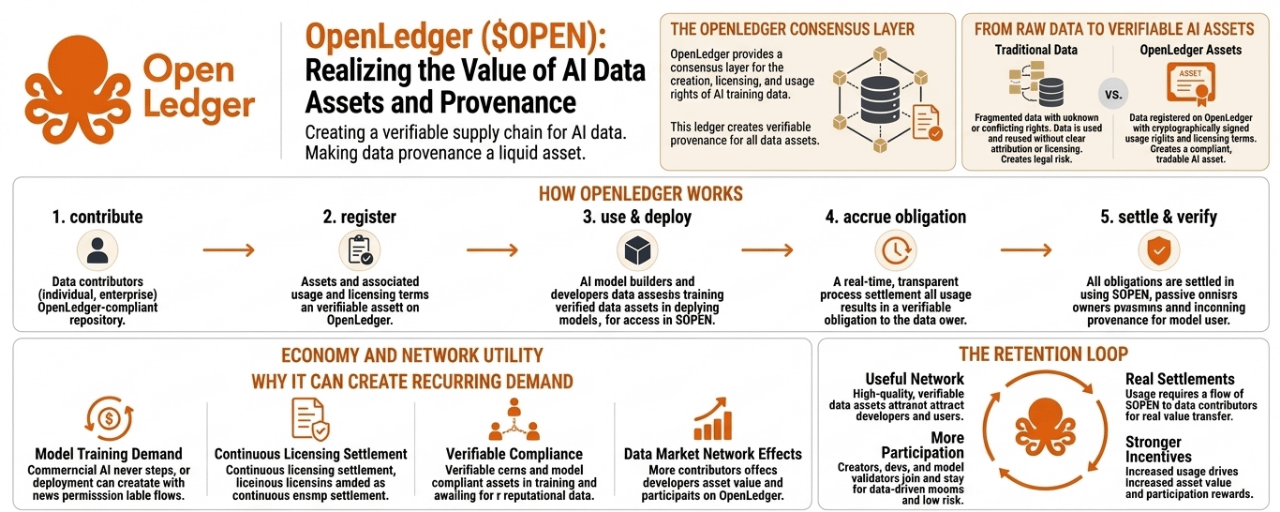
The conversation surrounding artificial intelligence in Web3 is undergoing a massive shift. In previous market cycles, projects could capture attention simply by putting "AI" in their whitepapers. But as we move deeper into 2026, the market is demanding real, sustainable infrastructure.
The primary problem facing modern AI development isn't a lack of computing power; it's a lack of equitable data attribution. Centralized platforms capture massive value from public contributions while giving nothing back to the data creators.
This is where @OpenLedger steps in to fundamentally redefine the data economy.
🛠️ Breaking Down the OpenLedger Architecture
#OpenLedger isn't just an application layered on top of an existing chain; it is a purpose-built EVM-compatible infrastructure designed from the ground up to orchestrate AI data, models, and autonomous agents.
The network relies on several core innovations:
Proof of Attribution: A mechanism that traces the exact lineage of data and model improvements, ensuring everyone who builds the AI gets fairly rewarded.
AI Liquidity Layer: This transforms static data into dynamic, composable on-chain assets that can interact seamlessly across DeFi ecosystems.
Data Integrity Protocol: Integrating advanced ERC-4626 financial coordination standards ensures safe, auditable interactions between AI agents and smart contracts.
📈 From Speculation to Real-World Integrations
What sets @OpenLedger apart right now is its expanding web of active partnerships. Rather than operating in a silo, the network has activated massive cross-chain and modular data integrations.
Major milestones—such as Injective utilizing #OpenLedger to power on-chain autonomous agents, and Theoriq deploying live DeFi agent rails—prove that $OPEN is actively building the "boring" but absolutely mandatory infrastructure that decentralized finance requires. Every transaction leaves an undeniable trail, removing the dangerous "black box" risks of older automated trading bots.
⚖️ Navigating the Market Outlook
While the long-term utility of the network is clear, smart market participants must evaluate the tokenomics of $OPEN . The token functions as the lifeblood of the network's data economy, but upcoming linear unlocks for team and investors slated for late 2026 mean that real ecosystem adoption and developer activity must continue to scale up to absorb supply.
Ultimately, projects that solve foundational problems—like tracking who gets counted and paid in the AI revolution—are the ones positioned to survive market volatility. OpenLedger is proving that data is the ultimate currency of the future.
