
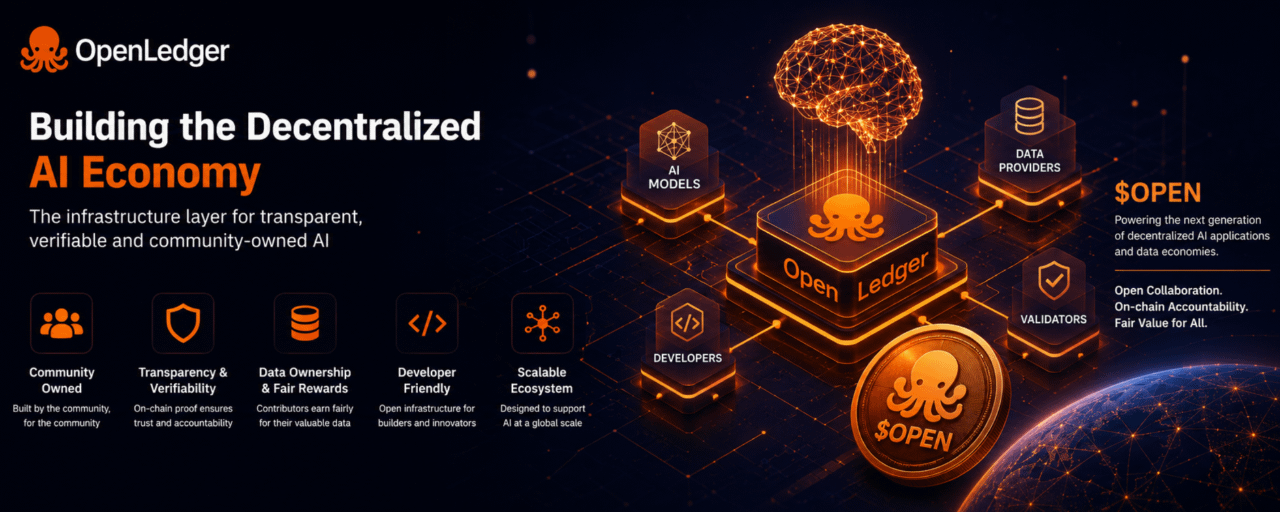

The rapid growth of artificial intelligence is transforming nearly every industry, from finance and education to healthcare and entertainment. However, behind the impressive capabilities of modern AI lies a major concern that many people are beginning to recognize: centralization. Most AI systems today rely on centralized data ownership, closed infrastructures, and opaque decision-making processes controlled by a handful of large corporations.
This is where @OpenLedger enters the conversation with a vision that feels both timely and necessary. Rather than building another short-term hype project, OpenLedger is developing a decentralized infrastructure layer designed to support transparent, verifiable, and community-powered AI ecosystems. The mission is ambitious but highly relevant for the future of Web3 and decentralized technology.
One of the most interesting aspects of OpenLedger is its focus on enabling fair participation within the AI economy. In traditional systems, users and contributors often generate valuable data without receiving ownership rights or fair rewards. OpenLedger aims to change this model by creating mechanisms where contributors, validators, and developers can participate in a more open and equitable environment. This approach aligns strongly with the original philosophy of blockchain technology: decentralization, transparency, and shared value creation.
The importance of data ownership will only increase as AI adoption accelerates globally. Data is becoming one of the world’s most valuable digital assets, yet most people still have limited control over how their information is collected, used, and monetized. OpenLedger’s infrastructure has the potential to create a more accountable ecosystem where trust is established through blockchain verification rather than centralized authority.
Another key factor that gives $OPEN strong long-term potential is ecosystem scalability. Sustainable blockchain projects are not defined only by token price movements but by their ability to attract developers, build partnerships, and create real utility. OpenLedger appears to understand this clearly by focusing on infrastructure and ecosystem growth rather than relying purely on speculation or marketing narratives.
In my opinion, projects combining AI innovation with decentralized coordination could become one of the most important sectors of the next crypto cycle. As users increasingly demand transparency, ownership, and fairness in digital systems, platforms like OpenLedger may gain significant attention from both developers and communities worldwide.
While the blockchain industry continues evolving rapidly, only a few projects are addressing foundational issues that could shape the future digital economy. OpenLedger stands out because it is not simply following trends — it is attempting to build the infrastructure layer needed for decentralized AI systems to thrive at scale.
The future of AI should not belong exclusively to centralized entities. It should be open, transparent, and community-driven. That is why I believe @OpenLedger and $OPEN are projects worth watching closely in the years ahead.