
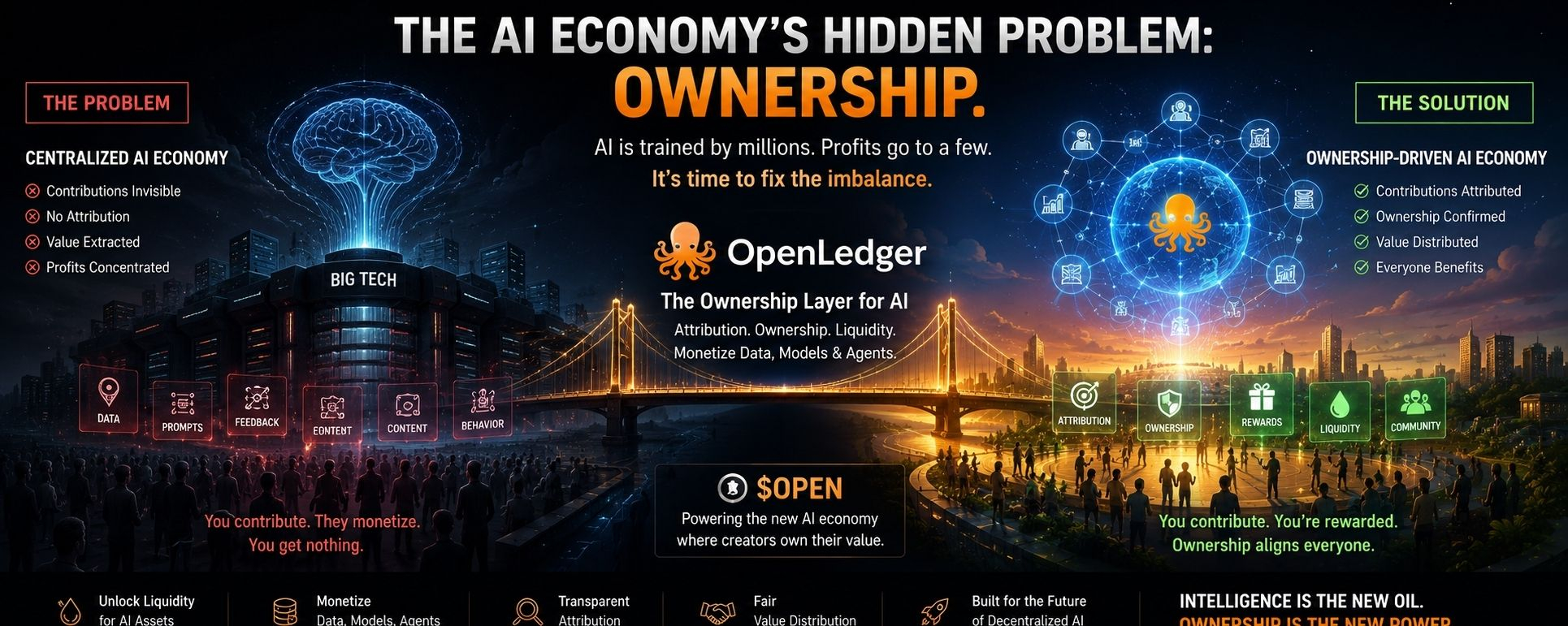
Everyone thinks the AI winners will be the companies with the biggest models and the most compute.
I actually think that narrative is getting weaker.
Because the more I study this space, the more obvious it becomes that intelligence itself is slowly turning into a commodity.
What stays scarce is ownership.
And honestly, that changes everything.
Right now millions of people are unknowingly helping train AI systems every single day.
Through prompts.
Data.
Behavior.
Corrections.
Content.
Conversations.
Feedback.
People are constantly feeding value into these models.
But once the platforms monetize the intelligence being created, almost none of those contributors stay connected to the upside.
That feels broken to me.
The current AI economy is incredibly good at extracting value from participation… but terrible at redistributing value back to the people creating the signal in the first place.
And I think that becomes a much bigger conversation later.
When I first looked into OpenLedger, I expected another generic AI + crypto narrative trying to ride the trend.
But after spending time understanding it properly, I realized the interesting part wasn’t the AI itself.
It was the ownership layer underneath it.
OpenLedger is building infrastructure where AI-related contributions like data, models, and agents can actually become attributable and economically connected across a network.
That immediately stood out to me because I think attribution becomes one of the most important missing pieces in AI.
Everybody keeps obsessing over who can build the smartest model.
Almost nobody is asking who owns the value once those systems start generating economic output at scale.
And eventually that question becomes unavoidable.
Because when AI agents begin operating autonomously across the internet, value starts flowing everywhere.
So naturally people will ask:
Who deserves a share of it?
The platform?
The model creator?
The contributor?
The data provider?
The community?
Right now centralized systems keep most of that value trapped internally.
That’s why I think ownership-driven infrastructure becomes more important over time than people currently expect.
Not because it sounds good in theory.
Because incentives matter.
Systems that align contributors usually scale stronger than systems that only extract from them.
That’s what makes this shift interesting to me.
AI is slowly evolving from a pure technology race into a coordination and ownership problem.
And crypto has always been strongest at coordination.
The more I think about it, the more I believe the future AI economy won’t just reward intelligence generation.
It’ll reward intelligence ownership.
People won’t only want access to AI anymore.
They’ll want exposure to the value their participation creates inside these systems.
That changes the structure of the entire market.
And honestly, I think most people are still early to understanding that transition.
The market still prices compute aggressively because it’s visible.
But invisible infrastructure usually becomes more valuable later:
ownership layers,
attribution systems,
coordination protocols,
value distribution networks.
That’s where I’ve quietly started focusing more attention lately.
Because if intelligence becomes abundant, then ownership becomes the real scarcity.
And scarce layers usually capture the most value.
That’s the deeper reason I keep paying attention to 👉 $OPEN
