
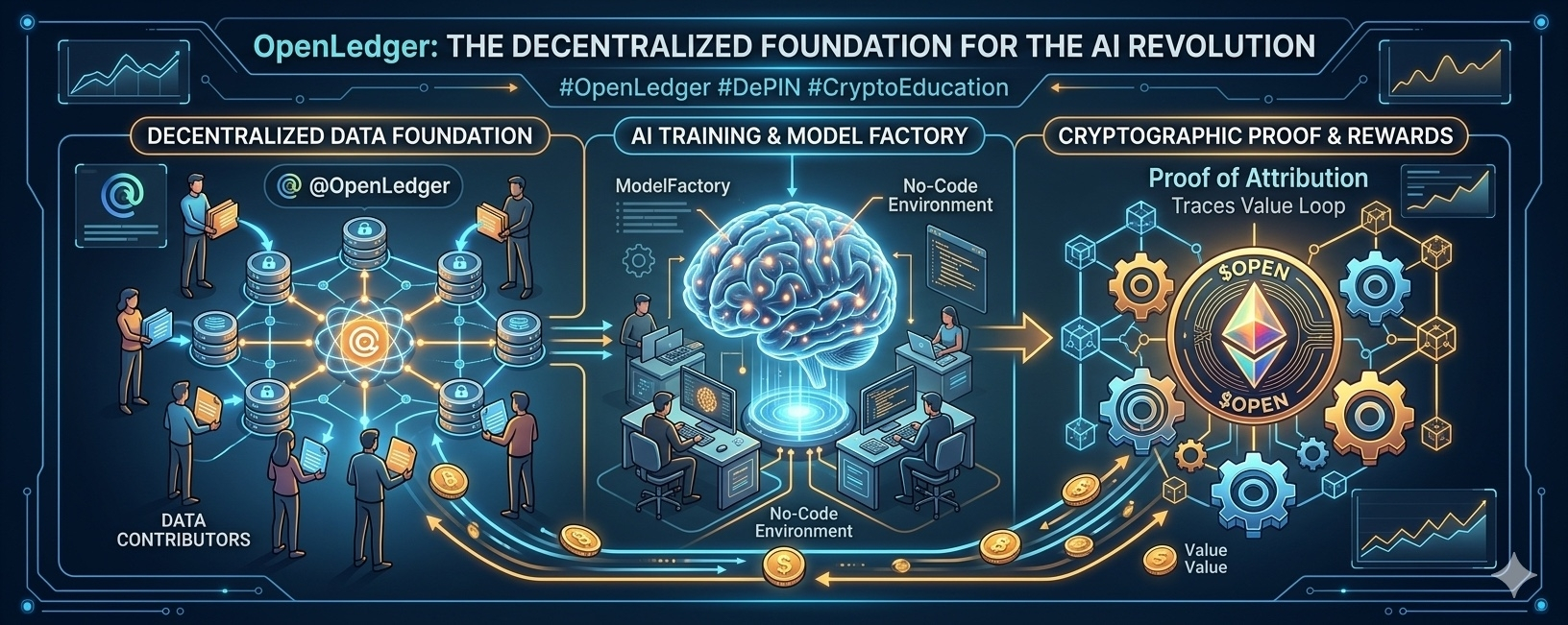
The rapid advancement of Artificial Intelligence has brought a massive structural problem to light: data monopoly. Right now, massive centralized tech corporations control the vast majority of AI training data, infrastructure, and model deployment. This creates a closed ecosystem where independent creators, data contributors, and open-source developers are completely cut out of the value loop.
This is exactly where @OpenLedger OpenLedger is stepping in to change the game. Built on over a decade of intensive academic research from Stanford, the network is designing the definitive execution layer for decentralized AI. It provides a secure, blockchain-native environment where data, models, and autonomous AI agents can interact seamlessly with absolute cryptographic proof and automated value distribution.
🛠️ The Core Architecture: How it Solves the AI Data Crisis
Rather than operating as a black box where users have no idea how their data is being used, the #OpenLedger ecosystem uses a transparent, multi-layered approach to handle the lifecycle of AI development:
Datasets: These are specialized, crowdsourced hubs designed to aggregate unique, high-quality datasets from around the globe.
ModelFactory: A highly accessible, no-code environment that allows developers to design, train, and test AI models without needing massive capital or proprietary server setups.
Proof of Attribution: This is the heart of the protocol's economy. It cryptographically traces exactly which data points influenced a specific model's output or inference, ensuring that contributors are fairly rewarded for their exact value.
📈 Real-World Integrations and the Utility of $OPEN
Unlike projects that rely purely on conceptual hype, the utility of the $OPEN token is directly tied to core on-chain operations. It serves as the native gas token of the ecosystem, powering everything from model inference fees and staking mechanisms to cross-network governance decisions.
The protocol’s practical utility is already being demonstrated through massive major network integrations. From partnerships with Injective to enable fully verifiable, on-chain AI agent execution, to working with Story Protocol to solve the legal complexities of AI training data and copyright licensing, the infrastructure is moving out of the laboratory and into the live Web3 economy.
As the demand for decentralized computing power, verifiable data provenance, and ethical AI development grows, the role of specialized Layer-1 protocols will become undeniable. Infrastructure plays are rarely the loudest assets in a bull market, but they are consistently the ones that build the longest-term value.