Look, I’ll be honest.
A few months ago, if I saw somebody post "ERC-4626 integration added" on my timeline, I probably would've kept scrolling without even thinking about it.
Not because it's useless.
Because it sounds boring.
Let's be real. Most people don't wake up excited about standards and infrastructure updates. People want shiny stuff. Bigger AI models. New agents. Crazy demos. Something they can point at and say, "Whoa, that's cool."
I get it.
I do the same thing.
But I've seen this before.
Tech cycles have this weird habit of making everyone obsess over the visible layer while completely ignoring the foundation underneath. Then a couple years later everyone suddenly realizes the boring part quietly became essential.
Funny how that works.
Right now AI conversations mostly sound identical.
More compute.
More intelligence.
Faster inference.
Bigger models.
Repeat.
And don't get me wrong that stuff matters.
Obviously.
You can't run serious AI systems on good vibes and optimism.
But here's the thing people don't talk about enough:
What happens after intelligence actually starts becoming useful?
What happens when AI stops being one application sitting in a browser and starts becoming an entire economic system?
Because that's where things get tricky.
OpenLedger isn't trying to build around one isolated thing.
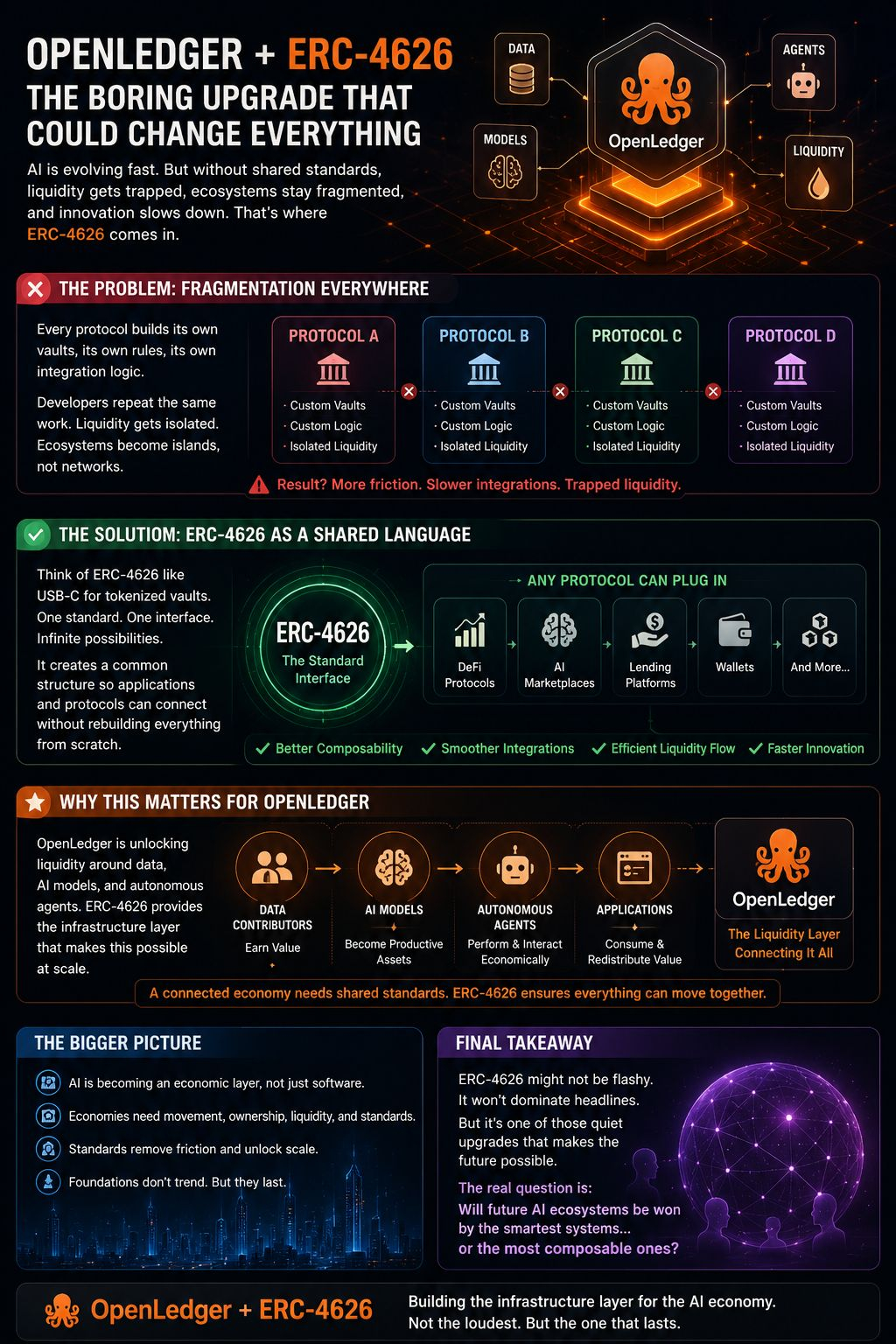
It's trying to unlock liquidity around data, AI models, and autonomous agents.
And the moment you start talking about value moving between all those different pieces, another problem immediately shows up.
Everything starts getting messy.
Fast.
Because right now ecosystems love building their own custom structures.
One protocol creates its own vault logic.
Another creates completely different asset mechanics.
Another builds an entirely separate integration process.
Then someone else says, "Nah, we're doing it our way."
Cool.
Until everyone needs to connect.
Then the headache starts.
Imagine traveling across ten countries where every place uses different traffic rules, different currencies, and completely different languages.
Could you still move around?
Sure.
But eventually you'd get annoyed.
Really annoyed.
Simple things suddenly become work.
And work creates friction.
That's the part people underestimate.
Friction sounds harmless until it starts stacking on itself.
Developers rebuild the same systems over and over.
Projects solve identical problems repeatedly.
Liquidity ends up trapped inside separate boxes.
Instead of creating one connected ecosystem, people accidentally build islands.
And that's where ERC-4626 gets interesting.
Honestly, I think people make this stuff sound way more complicated than it needs to be.
Forget the code for a second.
Think about chargers.
Seriously.
Years ago every device felt like chaos.
Different phones needed different cables.
Different devices had weird connectors nobody recognized.
Everybody carried bags full of adapters.
Absolute mess.
Then standards showed up.
Suddenly things just worked.
You plugged things in.
Done.
ERC-4626 works kind of like that for tokenized vaults and yield-bearing assets.
Instead of every protocol inventing completely different ways to structure them, ERC-4626 creates shared rules everyone can understand.
A shared language.
Simple idea.
Huge impact.
Because once systems start speaking the same language, something important starts happening.
Composability improves.
Yeah, I know.
Crypto people say "composability" every five minutes and sometimes I want to throw the word out a window 😭
But underneath all the buzzword energy, it's actually simple.
Things connect more easily.
That's it.
Applications don't keep rebuilding identical infrastructure.
Developers spend less time dealing with integration headaches.
Liquidity moves more freely.
People build faster.
And for OpenLedger specifically, that matters quite a bit.
Because if OpenLedger wants an ecosystem where data contributes value, AI models generate value, and autonomous agents interact economically, then everything underneath needs to move smoothly.
Imagine the opposite scenario.
Imagine AI models generating value but getting stuck in isolated systems.
Imagine contributors earning rewards nobody can efficiently use elsewhere.
Imagine agents operating in little disconnected pockets.
Sounds bad.
Because it is bad.
You don't build economies that way.
And honestly, I think this connects to a much bigger shift people still underestimate.
People keep treating AI like software.
I don't think that's the full story anymore.
I really don't.
Software performs tasks.
Economies coordinate participants.
That's different.
AI increasingly looks like an economic layer.
Data contributes value.
Models create value.
Agents perform work.
Applications consume value.
Everything starts interacting with everything else.
At that point you need movement.
You need liquidity.
You need standards.
You need infrastructure.
Not the exciting answer.
Probably the correct one though.
History keeps doing this over and over.
People fall in love with flashy things first.
Then eventually they realize foundations matter more.
Road systems aren't exciting.
Internet protocols aren't exciting.
Water pipes definitely aren't exciting.
Nobody tweets about plumbing.
Until plumbing breaks.
Then suddenly it's the only thing anybody cares about.
Maybe OpenLedger's ERC-4626 integration won't create huge headlines.
Maybe nobody runs around celebrating it.
Maybe people scroll past it exactly like I would've months ago.
Fair enough.
But years later, if AI ecosystems actually become large connected economies built around data, models, and agents, people might look back and realize something kind of funny:
Some of the biggest upgrades never looked important at first.
They just quietly made everything else possible.