
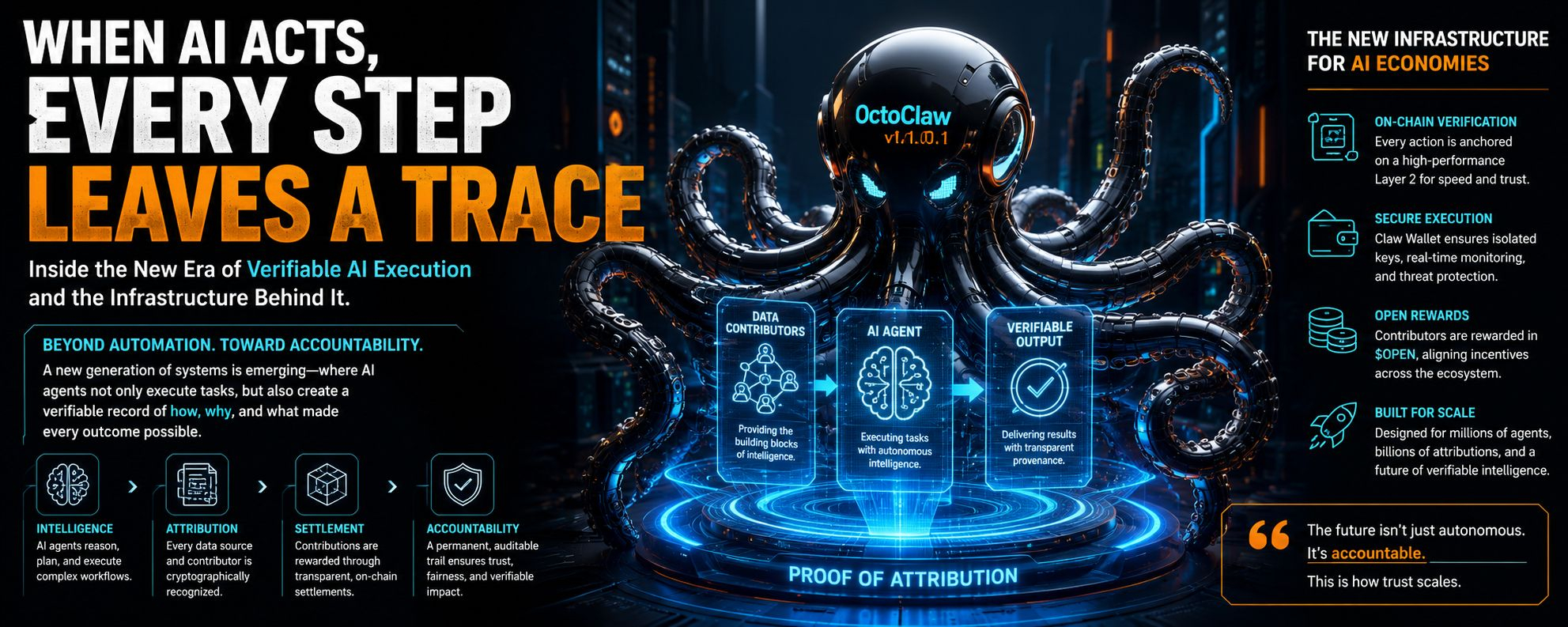
In most discussions about advanced AI, attention gravitates toward capability: how much a system can reason, how quickly it can act, how seamlessly it can automate human effort. That framing is becoming incomplete.
A more consequential shift is happening underneath the visible layer of intelligence systems. The core question is no longer what machines can do, but what they must be able to prove about what they did.
This subtle change is quietly reshaping the architecture of next-generation digital infrastructure. Intelligence is no longer being designed as a black box that produces outputs. It is being redesigned as a system that continuously produces structured evidence of its own behavior.
And that difference changes everything.
We are entering a phase where computation is no longer judged only by performance. It is being judged by legibility under scrutiny.
That is a far more demanding standard.
Because once systems begin interacting autonomously—calling external tools, combining data sources, generating derivative outputs, negotiating between competing signals—the question of correctness becomes secondary to a more fundamental issue: reconstructability.
Can the system explain itself in a way that survives inspection by another system, another agent, or another economic actor with opposing incentives?
If not, its output may be useful—but it is not structurally trustworthy.
This is where a new class of infrastructure begins to emerge, represented in early form by ecosystems like OpenLedger. These systems are not simply building smarter agents. They are attempting to build environments where every computational action leaves behind a verifiable trace that can be independently interpreted.
What matters here is not transparency as a moral ideal. It is coordination under uncertainty.
In complex machine networks, uncertainty is not an exception—it is the default state. Data is incomplete, models disagree, and intermediate steps influence outcomes in ways that are not immediately visible. Without a structured way to reconstruct those interactions, coordination becomes guesswork.
So the infrastructure begins to shift.
Instead of treating AI as isolated decision-makers, the system treats them as participants in a continuous chain of influence. Every output becomes a node in a larger dependency graph. Every action has upstream contributors and downstream consequences.
The important transformation is not computational—it is epistemic. The system is no longer just producing results. It is producing a record of how results become possible.
This introduces a new kind of constraint into AI design: machines are no longer only optimized for output efficiency, but for interpretive durability. In other words, how long their reasoning remains understandable when revisited under different conditions.
That requirement forces a redesign of how execution itself is handled.
Platforms such as OctoClaw—positioned within the broader OpenLedger ecosystem—hint at this shift in a practical sense. What appears externally as an agent interface is, in reality, closer to a controlled execution environment where actions are continuously translated into structured records of causality.
But the deeper implication is not the interface itself. It is what the interface is attached to: a system that tries to convert machine activity into economically meaningful structure.
This is where the idea becomes more than technical.
Because once machine actions can be traced with sufficient precision, they stop being abstract operations and start becoming accountable events. And accountable events can be priced, disputed, audited, and recomposed into new systems of value.
At that point, intelligence is no longer just a capability layer. It becomes part of an economic topology.
But this shift introduces a tension that is rarely acknowledged.
The more precise the system becomes in tracking causality, the more fragile its usability becomes at scale. Fine-grained accountability is expensive. It requires computation, storage, and interpretive overhead that grows with every additional layer of abstraction.
And so the system faces a paradox: the very mechanism that enables trust can also reduce usability if it becomes too heavy to interpret in real time.
This is why the future of such infrastructure will not be determined by how accurately it can track everything, but by how selectively it chooses what to make legible.
Not every action needs equal visibility. Not every dependency needs equal weight. The challenge is not capturing reality in full detail—it is designing a version of computational reality that remains economically and cognitively usable.
There is also a deeper psychological dimension emerging here.
As systems become more autonomous, humans are gradually removed from direct decision paths and repositioned as auditors of machine behavior rather than operators of it. That shift changes the relationship between agency and understanding.
Instead of asking “what should the system do?”, the question becomes “can I still interpret what the system is doing well enough to trust it?”
Trust, in this context, stops being emotional and becomes structural.
It depends on whether the system’s internal logic can be reconstructed after the fact without requiring blind faith in its outputs.
This is the real frontier: not artificial intelligence as performance, but artificial intelligence as accountable process.
If this direction continues, future AI systems will not be defined by how autonomous they are, but by how auditable their autonomy remains under pressure.
And that leads to an uncomfortable but important conclusion.
The most advanced systems will not be the ones that think the fastest or act the most independently. They will be the ones that can remain intelligible while doing both at scale.
Because in the end, intelligence without traceability is power without governance.
And no system—no matter how capable—can scale indefinitely without eventually answering for itself.