


the first time I used $OPEN , it didn’t feel like I was just holding a token, it felt like I was holding a key to the future of AI that actually knows what it’s talking about. I think the next big AI shift won’t only be about who builds the biggest model. That story already feels crowded. Everyone is chasing one giant system that can answer everythin, write everything, analyze everything, and somehow understand every industry at once. Sounds powerful, yeah, but yeah.. I keep thinking the real value may move in a different direction. The future might belong to smaller, sharper, more focused AI systems that know one thing extremley well. & this is where OpenLedger starts to feel way more interesting than just another AI crypto project.
I’ve noticed that general AI is amazing when you want broad answers. It can summarize, explain, generate ideas, and help people move faster. But broad intelligence has a weakness too. It often sounds confident even when it doesn’t fuly understand the depth of a niche subject. That’s the uncomfortable part. A general model can talk about law, medicine, finance, gaming, supply chains, crypto, and science in the same smooth tone, but smooth doesn’t always mean precise. sometimes it gives you a decent answer, not the best answer. And in serious industries, “decent” isn't enough..!
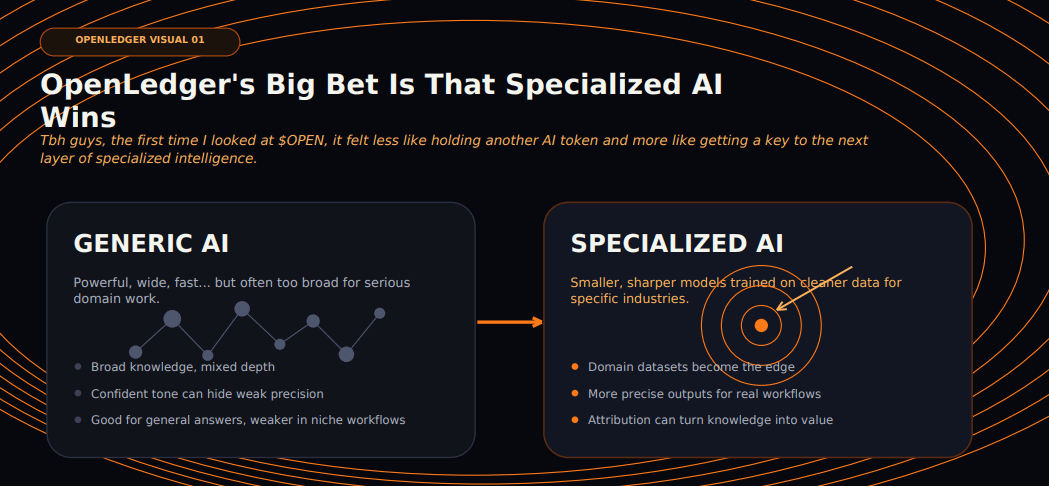
I believe this is why specialized AI matters so much. A hospital doesn’t need a model that casually knows everything. It needs intelligence trained around medical workflows, patient data rules, diagnosis patterns, clinical language, and compliance. A trading desk doesn’t just need generic market commentery. It needs focused intelligence around liquidity, order flow, volatility, risk models, and execution behavior. A legal firm doesn’t need random internet knowledge. Different industries don’t just need AI. They need AI that understands their world.
In my opinion, OpenLedger’s Datanets fit directly into this specialized AI thesis. Datanets are not just a fancy data word. The idea points toward focused datasets created around specific communities, industries, or knowledge areas. That matters broo because specialized AI is only as good as the data behind it. You can’t build sharp intelligence from messy, random scraping forever. At some point, better data becomes the real edge. Clean data, traceable data, owned data, and niche data start becoming more valuable than just massive piles of internet text.
I keep thinking OpenLedger is trying to build the missing layer between data contributors and AI models. In today’s AI world, data gets swallowed into systems and the people behind that knowledge usually disappear. What if niche intelligence could be built from community-owned knowledge instead of invisible extraction? That’s a much BIGGER idea than simple token hype....
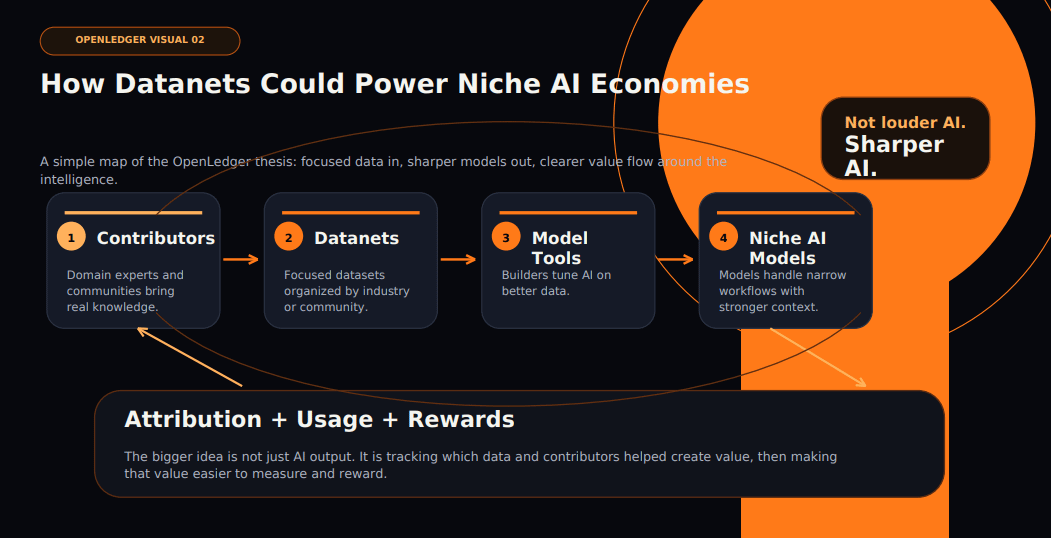
I think the model tools side is also important because datasets alone aren't enough. You need infrastructure that helps those datasets become useful AI models. Wow, that’s where the idea starts getting serious fella....
I’ve also been thinking about how crypto fits into this. The strongest crypto narratives usually appear when ownership and coordination become hard in the normal world. Bitcoin did it for money. Ethereum did it for programmable assets. DePIN tried it for physical networks. OpenLedger is aiming at the coordination problem inside AI data. Who owns the data? Who contributed value?? Which dataset helped which model...? Who should get paid when intelligence is used? These questions are messy, but they’re also exactly the kind of problems crypto is built to attack.
I believe the market may be late to understand this because people still look at most AI tokens through the same tired lens. Price. Listins. Hype. Narrative rotation. Green candle. Red candle. Done.. But the deeper AI crypto story may not be about “which token sounds most futuristic.” It may be about which protocols actually help organize value in the AI economy. and model creation could sit very close to the value layer.
In my opinion, generic AI won’t disappear. Of course not. Big general models will keep improving and they’ll stay powerful. But I don’t think one giant model will own every serious use case. The world is too specific for that. Industries have there own language, rules, risks, and hidden knowledge. The future may look more like a network of specialized models, each trained on better datasets, each serving a focused purpose, and each needing a way to prove where its intelligence came from.
I keep coming back to this thought: OpenLedger’s real bet isn't just that AI growss... Everyone already believes that. The real bet is that AI becomes more specialized, more data-sensitive, and more dependent on traceable contribution.
I think that’s why OpenLedger feels different. It’s not only chasing the AI buzzword. It’s pointing toward a future where the smartests AI may not be the biggest one. that future feels way more believable than one mega model trying to understand everything perfectly!
@OpenLedger #OpenLedger