
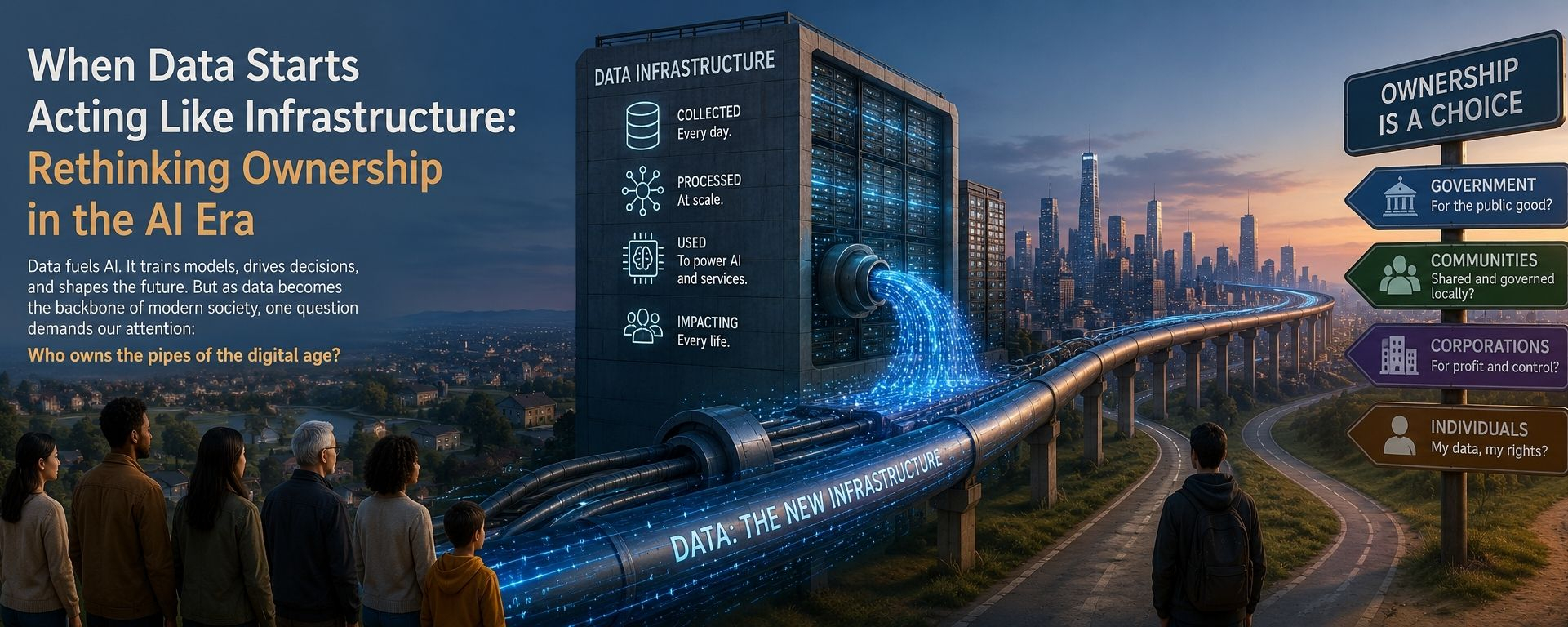

I’ve started noticing that the conversation around AI and crypto has become strangely emotional lately. Not loud in the usual speculative way but tense underneath. There’s this growing feeling that something important is quietly being reshaped online, and most people can sense it even if they can’t fully explain it yet. AI systems are becoming more powerful every few months, but at the same time the raw material feeding those systems still comes from ordinary human activity scattered across the internet. Posts conversations labels reviews code images voice clips. Tiny fragments of people constantly absorbed into larger machines.
What feels strange is how invisible that process has become.
That’s partly why projects like OpenLedger keep appearing in conversations around Web3 infrastructure. Not because they promise some perfect future, but because they’re trying to wrestle with a question the internet has mostly ignored until now: if data is becoming one of the most valuable resources in the digital economy, who actually owns the value created from it?
I don’t think blockchain alone solves that problem. Honestly sometimes crypto makes coordination harder rather than easier. But I do think there’s something important about the direction these projects are exploring, especially as AI systems start behaving less like isolated software and more like economic ecosystems.
OpenLedger seems to frame this idea through liquidity. Not just financial liquidity in the trading sense, but liquidity around data itself around AI models and eventually around autonomous agents interacting with one another. That wording sounded abstract to me at first. Then I started thinking about how fragmented the current AI landscape actually is.
Most valuable datasets live behind company walls. Models are often treated like black boxes. Contributors who provide the underlying data rarely see any meaningful participation once the system scales. Even open-source AI communities still rely heavily on centralized hosting, centralized compute or centralized funding. The structure underneath remains surprisingly closed considering how open the internet once felt.
What OpenLedger appears to be attempting is a more composable environment where data providers developers models and agents can all exist inside the same economic framework. In practice that could mean contributors are rewarded when their data improves a system or that AI agents can transact across networks without relying entirely on centralized intermediaries.
At least that’s the theory.
The difficult part is that data is messy in ways blockchains aren’t naturally good at handling. Chains work well when information is deterministic and verifiable. A token balance is easy to confirm. A transaction either happened or it didn’t. But useful data is subjective contextual and constantly changing. One dataset might be valuable today and irrelevant six months later. Another might contain hidden biases nobody notices until after deployment.
That creates an awkward tension for protocols trying to financialize data contributions. Once incentives exist, behavior changes. People optimize around rewards. Anyone who spent time on the internet during the SEO era probably remembers what happened when algorithms started rewarding content production at scale. Quantity exploded. Quality didn’t always follow.
AI ecosystems could run into something similar.
If contributors are rewarded for supplying data, how does the system distinguish genuinely useful information from synthetic noise designed purely to farm incentives? That question feels much more important than token mechanics or throughput numbers but it’s also harder to solve because it depends partly on human judgment.
And then there’s the issue of attribution which might quietly become one of the defining infrastructure problems of the AI era.
Right now, most people have almost no visibility into how their information moves through machine learning systems. A model gets trained somewhere on enormous pools of data outputs become products, companies monetize those outputs, and the original contributors disappear into statistical abstraction. Protocols like OpenLedger seem interested in making those contribution pathways more visible and trackable.
I can see why that matters.
Not necessarily because every user wants to monetize their data directly but because the internet is slowly shifting from a place where humans primarily consume information into a place where humans continuously train systems. That changes the relationship entirely. The value extraction becomes deeper and less obvious at the same time.
Still, I wonder whether decentralization always improves these systems in practice. Centralized AI companies move faster partly because they avoid governance friction. They can iterate aggressively manage infrastructure internally and make decisions without consensus layers slowing everything down. Decentralized systems often gain openness at the cost of simplicity.
Sometimes that trade-off is worth it. Sometimes it really isn’t.
There’s also something oddly philosophical about treating AI agents as participants inside blockchain networks. OpenLedger talks about agents almost like emerging economic actors rather than passive software tools. A few years ago that would have sounded exaggerated, but it feels less unrealistic now. Bots already execute trades, automate workflows, negotiate services, generate media, and coordinate information faster than humans in certain environments.
The line between software and participant is becoming blurry.
And once that line blurs, questions around ownership become harder to ignore. If an AI agent produces value using multiple datasets several models, and shared infrastructure maintained by different contributors who actually deserves compensation? The company deploying the agent? The dataset creators? The infrastructure providers? The model trainers? All of them?
The internet was never really designed for these kinds of economic relationships.
That’s probably why so many AI-blockchain projects still feel experimental in a very raw way. Not immature exactly, but unfinished. They’re trying to build systems around behaviors that haven’t fully stabilized yet. Sometimes the infrastructure arrives before the culture surrounding it exists.
Crypto has always had that quality. It prototypes social and economic systems before society fully decides whether it wants them.
I don’t know if OpenLedger becomes foundational infrastructure or just another interesting attempt that gets absorbed into broader trends later on. Honestly it may not matter as much as people think. What feels more important is the direction these projects are pointing toward. The realization that AI is not just a software industry anymore. It’s becoming a coordination problem. A governance problem. A data ownership problem. Maybe even a labor problem in some strange digital sense.
And underneath all of it is a fairly uncomfortable question that Web3 keeps circling back to in different forms: if human knowledge is increasingly transformed into machine intelligence what should people actually retain ownership over once that transformation happens?
I don’t think anyone has a clean answer yet. That uncertainty is probably the most honest part of the entire space right now.
