
It’s funny how some of the most important shifts in technology happen without anyone really making noise about them. No flashy announcements, no overnight pumps, no viral threads that everyone rushes to screenshot. Just quiet, steady progress that slowly rearranges how things actually function behind the scenes. That’s kind of where we are right now with the whole intersection of artificial intelligence and crypto, and honestly it feels like a breath of fresh air after years of big promises that never quite landed.
For the longest time, the conversation around intelligent agents in this space felt like reading science fiction. Everyone had a vision of autonomous systems that would trade, analyze, and execute without human intervention, but when you actually tried to use any of it, the gap between the idea and the reality was painfully wide. Things would break under pressure, setups were clunky, and scaling beyond a handful of strategies felt like trying to juggle while riding a unicycle. The theory was solid, but the practical side just wasn't ready.
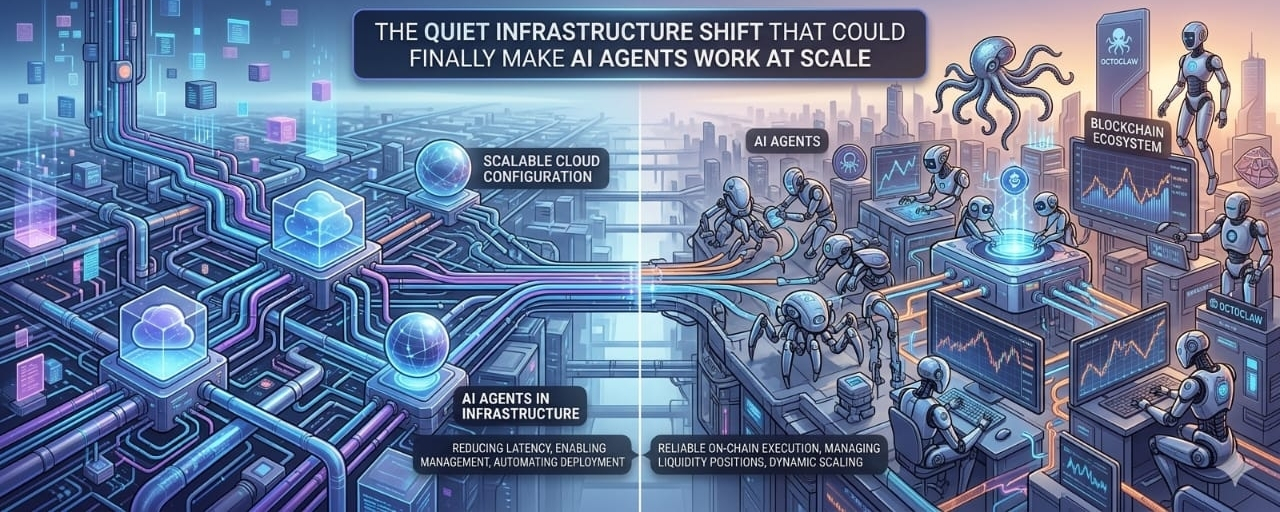
What’s starting to change now, and what makes developments like Octoclaw’s cloud configuration from OpenLedger genuinely interesting, is that people are finally paying attention to the unsexy stuff. The plumbing. The infrastructure layer that nobody writes hype threads about but that ultimately decides whether a tool becomes part of your daily workflow or something you abandon after two frustrating weeks.
At first glance, cloud configuration sounds about as exciting as reading a manual for a dishwasher. It’s not the kind of thing that makes your heart race or gets you refreshing charts at three in the morning. But if you’ve spent enough time building or using automated systems in crypto, you learn pretty quickly that infrastructure choices are the quiet architects of your entire experience. They determine whether your execution is sharp or sluggish, whether your strategies stay online during volatile moments, and whether you can actually trust a system to do what it’s supposed to do when you’re not sitting there watching it.
What OpenLedger seems to be doing with Octoclaw is shifting the focus from simply creating AI agents to actually figuring out how to deploy and manage them in a way that doesn't fall apart when things get real. Instead of keeping everything locked into rigid, hard-to-scale setups, the goal appears to be making these systems flexible enough to grow with demand without requiring a team of engineers to babysit them. That’s a bigger deal than it might sound because one of the quiet truths about AI and blockchain is that building something smart is only half the battle. Keeping it reliable, responsive, and adaptable as usage scales is where most things quietly fail.
If you think back to how trading tools evolved over the years, the pattern is pretty clear. The earliest bots were simple scripts running on someone’s laptop or a cheap VPS, and for a while that was enough. They worked fine when markets were calm and strategies were basic. But as more people started using them, as strategies became more layered and execution speed started to matter more, those simple setups began showing their limits. Latency crept in, systems became harder to manage, and the whole thing started feeling fragile. That’s the exact moment where proper cloud infrastructure stops being a luxury and starts being the thing that separates functional tools from abandoned projects.
In simple terms, cloud configuration means distributing your systems across multiple servers rather than relying on a single machine to handle everything. This lets resources expand or contract depending on what’s actually needed at any given moment, which for AI agents is pretty much essential. These systems aren't just sitting there passively, they're constantly processing data, evaluating conditions, and sometimes making split-second decisions that actually matter. If the underlying infrastructure can't keep pace, none of the intelligence on top matters because the whole thing becomes too slow to be useful.
Looking at where things stand in early 2026, there's a noticeable shift in what projects are prioritizing. It's less about adding another feature to the checklist and more about answering practical questions. How easy is this to actually use? What happens when a hundred people run it simultaneously? Does it hold up under real market conditions or does it start crumbling the moment volatility spikes? These are the kinds of questions that separate tools that get adopted from tools that get forgotten, and more teams seem to be taking them seriously now.
Octoclaw's approach to cloud configuration feels like it's aimed directly at this problem. It's not just about having AI agents exist, it's about making them manageable in a way that doesn't consume your entire day. That covers things like spinning up multiple agents without having to configure each one from scratch, keeping an eye on performance without building custom dashboards, updating strategies across deployments without breaking anything, and ensuring that everything runs consistently even when conditions change. For developers, this kind of streamlining removes friction that otherwise kills momentum. For traders and users, it creates an environment where you can actually focus on strategy instead of constantly troubleshooting infrastructure.
Anyone who's tried running multiple strategies across different platforms knows exactly how messy it can get. You're switching between interfaces, remembering which settings apply where, dealing with random downtime that throws off your entire approach, and slowly accumulating a mental load that makes the whole thing feel more exhausting than it should. Now imagine a setup where a lot of that overhead just disappears, where agents can be deployed, monitored, and adjusted without the constant manual intervention that burns people out. That's the kind of shift this points toward, and it's the kind of improvement that doesn't make headlines but completely changes how you operate day to day.
Part of why this is becoming important right now has to do with how the market itself has matured. We've been through enough cycles that users aren't easily impressed by whitepapers and roadmaps anymore. They've been burned by tools that looked great in demos but fell apart in practice, and they've developed a much sharper sense for what actually works. At the same time, the AI side of things has genuinely advanced to a point where it can handle more complex tasks, but only if the infrastructure underneath is solid enough to support it. Having a brilliant agent running on shaky servers is like putting a race car engine in a car with flat tires.
There's also this growing overlap between AI capabilities and actual on-chain activity that makes infrastructure even more critical. It's not just about analyzing price charts anymore, it's about interacting with protocols, managing liquidity positions, responding to governance changes, and adapting to market conditions in ways that require both intelligence and reliable execution. Neither piece works without the other, and both depend heavily on having a backend that doesn't crumble when things get busy.
From a personal perspective, this whole phase feels like one of those moments where the space is quietly leveling up without anyone really announcing it. You don't notice it day to day, but over time you realize that systems feel smoother, that tools respond faster, that strategies are easier to iterate on and deploy. Each individual improvement is small enough to ignore, but taken together they fundamentally change what's possible and how you approach your work.
Of course, it's still early and there are plenty of challenges that come with cloud-based systems. Security becomes more complex when you're dealing with distributed infrastructure. Reliability depends on how well the architecture is designed and maintained. Cost management can spiral if scaling isn't handled thoughtfully. If these things aren't addressed properly, scaling up can introduce new problems instead of solving old ones. The execution matters just as much as the vision, maybe more.
Adoption is another factor that takes time no matter how good the technology is. Traders and developers don't switch tools overnight just because something new exists. There's always a period of testing, skepticism, and gradual trust-building before people are willing to rely on a system with real capital. But once something proves itself reliable over time, adoption can accelerate quickly because the demand for better infrastructure has been building for years.
When you zoom out and look at the broader direction, this move toward scalable, cloud-based AI deployment fits perfectly with where both crypto and artificial intelligence seem to be heading. Less obsession with isolated features, more attention to how systems connect and scale. Less manual babysitting of bots and agents, more automation that actually functions under real-world conditions without constant intervention. It's not about removing humans from the equation, it's about giving them tools that don't require constant fighting just to keep running.
For people looking at this from an investment perspective, infrastructure improvements like this rarely show up immediately in price action. They're not the kind of catalyst that sparks a sudden rally or trends on social media. But over the long term, projects that solve genuine problems around usability, reliability, and scalability tend to stick around while flashier competitors fade. They become the foundation that other things are built on, and that kind of positioning creates value that compounds quietly over time.
What Octoclaw's cloud configuration really represents isn't just a single feature or update. It's a signal about direction and priorities. It shows that OpenLedger is thinking beyond the surface-level excitement of AI tools and digging into the harder, less glamorous work of making sure those tools can actually be deployed, managed, and scaled in ways that hold up when it matters. In a space where execution has always mattered more than ideas, that kind of focus is worth noticing even if it doesn't make noise.
These aren't the moments that feel big while they're happening. They're the quiet shifts that slowly reshape how the next phase of this whole experiment evolves, and looking back, they're usually the ones that ended up mattering most.