
I keep looking at the crypto market the same way people watch changing weather patterns. After enough years, you stop reacting to every storm. You start noticing the repetition instead. A new narrative shows up, timelines become flooded with certainty, influencers suddenly become experts overnight, and every project claims it’s building the future. Then a few months later the attention moves somewhere else and most of those promises quietly disappear into the background. Crypto moves fast, but memory moves even faster here. People forget failures almost immediately because there’s always another story arriving to replace the last one.
Lately, AI has become the newest thing everything wants to attach itself to. Almost every week there’s another protocol talking about decentralized intelligence, AI infrastructure, autonomous agents, or tokenized data economies. Most of it blends together after a while. That’s honestly why OpenLedger (OPEN) didn’t stand out to me at first. It looked like another project trying to ride the AI wave while the market is still hungry for anything connected to that narrative.
But after sitting with it for a bit and reading deeper, I started thinking there might actually be something more grounded underneath the surface.
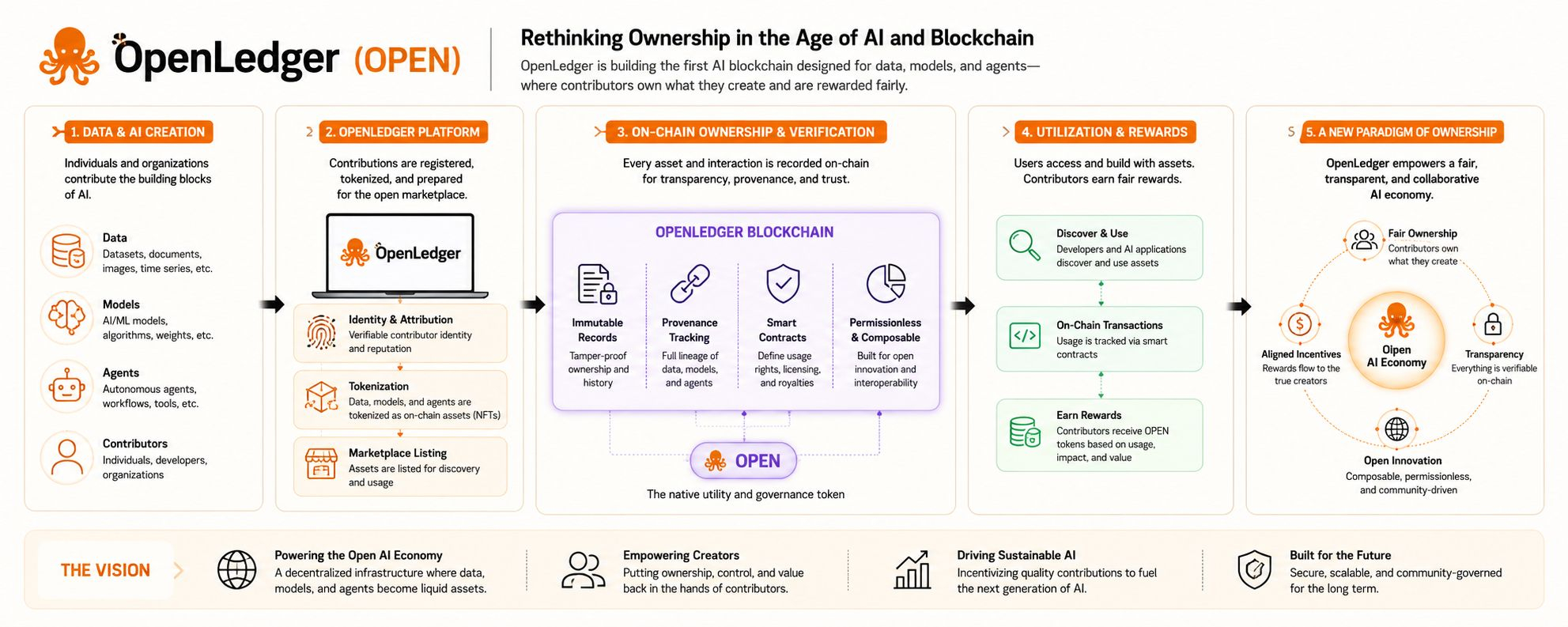
The idea behind OpenLedger feels surprisingly simple once you remove the usual crypto vocabulary. AI systems today rely on huge amounts of human input — data, models, training, feedback, behavior patterns — yet the people contributing all that value rarely own any part of the outcome. Most of the rewards end up concentrated in a small group of companies controlling the infrastructure. OpenLedger seems to be exploring whether blockchain can create a system where contributors to AI ecosystems can actually earn from the value they help create instead of being invisible participants feeding giant platforms.
That part feels connected to reality in a way a lot of crypto ideas don’t.
The internet already runs on unpaid contribution. Social platforms became massive businesses because users constantly generate content, behavior, and information. AI is now accelerating that dynamic even further. Models improve because millions of people interact with systems every day, often without realizing how valuable those interactions become. OpenLedger appears to be asking a pretty direct question: if data and intelligence are becoming economic assets, should the people providing them have some kind of ownership layer attached to that process?
I think that’s the part that stayed in my head.
Not because it guarantees success. Crypto has no shortage of good ideas that failed once they collided with reality. And reality is usually slower and messier than whitepapers make it seem. Building a decentralized economy around AI contributions sounds interesting conceptually, but actually getting developers, companies, and users to participate is a completely different challenge. Traditional industries don’t move with crypto speed. Businesses care about reliability, regulation, integration, and simplicity far more than ideology.
That gap between crypto ambition and real-world adoption still feels enormous.
There’s also the question that hangs over almost every AI-related blockchain project right now: does this truly need crypto underneath it? Sometimes blockchain genuinely helps coordinate ownership and incentives between strangers online. Other times it feels like tokens are added simply because that’s how funding and attention work in this industry. I don’t think that skepticism is unhealthy anymore. If anything, it’s probably necessary after watching so many cycles repeat themselves.
Still, I can understand why OpenLedger is getting attention. At the very least, it’s trying to approach a problem that will probably become more important over time. AI is evolving quickly, but conversations around ownership, compensation, and control are still unresolved. The technology is moving ahead faster than society’s ability to decide who benefits from it. That tension feels real.
And maybe that’s why the project feels more interesting the longer I think about it. Not because it promises to change everything overnight, but because it’s touching a question the broader tech world hasn’t solved yet either.
I’m still cautious. Crypto has a habit of turning meaningful ideas into speculative distractions long before actual utility arrives. Maybe OpenLedger manages to build something lasting. Maybe it fades once the market finds another obsession. Both outcomes are possible. But in a space filled with recycled narratives and empty promises, at least this feels like an attempt to engage with something happening outside crypto itself and honestly, that alone already makes it more worth watching than most.