
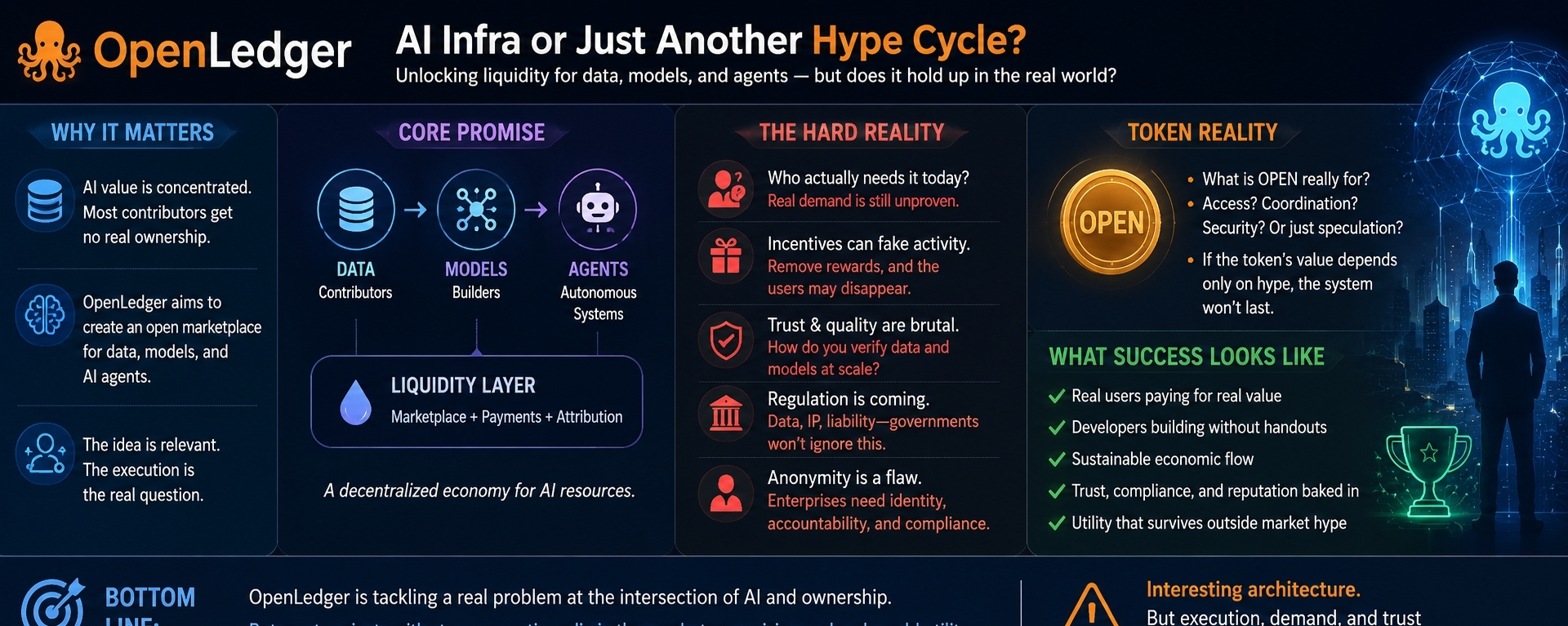
OpenLedger keeps showing up in conversations about AI infrastructure, which immediately makes me suspicious. I have watched this industry manufacture entire markets out of adjectives. “Decentralized AI.” “Permissionless intelligence.” “Data liquidity.” The language gets polished long before the plumbing exists. Usually a token arrives first, utility later. Sometimes never.
Still, I keep circling back to OpenLedger because the underlying problem is not imaginary. AI has turned data, models, and compute into strategic assets, yet the ownership layer remains absurdly concentrated. A handful of firms control distribution, capital, and increasingly the training pipelines themselves. Everyone else contributes fragments. Data labeling here. Fine-tuning there. Marginal labor. No real leverage. OpenLedger appears to be making a bet that this imbalance creates room for a marketplace where contributors, developers, and autonomous systems can coordinate economically without defaulting to centralized intermediaries.
Fine. Reasonable premise.
The harder question sits underneath: why does this need a blockchain at all?
That question gets dodged constantly in crypto because people confuse technical possibility with necessity. A distributed ledger only matters if trust failure is severe enough to justify the operational drag. Extra latency. Economic complexity. Governance overhead. Token speculation stapled onto infrastructure. If OpenLedger is serious about monetizing models and data, then provenance matters. Attribution matters. Payment rails matter. Reputation matters. Nobody paying real money for datasets or inference layers wants mystery boxes wrapped in pseudonymous optimism.
Enterprise reality enters the room quickly and kills half the fantasy. Public-by-default architecture sounds ideologically elegant until institutions touch it. Then legal departments start having opinions. Nobody serious wants sensitive data flows leaking into transparent systems. Nobody handling regulated workloads wants counterparties hidden behind anime profile pictures and Discord governance rituals. Selective disclosure becomes mandatory. Auditability without exposure. Verifiable contribution without public contamination of commercially sensitive information. That tension never disappears. Crypto keeps pretending it will.
OpenLedger lives or dies on coordination, not rhetoric. Can it actually create a marketplace where contributors trust pricing, developers trust quality, and buyers trust provenance without introducing enough friction to make centralized alternatives look simpler? Because centralized systems are brutally efficient. People forget that. AWS wins because it works. OpenAI wins because convenience crushes ideology nine times out of ten.
The token question gets uncomfortable fast.
I have seen too many networks mistake subsidized activity for demand. Incentives flood in, dashboards light up, wallets multiply, engagement spikes. Beautiful metrics. Completely fake economy. Strip away emissions and suddenly the marketplace feels abandoned, like a trade show after teardown. OpenLedger does not escape this test. If the token exists mainly to manufacture temporary participation, the architecture becomes circular. People show up to earn the token whose value depends on people showing up. Reflexive nonsense. No real external demand entering the system.
Something else bothers me. AI infrastructure is expensive. Persistently expensive. Models degrade. Data quality decays. Compute bills do not care about ideology. Somebody has to pay. Real money. If OpenLedger wants to become economic infrastructure rather than narrative infrastructure, value has to flow through the system in a way that survives outside speculative cycles. Enterprises paying for outputs. Developers paying for access. Autonomous agents transacting because efficiency demands it, not because farming rewards looks attractive for a quarter.
Identity becomes unavoidable too, though crypto still treats it like an allergic reaction. Anonymous coordination works until money becomes serious. Then reputation starts reappearing under different names. Credentialing. Verification. Counterparty trust. Institutions do not transact based on vibes. They want accountability with legal weight attached. A system coordinating valuable AI resources eventually collides with this reality whether it likes it or not.
Regulators will not stay passive either. Data provenance, copyright exposure, model ownership, liability allocation. Nobody has solved these cleanly. The assumption that governments will politely step aside while decentralized AI marketplaces rewrite intellectual property economics feels almost childishly optimistic.
OpenLedger might still find a place. Niche infrastructure often survives quietly while louder competitors implode under their own narrative gravity. Stranger things have happened. But the distance between “interesting architecture” and “critical infrastructure” is filled with abandoned token economies, dead developer communities, and dashboards nobody checks anymore.
I keep looking at projects like this and thinking the same thing: eventually somebody from procurement asks a very boring question — who exactly is liable when this breaks? Silence after that tends to get expensive fast.