
A while ago, I was having a casual conversation with a friend who works as a developer in DeFi, and he said something that has stayed in my head since then. He told me that his job no longer feels like it is only about writing smart contracts. More often, it feels like debugging coordination between humans. At that moment, the line sounded interesting, but I did not fully understand how much truth was hidden inside it. The more I have been reading about OpenLedger and thinking about where crypto infrastructure is moving, the more that sentence starts to feel accurate. Crypto has spent years improving logic, security, transparency, and composability, but one of the biggest gaps still appears after the logic is already written. The system may be on-chain, but the execution around it still depends heavily on humans noticing things, agreeing on them, translating them into actions, and then carrying those actions across different protocols and interfaces.
This slowly changed the way I think about DeFi work. Earlier, I imagined crypto developers mostly dealing with contract architecture, gas optimization, audits, and technical design. Of course, all of that still matters, but when you look closer at how real systems are operated, another layer becomes visible. A lot of the work is not only about whether the code can perform a function. It is about whether people can coordinate around the same state, understand the same risks, and execute the same intention without the process breaking apart. In many cases, humans are not just governing the system from above. They are being pulled directly into the execution layer itself, acting as the bridge between fragmented protocols, dashboards, multisigs, and treasury decisions.
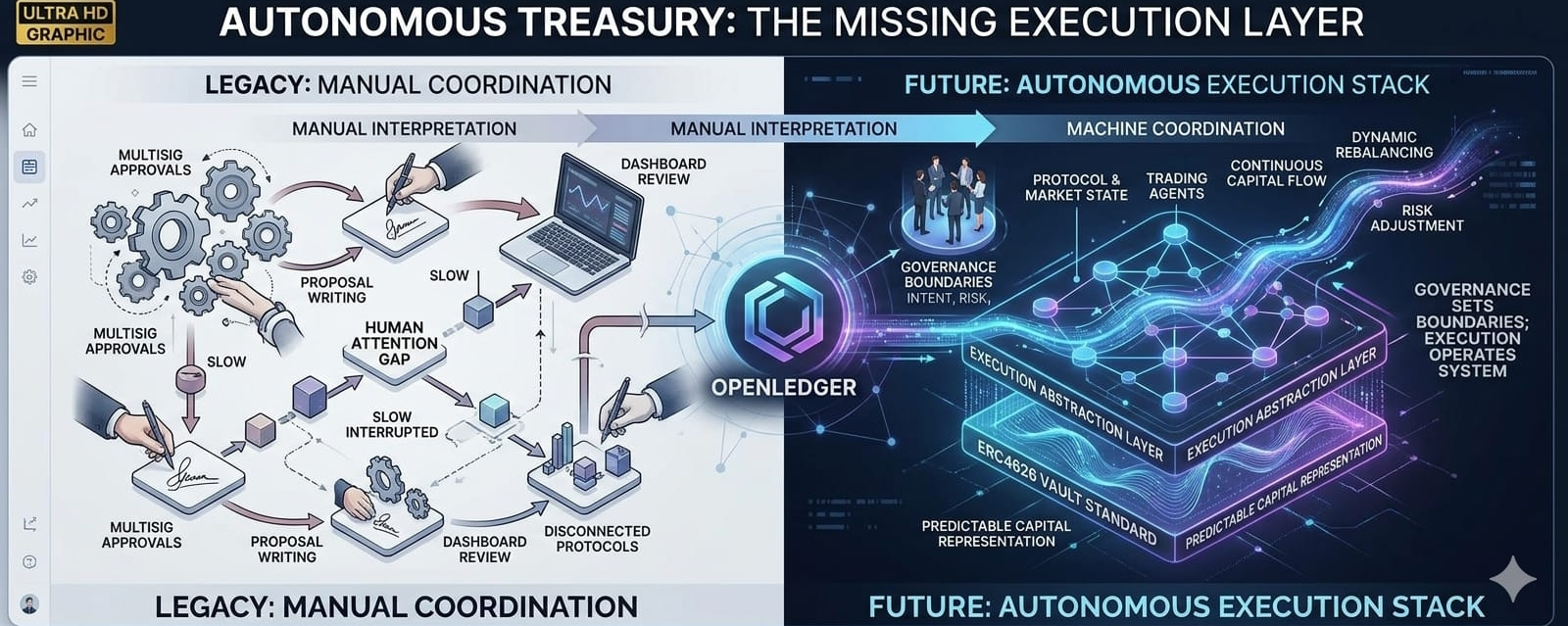
DAO treasuries make this problem especially clear. From the outside, they appear very structured and very on-chain. There are governance proposals, voting systems, multisig wallets, analytics dashboards, vaults, and public transaction histories. But once you look beneath the surface, treasury management is still mostly a chain of manual steps. A simple rebalance is rarely just a single action. It usually becomes a process of discussion, proposal drafting, reviewing, approving, signing, executing, checking, and sometimes correcting across several different platforms. When something feels slow or messy, the issue is not always that the treasury lacks logic. The issue is that there is no unified execution flow that can see the treasury as one system and operate from that shared understanding continuously.
For a long time, I assumed this was just the natural shape of DAO governance. Treasuries should be careful, decisions should be reviewed, and no one wants capital to move without proper boundaries. But the more I think about it, the more I feel the real problem is not governance itself. Governance is necessary. The problem is that execution has been broken into so many separate human-dependent actions that the treasury never becomes a continuous operational system. It becomes a collection of decisions waiting to be manually carried from one place to another. Every protocol has its own interface, every vault has its own logic, every chain has its own state, and every treasury action requires humans to connect these pieces again and again.
That is why the deeper issue is not simply inefficiency. Inefficiency is only what we see on the surface. The more important problem is the lack of an execution abstraction layer. Crypto has done a lot of work to standardize how capital is stored, recorded, secured, and represented, but it has not yet fully standardized how capital should be operated continuously. A treasury should behave like a living financial system, but in practice, it often behaves like a manual workflow scattered across different tools. Capital does not move like a stream. It moves in fragments, interrupted by waiting periods, approval cycles, interpretation gaps, and human attention.
This is where ERC4626 becomes important. I do not see ERC4626 as only a vault standard. Its deeper value is that it gives capital a more consistent shape. Deposits, withdrawals, shares, yield accounting, and vault interactions can all be expressed through a more unified model. That matters because before capital can be operated intelligently, it first has to be represented in a predictable way. ERC4626 gives the system a clearer language for vault-based capital. But it also has a limit. It standardizes representation, not continuous execution. It helps define how capital sits inside vaults and how users interact with those vaults, but it does not fully answer how capital should move, rebalance, react, and coordinate in real time.
The layer above this is where the bigger architecture starts to become interesting. If ERC4626 standardizes how capital is represented, then the next layer has to standardize how capital is operated. This is where trading agents and execution infrastructure begin to matter in a deeper way. They are not just external bots or tools that sit outside the system and wait for humans to trigger them. In a more advanced treasury architecture, agents can become direct execution actors inside the capital flow. They can respond to state, adjust allocations, rebalance positions, and coordinate capital movement across vaults according to defined goals, constraints, and permissions.
This is the part of OpenLedger that feels different to me. It points toward a treasury model where vaults, agents, and state updates are not separate pieces held together by human effort, but parts of one continuous execution stack. In that kind of system, the treasury is no longer just a place where assets are stored or observed. It becomes an environment where capital can be coordinated in real time. Humans still matter, but their role becomes more natural. They define intent, risk limits, permissions, and governance boundaries. They should not have to manually perform every operational movement that happens inside those boundaries.
The way I picture DAO treasuries now is like a body that has all the organs but does not yet have a reflex nervous system. The structure exists, the assets exist, the governance process exists, and the tools exist, but every movement still needs to pass through human coordination. That creates delays, but more importantly, it creates discontinuity. The system cannot respond naturally because every response has to be noticed, discussed, translated, approved, and executed by people. The shift that OpenLedger suggests is not only from manual work to automation. It is from manual coordination to machine execution coordination, where the system can keep operating continuously while still staying inside human-defined limits.
This also changes how governance should be understood. If execution becomes continuous, governance does not need to approve every small action. Governance can define the space in which action is allowed. Instead of deciding every rebalance, every adjustment, and every response to market or protocol changes, governance can set the boundaries, goals, risk thresholds, and permissions. The execution layer can then operate within that space. This feels like a much healthier separation between human responsibility and machine operation. Humans should guide the system, but they should not be forced to act as the middleware that keeps the system moving.
At the same time, this shift creates new questions. When execution becomes more automated, responsibility becomes harder to trace. A decision may no longer look like one person pressing a button. It may become a chain of reactions between data, agents, vaults, market conditions, and capital flows. That makes the system more powerful, but it also makes clarity more important. A self-coordinating treasury cannot only be fast or efficient. It also has to be understandable, auditable, and properly constrained. Otherwise, automation does not solve the coordination problem. It only moves the problem into a more complex layer.
There is also the issue of state. DeFi is not one clean, unified environment. It is made of many states updating across many protocols, vaults, chains, liquidity venues, and risk models. Without an execution abstraction layer, every part of the system carries its own version of reality. High-level coordination then becomes difficult because there is no single operational surface from which the treasury can understand what is happening and act on it. Dashboards can show information, and governance tools can structure decisions, but observation alone is not execution. A system that can see the state still needs a layer that can continuously act from that state.
The more I look at it, the more I feel that the slowness of DAOs is not just a design weakness. It is also the natural limit of a system that depends on human observation for every meaningful action. Humans are good at setting direction, defining constraints, judging risk, and creating accountability. But humans are not built to continuously maintain state across a fragmented financial system. When humans are placed inside the execution layer, the system can only move as fast as human attention allows. OpenLedger seems to point toward a different structure, where human governance defines what should be allowed, and machine coordination handles the operational flow inside those limits.
That is why I do not see this as just another infrastructure idea. The bigger gap is becoming clearer. Crypto has standardized many things around capital: how it is recorded, how it is secured, how it is represented, and how it can be composed. But it has not fully standardized how capital can be continuously operated. ERC4626 addresses an important part of the representation problem. Trading agents and execution layers begin to address the operational problem. Together, they suggest a treasury architecture where vaults are not passive containers, but active environments where capital can be coordinated according to goals, state, and constraints.
For me, the most important realization is that treasury automation has not only been waiting for better tools. It has been waiting for a natural architectural layer where automation actually belongs. Once that layer exists, automation stops feeling like something added on top of treasury management and starts becoming part of how treasury should work by default. The future may not be about DAOs moving through the same fragmented process a little faster. It may be about changing the structure of treasury itself, from a manual coordination system into a capital system that can self-coordinate within boundaries defined by humans.
