
For the past five years, I have watched the AI industry turn into something I never expected.
When I started my research, I believed artificial intelligence would democratize knowledge.
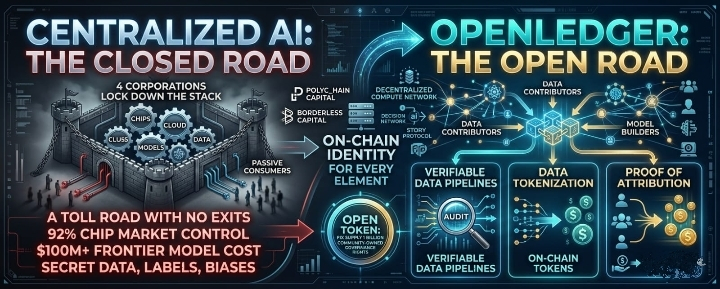
Instead, I have watched four corporations lock down the entire stack chips, cloud, models, and data.
Today, one company controls ninety two percent of the AI chip market.
Training a single frontier model costs more than a hundred million dollars.
That is not open innovation.
That is a toll road with no exits.
And here is what worries me most as a researcher: nobody can see inside.
I have interviewed engineers at large AI firms who admit they do not fully understand why their models give certain answers.
The training data is a secret.
The labeling process is a secret.
The biases, the failures, the hidden costs all of it sits behind a corporate firewall.
We are handing decision‑making power to black boxes built by people we do not vote for.
That should terrify anyone.
But last year, I stumbled onto a different approach.
A project called OpenLedger is trying to build what I have been dreaming about for years: an AI system that lives on a public blockchain, where every dataset, every model, and every output leaves a trace.
I spent weeks digging into their architecture, and I want to share what I found.
The core idea is deceptively simple.
Instead of hiding data sources inside a private server, OpenLedger puts every step of the AI pipeline on‑chain.
From the moment someone contributes a dataset to the moment a model uses it for training, the entire journey is recorded.
They call this verifiable data pipelines.
As a researcher, I cannot overstate how radical this is.
For the first time, we could actually audit an AI’s answers.
We could see if a model was trained on copyrighted material, or biased data, or even maliciously poisoned inputs.
Then there is the data tokenization mechanism.
In today’s world, the richest companies hoard valuable data and pay nothing to the people who created it.
OpenLedger turns high quality datasets into tradable on chain tokens.
You can price your data, sell it, even use it as collateral in decentralized finance.
I spoke to a small medical imaging lab that is already preparing to tokenize their X‑ray dataset.
They told me they have been ignored by big AI firms for years.
Now they have a way to participate and get paid.
The part that truly convinced me, though, is proof of attribution.
This is the feature I wish every AI company had.
Every dataset, every model, every agent gets a permanent on chain identity.
When an AI produces an output, you can trace every contributor who helped make it possible.
And those contributors get automatic payments based on how often their work is used.
I have seen the legal battles over AI and copyright.
This system would have prevented half of them.
OpenLedger is not just a whitepaper.
They have already launched their mainnet, backed by serious investors like Polychain Capital and Borderless Capital.
I tracked their recent announcements closely.
Just last week, they partnered with a decentralized compute network to solve AI’s biggest bottleneck raw processing power without renting from Amazon or Google.
They also integrated with a project called Perception Network to make AI decisions fully auditable on‑chain.
And in a move that targets the eighty trillion dollar global IP market, they teamed up with Story Protocol to let AI systems legally use creative works while automatically paying rights holders.
This is happening now, while lawsuits against OpenAI and Google multiply every month.
Their native token, OPEN, powers the whole ecosystem.
There is a fixed supply of one billion tokens.
Most of them are reserved for the community ecosystem growth, developer grants, model incentives, and public goods.
As a researcher, I appreciate that token holders also get governance rights.
That means the people using the network actually decide where it goes.
Compare that to a traditional AI company where shareholders vote and users just consume.
After all my years studying centralized AI, I have reached a simple conclusion.
The black‑box model is broken.
It concentrates power, hides risks, and treats users like passive consumers.
OpenLedger offers a transparent, community‑owned alternative.
It is not perfect decentralized AI is still young and has scaling challenges.
But for the first time, I see a path forward that does not end with three or four corporations deciding what truth looks like.
I choose to support the open road. I hope you will too.
