
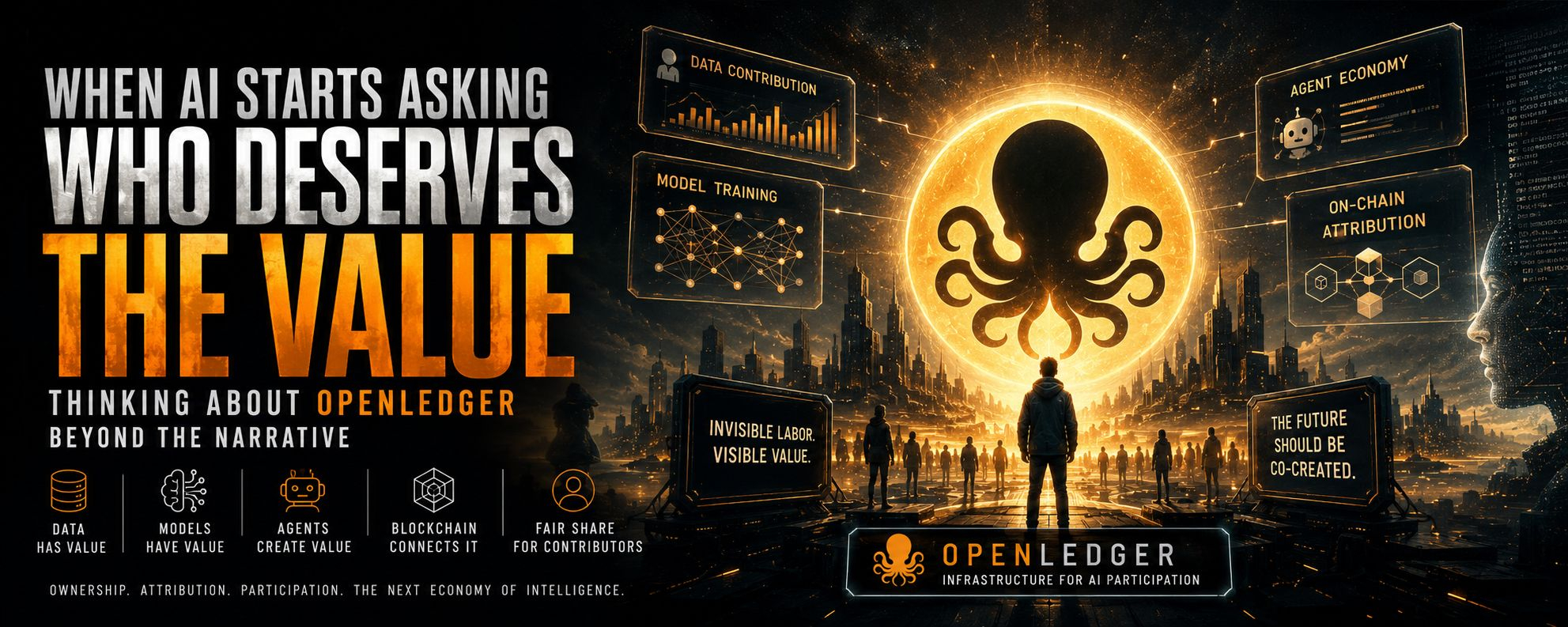
I have been in crypto long enough to become suspicious of narratives that arrive too perfectly packaged. Every cycle seems to manufacture a new certainty, a new phrase everyone suddenly repeats as if it was inevitable all along. DeFi was supposed to rebuild finance, NFTs promised digital ownership, modular systems claimed to fix scalability, and AI now sits at the center of almost every conversation. So when I first looked at OpenLedger, positioning itself as an AI blockchain designed to unlock liquidity around data, models, and agents, my instinct was not excitement. It was caution. But I keep coming back to this idea, mostly because it touches a problem the market keeps ignoring: who actually captures value when intelligence becomes infrastructure.
What interests me is not the branding around AI. We have already reached the point where “AI-powered” means almost nothing in crypto because speculation absorbs language faster than meaning. The thing that quietly catches my attention about OpenLedger is the uncomfortable question beneath the surface. If models are trained on collective inputs, if datasets emerge from invisible labor, and if autonomous agents begin performing meaningful economic work, then ownership becomes strangely blurry. That part makes sense to me. It does not make me trust it. It just makes me pay attention.
Crypto has always been obsessed with visible incentives while often ignoring invisible contributors. We reward liquidity providers because we can measure them. We reward validators because their role is obvious. But data contribution, behavioral feedback, training signals, model improvement—these things often disappear into black boxes, especially in traditional AI systems. Maybe OpenLedger is trying to pull some of that hidden economic activity back into transparent infrastructure. I’m still skeptical because crypto loves to promise fair attribution while quietly centralizing power somewhere else. I have seen this before. Yet the problem itself feels real enough to deserve attention.
There is also something psychologically interesting happening here. Markets are exhausted. Not dead, just tired. You can almost feel it in the way people react to new narratives now. Excitement exists, but it arrives mixed with suspicion. Investors want something meaningful, but they have been disappointed too many times to surrender fully to optimism. AI fits perfectly into that emotional contradiction because it feels undeniably important while simultaneously attracting some of the loudest speculative behavior we have seen in years. OpenLedger enters that tension directly. That matters more than people realize.
I keep noticing how crypto repeatedly struggles with infrastructure projects because infrastructure rarely feels exciting at first. Most people arrive looking for velocity, not systems. Price movement speaks louder than architecture. Yet years later, when narratives fade, infrastructure quietly explains why some ecosystems survived and others collapsed. That tension matters. OpenLedger positioning itself around AI participation—from training to deployment—sounds compelling in theory, but theory is easy in this market. Execution has always been the harder story, especially when incentives collide with human behavior.
Something about AI economics feels different, though I hesitate even saying that because every cycle convinces itself it is uniquely important. Still, there is an uncomfortable reality emerging: data has value, models have value, and increasingly autonomous systems may generate value too. Yet the pathways connecting contributors to economic ownership remain fragmented and opaque. Maybe blockchains eventually become coordination layers for that problem. Maybe they do not. I do not know yet. But if OpenLedger is even partially addressing that structural gap, it touches something larger than short-term speculation.
Of course, this is where skepticism returns. Crypto is unusually talented at identifying genuine problems while offering solutions that arrive too early, too idealistic, or too dependent on perfect participation. Decentralization sounds beautiful until convenience wins. Fair attribution sounds important until capital concentration quietly takes over. That is the part I cannot ignore. OpenLedger might recognize something meaningful about contributor economies in AI, but recognition alone does not create adoption. Real systems survive friction. Narratives rarely do.
There is another emotional layer to this that feels impossible to separate from the technology itself. A lot of people are quietly anxious about AI, even if markets mostly discuss it through productivity and profit. There is fear underneath the optimism. Fear of replacement. Fear that invisible systems will generate immense value while ordinary contributors remain economically disconnected from outcomes they helped create. In that sense, OpenLedger feels less like an infrastructure conversation and more like a trust conversation. And trust, in crypto, is always fragile.
What I find myself reflecting on is how often crypto succeeds when it turns invisible systems into visible incentives. Bitcoin turned monetary distrust into transparent scarcity. Ethereum turned programmable coordination into open participation. Those systems were imperfect, sometimes painfully so, but they addressed tensions people already felt. OpenLedger appears to be asking whether AI participation deserves a similar economic layer. Not proven. Just interesting. The question itself feels more important than most people admit.
I am cautious with stories like this because crypto has trained many of us to be. Every compelling idea eventually attracts speculation loud enough to distort its purpose. Maybe OpenLedger becomes meaningful infrastructure. Maybe it becomes another narrative briefly mistaken for inevitability. I honestly do not know. But I keep noticing that whenever a project touches hidden value creation, invisible labor, and questions of ownership, I hesitate before dismissing it. Not convinced. Not dismissive either. Just paying attention.