
I had a gut feeling I knew the structure of OpenLedger pretty much as soon as I saw it for the first time.
People contribute data. Models improve. AI agents serve their users. The tokens circulate around the network as rewards. To the outside, it seemed tidy, almost formulaic, like one of these systems where the mechanics are obvious enough from the get-go as long as you spend enough time reading the documentation or watching how the dashboard works.
However, after considering it further, I began to think that the mechanics, the physical aspect, were not that important.
One of the weirdest parts about systems based on contribution is that they don't necessarily pay you for contributing. Not, anyway, over time. They tend to give lip service to the start point. Not only early, but early enough to influence behaviour prior to the stability of the system.
I believe that other people don't pay nearly enough attention to that difference.
When people first join a network such as OpenLedger, they think that value is derived from accuracy. Better data. Better ideas. Better models. Better participation. The logic is just from an outside perspective. Almost merit-based.
The actual behavior within networks tends to change differently, though.
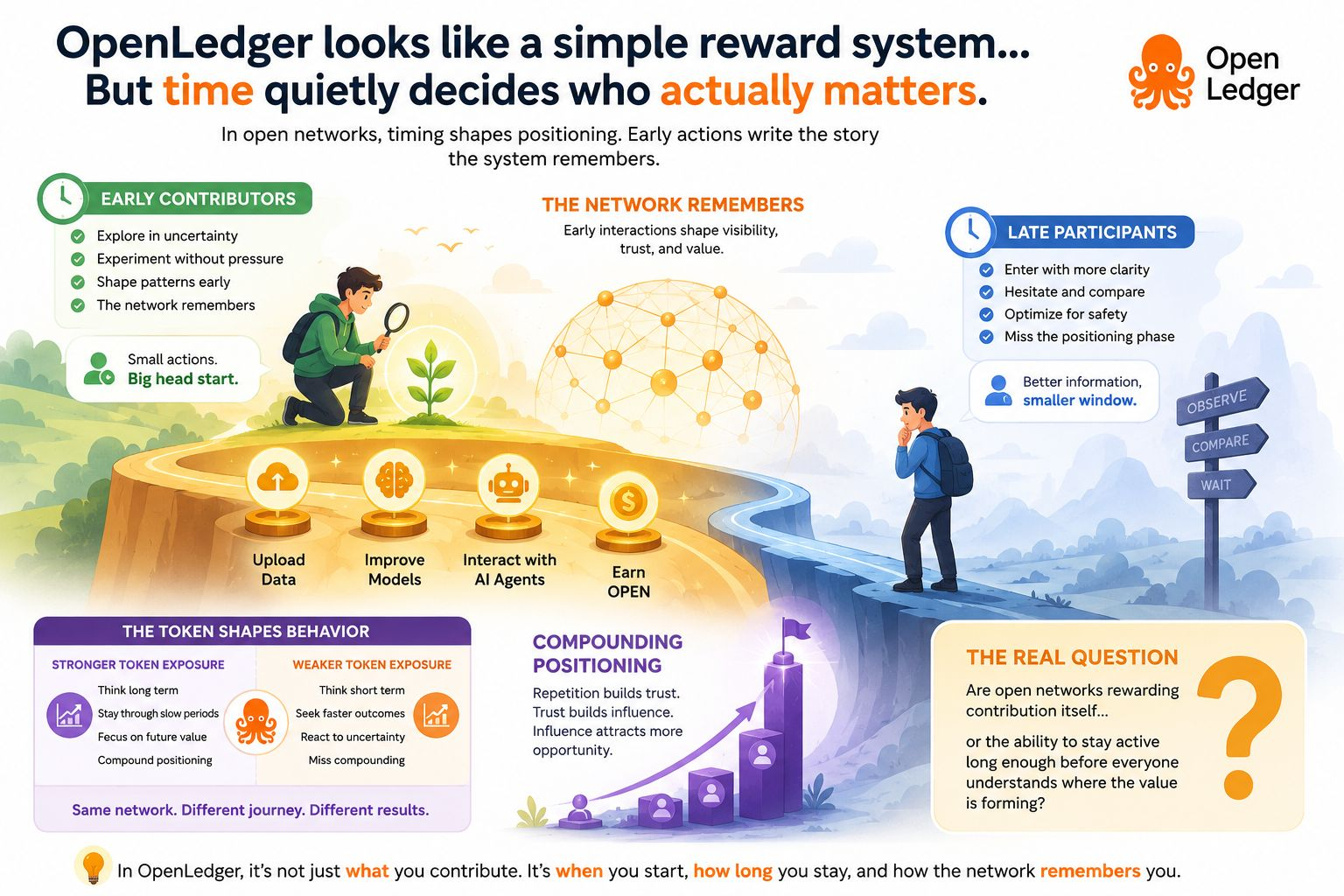
Typical early users tend to work under uncertainty. They experiment in a non-conformist fashion. They can handle partial systems. There are times when they are simply throwing poor experiments in the bin just because there's not as much social risk in making such an effort at this point. Less competition available. Less visibility. Reduced stress to be right every time.
That makes subtle.
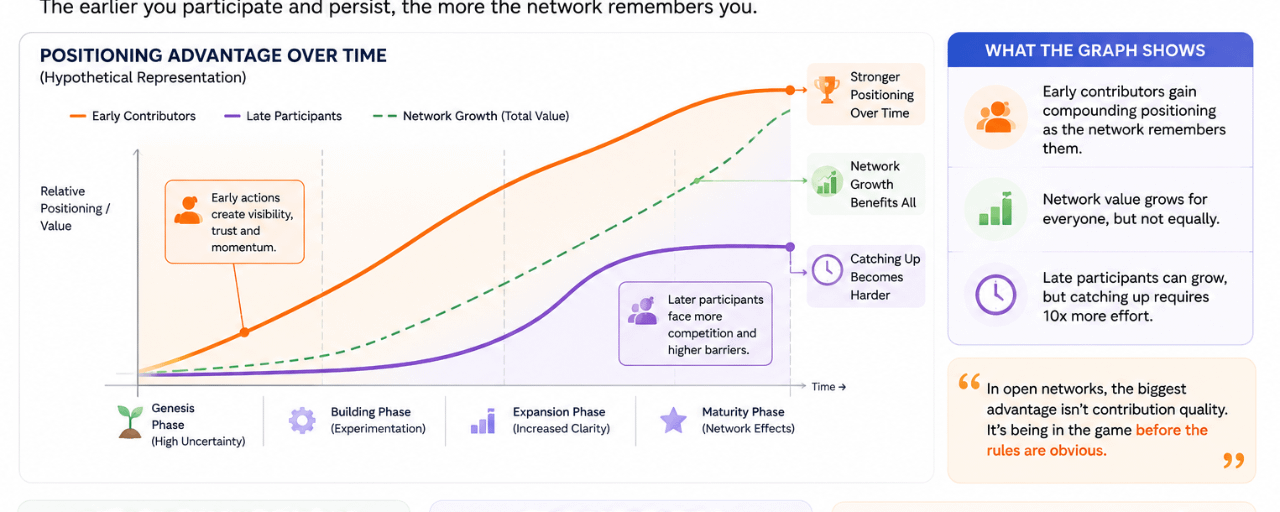
Conversely, the network begins to remember those users slowly before the full understanding of itself.
Once a system begins to remember some players more often than others, it doesn't take long for small features to begin adding up as the system learns more quickly.
Not dramatically.
Quietly.
A wallet that has previously interacted is more trusted. A contributor that has tried during quieter times becomes more familiar. But a small group of users starts to shape what “valuable participation” will mean for the next group of users that enters the ecosystem.
Now the second group shows up.
Usually more informed. More analytical. More careful.
But also later.
Late participation has different psychological effects. Those who come in when the focus is raised do not move forward as easily. They learn beforehand, then take action. They measure themselves by other contributors. They try to get things done efficiently because one error becomes apparent.
This extreme caution can actually lead to less positioning over time due to the irony of the situation.
I was going to remember that part a long time after.
I'm not convinced that this is just a reward layer with the token. It almost looks like a mechanism that alters emotional behavior within the network, with $OPEN . Those with more exposure can be patient. They are active during lean times due to their future incentives, future recognition, future utility.
SMEs are not always in a position to think that way.
They have shorter cycles. Faster outcomes. Immediate relevance.
That is, two people may be on the same network but have entirely different psychological systems under that network.
One experiments freely.
The other awaits to be sure.
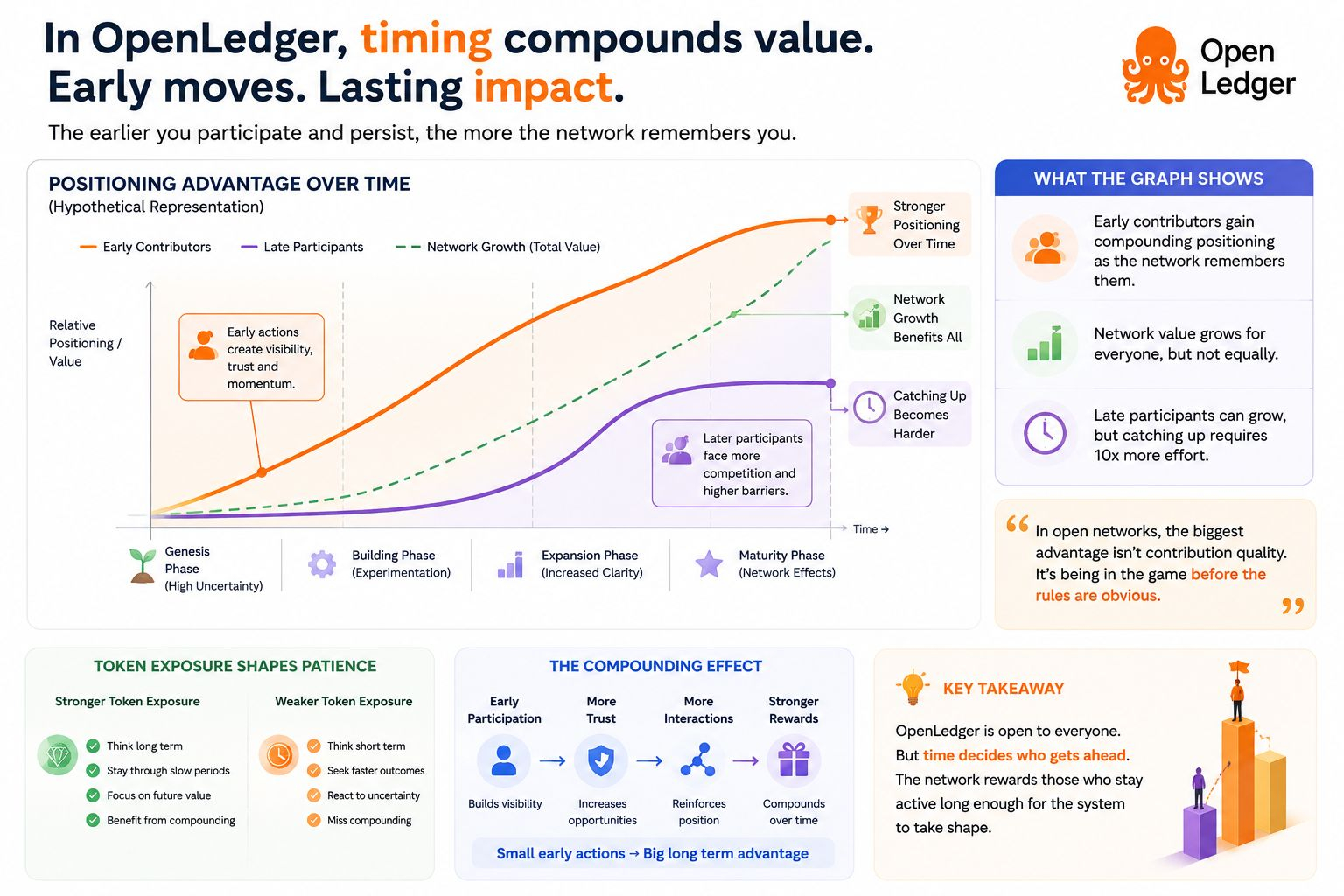
Certainty is usually at the end of the most crucial positioning phase.
I believe that's where it gets tricky to completely iron out the wrinkles for an internal project such as @OpenLedger . Openness is key to decentralized AI systems as it enhances the system as a whole by attracting diverse contributors. The nature of tokenized environments, however, magnifies visibility. The more the system remembers certain users the more it is able to focus over and over on those users.
Efficiency grows.
Slowly, equality bows down to the point of breaking.
Not in a blatant manner. That's what makes it cool.
These structural differences will likely not be apparent to most participants as they occur unless observed from the outside, when everything is still accessible. Anyone can contribute. Anyone can participate. Anyone can enter.
Technically true.
However, access often isn't the only determinant of behavior in open systems. It's influenced by timing, confidence, repetition and mental strength when there's still a lot of uncertainty in the outcome.
And I wonder if the value of contribution is really the reward of contribution, or staying active long enough before everyone else realizes where the value is actually being created, with a network like OpenLedger.
