Sometimes I think the most important projects in crypto are the ones people struggle to explain in a single sentence.
@Not every system is built for instant hype. Some are trying to solve problems that only become obvious years later.
That’s honestly how @OpenLedger feels to me.
I’ve spent enough time around this industry to notice a pattern. Every cycle, crypto gets louder. Bigger promises. Faster chains. More aggressive marketing. Everyone talks about price, but very few people stop to ask what kind of infrastructure is quietly forming underneath all the noise.
And lately, one thing keeps standing out:
AI is slowly becoming part of financial systems themselves.
Not in the futuristic movie sense. More in the practical sense.
Systems that analyze data, make decisions, manage risk, coordinate information, and eventually interact with markets faster than humans realistically can.
The thing is, most of that infrastructure today is controlled privately by large companies and institutions. Closed systems. Closed data. Closed intelligence.
Crypto originally existed to challenge exactly that kind of concentration.
So the real question becomes:
What happens when intelligence itself becomes part of decentralized infrastructure?
That’s where $OPEN starts becoming interesting.
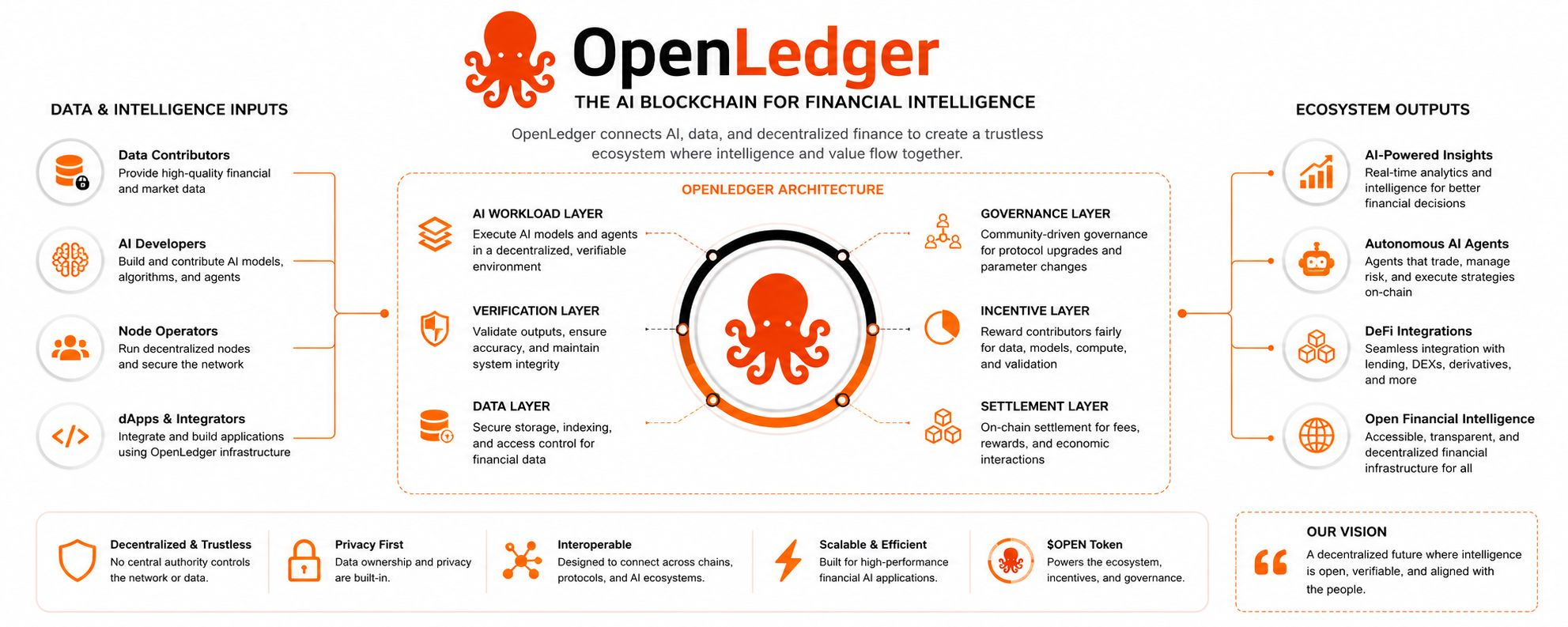
The project doesn’t feel like it’s chasing the usual DeFi formula. It feels more like an attempt to build a framework where AI systems, data contributors, and decentralized economic networks can actually interact together without one side fully controlling the other.
And honestly, I think that’s much harder than people realize.
Because once you move beyond simple token transfers, you run into uncomfortable questions very quickly.
Who verifies the outputs of intelligent systems?
Who owns the data feeding those systems?
How do incentives stay aligned over time?
What happens when the network is under stress instead of growth?
Those are not easy engineering problems. They are human coordination problems disguised as technical ones.
That’s also why I appreciate that #OpenLedger doesn’t seem obsessed with pretending decentralization is perfect. Real infrastructure is always a tradeoff.
Fully decentralized systems can become slow and difficult to coordinate. Highly optimized systems often drift back toward centralization because efficiency naturally concentrates power. Every serious network eventually has to find a balance between openness, speed, security, and governance.
There’s no magical solution to that.
And personally, I think the biggest challenge for projects like OpenLedger won’t even be technology.
It’ll be endurance.
Building infrastructure is exhausting work because progress usually happens quietly. Slowly. Sometimes without recognition for long periods of time. Markets reward narratives immediately, but infrastructure only proves itself after surviving pressure repeatedly.
That’s the part people forget during bull markets.
A network doesn’t reveal its strength when everything is going up. It reveals itself when incentives weaken, liquidity disappears, and participants stop acting rationally.
Can systems built around decentralized intelligence still function when conditions turn chaotic?
I don’t think the industry fully knows yet.
And to be fair, there are real risks here. Complexity itself can become dangerous. Governance can become messy. Adoption is never guaranteed. Even strong ideas fail sometimes because execution over many years is incredibly difficult.
But still… I think projects like @OpenLedger matter because they point toward something deeper than speculation.
Maybe the next phase of crypto is not just about money moving faster.
Maybe it’s about building systems where intelligence, coordination, ownership, and incentives can exist together without depending entirely on centralized institutions.
That future is still uncertain.
But it’s probably one of the few directions in crypto that actually feels meaningful to think about long term.