
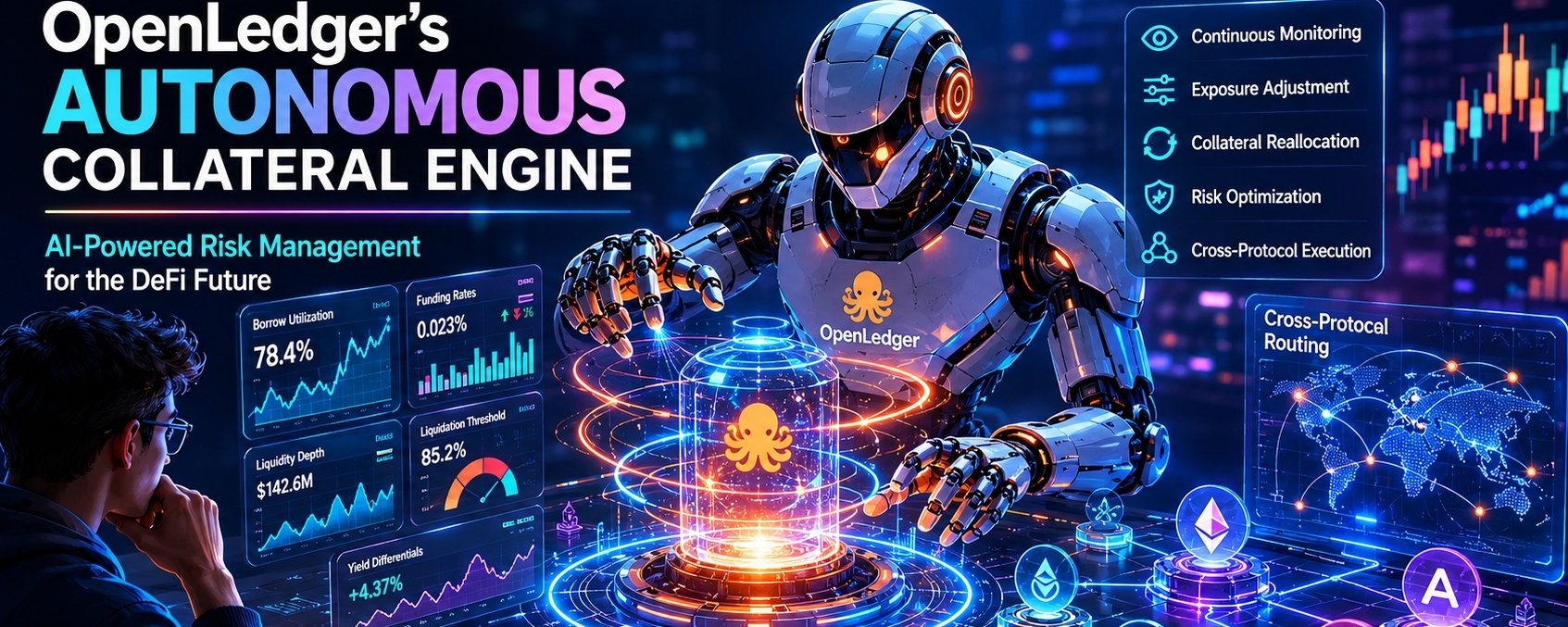
Late at night, I found myself drifting between different DeFi dashboards, watching numbers shift faster than I could process them. Every protocol seemed to carry its own kind of chaos. Borrow utilization changed within minutes, funding rates swung unpredictably, and liquidity moved from one pool to another almost without warning. That’s the uncomfortable reality of DeFi: everything is constantly in motion. Look away for a moment, and risk begins building quietly in the background before you even realize it.
In the middle of that uncertainty, OpenLedger’s Autonomous Collateral Engine feels like a different approach entirely. It isn’t just another monitoring tool. It acts as an automated layer that continuously tracks exposure, liquidation thresholds, liquidity depth, yield differentials, and borrowing activity across multiple protocols. Whenever imbalance starts forming, the system reacts on its own. Collateral gets repositioned, exposure is rebalanced, and capital keeps moving dynamically instead of sitting idle. Most of it happens silently in the background, almost unnoticed.
A few months ago, I was still managing lending positions manually. At the time, it felt like I was in control, but looking back, I was mostly reacting to problems after they appeared. Some positions stayed underutilized while others drifted dangerously close to liquidation. Every market movement created another layer of stress. What stood out about the Autonomous Collateral Engine was how unemotional it felt. It doesn’t panic, hesitate, or overestimate itself. It simply reads data, evaluates risk, and acts immediately.
The execution layer is probably the most impressive part of the system. Coordinating assets across fragmented liquidity pools, multiple chains, and different protocols is incredibly complex, yet the engine handles it in real time. If liquidity weakens somewhere or a protocol begins showing signs of stress, exposure is adjusted automatically. Hedging coordination, collateral routing, and capital reallocation happen continuously in the background, making manual management feel outdated by comparison.
Over time, I realized this technology is not really about chasing the highest APY anymore. The focus has shifted toward capital efficiency and sustainable exposure management. In DeFi, people often obsess over maximizing yield, but higher returns do not always mean smarter decisions. The Autonomous Collateral Engine approaches the market differently. Instead of aggressively chasing every opportunity, it prioritizes stability, healthy utilization, and controlled risk exposure.
That said, complete trust still feels difficult. No matter how advanced AI-driven systems become, markets remain unpredictable. There will always be situations where human intuition, unconventional judgment, or even timing could outperform automation. And that creates a subtle tension. On one side, automation removes a huge mental burden. On the other, it reminds you that control is slowly shifting away from humans and toward algorithms operating beneath the surface.
But maybe that is simply where DeFi is heading. Markets have become too fragmented, too fast-moving, and too complex for constant manual oversight. In that environment, a system capable of continuously managing exposure, reducing liquidation risk, and reallocating capital with discipline becomes more than a convenience — it becomes a necessity.
The engine is not flashy. It does not rely on hype or promise unrealistic returns. Its strength lies in consistency. Quietly containing risk, avoiding unnecessary exposure, and keeping capital efficient may not sound exciting, but those invisible adjustments are often what prevent major failures later on. And perhaps that is the real lesson hidden inside all of this: in DeFi, the systems that survive are not always the loudest ones, but the ones capable of maintaining discipline while everything around them moves chaotically.#OpenLedger $OPEN @Pixels