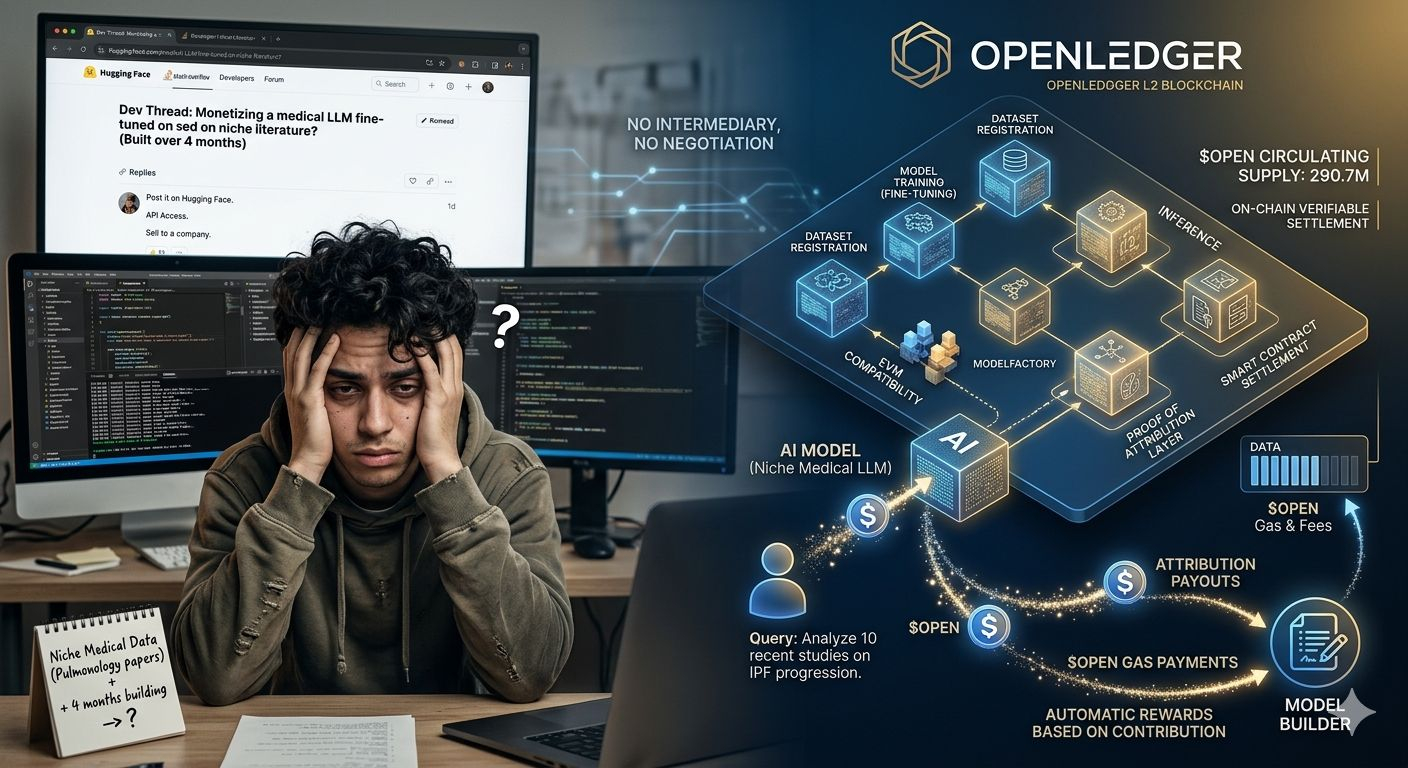
Had a weird moment earlier this week. Was scrolling through a dev thread where someone was asking how they could actually make money from an AI model they'd spent four months building. Good model. Fine-tuned on niche medical literature. The replies were mostly: "post it on Hugging Face," "charge API access," "sell it to a company."
Nobody had a clean answer. The model was useful. The builder got nothing.
I ended up closing the thread and going back to something I'd been sitting on — the OpenLedger documentation. I wasn't looking for anything specific. I just kept thinking about that question.
So I started reading through how the attribution layer actually works on their L2. And somewhere in there, something clicked in a way I didn't fully expect.
Here's the thing. Every conversation about OpenLedger and $OPEN leads with the same framing: it's accessible for AI builders. EVM-compatible. Familiar tooling. No-code model deployment through ModelFactory. Low friction entry. And that's all true — the OP Stack rollup design means any Ethereum developer can start building on it without relearning anything.
But I think that framing is pointing at the wrong problem.
Building an AI model was never that hard. The tooling ecosystem for training, fine-tuning, deploying — it's enormous. What was impossible — genuinely, structurally impossible — was getting paid for what the model does after it's deployed. Every inference. Every time someone's prompt hits your weights. Every time your training data shapes an output. That all happened invisibly. The value transferred, and nobody tracked it.
OpenLedger's Proof of Attribution system records that on-chain. Every dataset, every training step, every inference interaction — timestamped, verifiable, settled automatically through smart contracts. With 290.7M $OPEN currently in circulation and the network processing active inference activity, those attribution payouts run on gas — which means the settlement layer is live and moving.
The mechanism is cleaner than most infrastructure projects bother to be: a developer registers a model. A user runs an inference. Attribution fires. Rewards distribute automatically based on verified contribution. No intermediary. No negotiation. No revenue share agreement sitting in someone's inbox for six months.
That's not "accessible infrastructure." That's a business model that didn't exist before.
But here's the part that bothers me.
The attribution system works elegantly in theory. In practice, it only generates meaningful payouts if inference demand is actually high enough to sustain them. Right now, the OpenLedger ecosystem is early. The 50+ dApps in development are mostly still in development. ModelFactory is live, but model usage metrics aren't publicly granular enough to tell what real inference volume looks like versus testnet noise.
I genuinely don't know if a builder deploying a niche fine-tuned model today would see any attribution revenue worth talking about. The network needs liquidity on both sides — people running models and people running queries against them. One without the other and the payout mechanism is technically functional but economically hollow.
There's also the gas question. $OPEN is the native gas token on L2. Every interaction costs $OPEN. For high-volume models that sounds fine. For small specialized models running low query volume? The economics might not close. A medical literature model queried fifty times a month isn't going to generate attribution revenue that covers much.
And yet.
I keep coming back to that dev thread. That builder with the four-month model and no monetization path. Because the alternative — API subscriptions, enterprise deals, Hugging Face donations — those paths exist but they require distribution, salesmanship, or luck. None of them are baked into the model itself.
OpenLedger is trying to make the model the revenue unit. Not the product around the model. The model itself. When that actually scales, that changes who can afford to build seriously — not just the teams with enterprise sales pipelines but anyone who can produce something genuinely useful.
Whether the inference demand grows fast enough to validate that before the token unlock schedule introduces real supply pressure around September 2026 — that part I don't have an answer for yet.
Anyway. That dev thread got no good replies. Someone eventually just said "get a job at an AI company." Closing that tab felt different after reading the docs.