
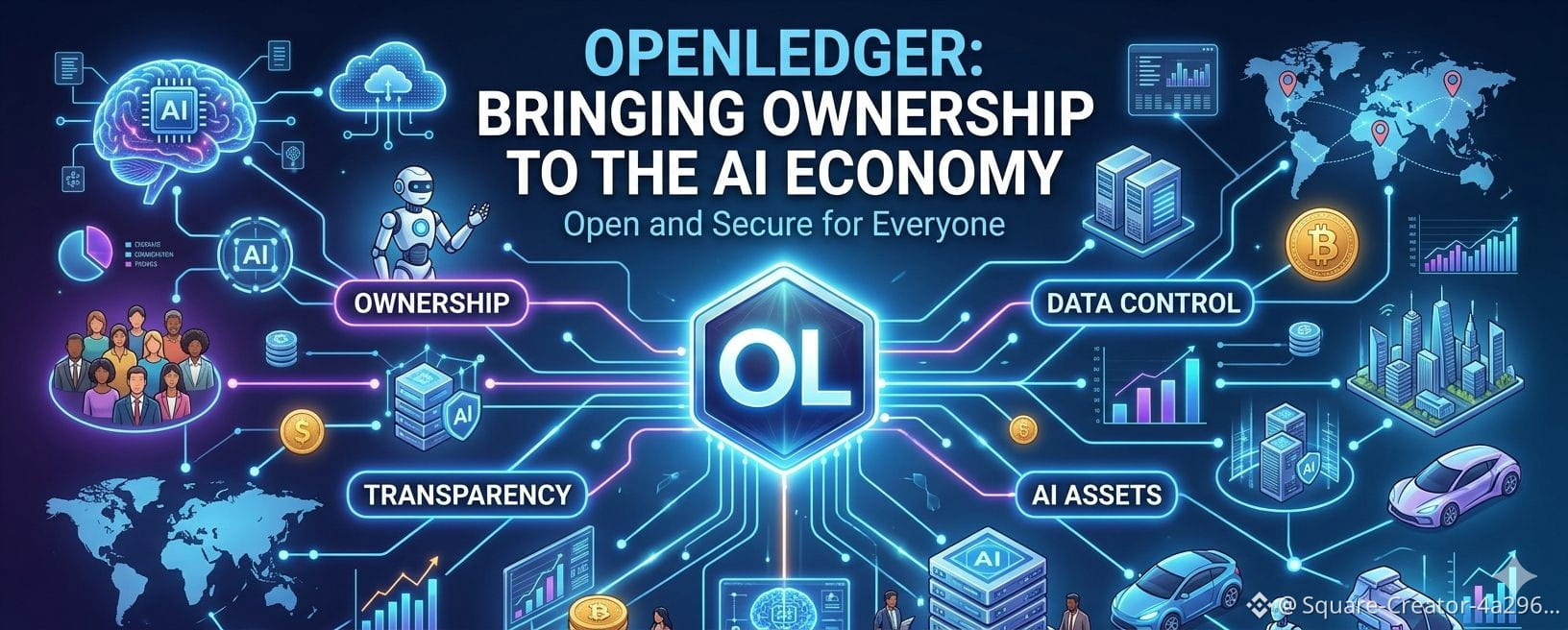
OpenLedger is interesting to me because it sits at the point where two big narratives are starting to overlap: artificial intelligence and on-chain ownership. For a long time, crypto has talked about giving users control over their assets, but AI has created a new kind of asset that is harder to measure: data, models, and agents.
The problem is simple, but important. AI systems need data to become useful. They need models to process that data. They need agents to act on top of those models. But in most of today’s AI economy, the people who contribute useful data or help improve intelligence often remain invisible. The value flows upward to large platforms, while the original contributors rarely get transparent credit or rewards.
That is where OpenLedger’s idea becomes relevant. It is trying to build an AI-focused blockchain where data, models, and agents can become trackable, usable, and monetizable. Instead of treating AI inputs like free raw material, OpenLedger wants to create an economy where contributions can be recorded and rewarded more transparently.
I think this matters now because the AI market is moving from general hype toward practical infrastructure. The first wave was about large models and impressive demos. The next wave may be about ownership, provenance, and specialization. If AI becomes part of finance, gaming, research, trading, customer service, and on-chain automation, users will need to know where the intelligence comes from and whether it can be trusted.
For crypto users, this is a familiar idea. Blockchain already gives us transparent transaction history. OpenLedger is applying a similar logic to AI contribution history. If a dataset helps train a model, or if a model powers an agent, there should be a way to trace that value flow. In theory, this could make AI less like a black box and more like an open economic network.
The strongest part of the OpenLedger narrative is that it is not only about “AI plus token.” Many projects attach AI branding to existing crypto ideas, but OpenLedger’s focus is more specific. It is trying to solve attribution and monetization, which are real problems in the AI industry. If creators, developers, researchers, and data providers can earn from useful contributions, the ecosystem could attract better quality inputs over time.
A simple comparison is YouTube. Creators upload videos because there is a system for distribution, audience growth, and monetization. AI data and model contributors do not yet have an equivalent open marketplace at scale. OpenLedger is attempting to move in that direction for AI assets.
The opportunity is clear. If AI agents become more common in Web3, they will need trusted data, specialized models, and transparent execution layers. A trading agent, for example, is only as useful as the data and logic behind it. A healthcare or legal AI model needs even stronger proof of quality and source reliability. In these areas, provenance is not a luxury; it is part of trust.
But I also think the risks should not be ignored. Building this kind of ecosystem is difficult. Tracking contribution quality is not easy. Not all data is valuable, and not every model deserves liquidity. There is also the challenge of adoption. Developers and AI builders will only use OpenLedger if it makes their work easier, cheaper, or more profitable than existing centralized options.
Another risk is market narrative. AI tokens can attract attention quickly, but attention alone does not create sustainable value. The project will need real usage, active builders, useful models, and a clear reason for the OPEN token to matter inside the ecosystem. Without that, the market may treat it as another short-term AI narrative trade.
My balanced view is that OpenLedger is worth watching because it targets a real structural issue: how AI value is created, tracked, and shared. If the team can turn the concept into working infrastructure with meaningful adoption, it could become part of the next phase of decentralized AI. But the execution gap is large, and investors should separate the long-term idea from short-term price excitement.
For me, OPEN is not just a token story. It is a test of whether crypto can bring ownership and transparency to one of the fastest-growing industries in the world. That makes the project relevant, but not risk-free.
#OpenLedger @OpenLedger $OPEN
-6.21%