
If you’ve been in crypto long enough, you start noticing a pattern.
Every cycle begins with excitement around consumer-facing narratives. In one era it was payments. Then it became smart contracts. After that came DeFi, NFTs, and endless variations of “the next internet.” Now the spotlight has shifted toward AI.
But beneath the noise, the real value has almost always been created at the infrastructure layer.
That’s the part newer participants often overlook. Markets tend to obsess over applications first because they are easier to understand. Infrastructure feels slower, less emotional, and sometimes even boring. Yet over time, infrastructure is usually what survives. It’s what developers build around, what businesses quietly integrate, and what eventually shapes the next generation of digital systems.
From my perspective, that’s where projects like OpenLedger become interesting.
Not because they promise overnight disruption, but because they are trying to solve a structural issue that is becoming impossible to ignore: AI systems need economic coordination, ownership frameworks, and scalable data liquidity if they are going to operate sustainably in the real world.
And that conversation is much bigger than price charts.
---
The AI Boom Is Creating a New Infrastructure Problem
Right now, AI is moving through the same chaotic growth phase crypto experienced years ago.
Everyone wants the outputs. Few people are paying attention to the systems underneath.
Most users interact with AI through polished interfaces. They ask questions, generate images, automate workflows, or create content. But behind every AI model sits an enormous infrastructure stack involving compute power, training datasets, contributors, APIs, model optimization, inference layers, and increasingly autonomous agents.
That stack is expensive.
More importantly, it is becoming centralized very quickly.
A handful of companies currently control massive portions of AI training infrastructure and data access. That creates efficiency, but it also creates dependency. If you’ve watched multiple tech cycles unfold, you know dependency eventually becomes friction.
This is where blockchain infrastructure begins to matter again—not as a speculative asset class, but as a coordination mechanism.
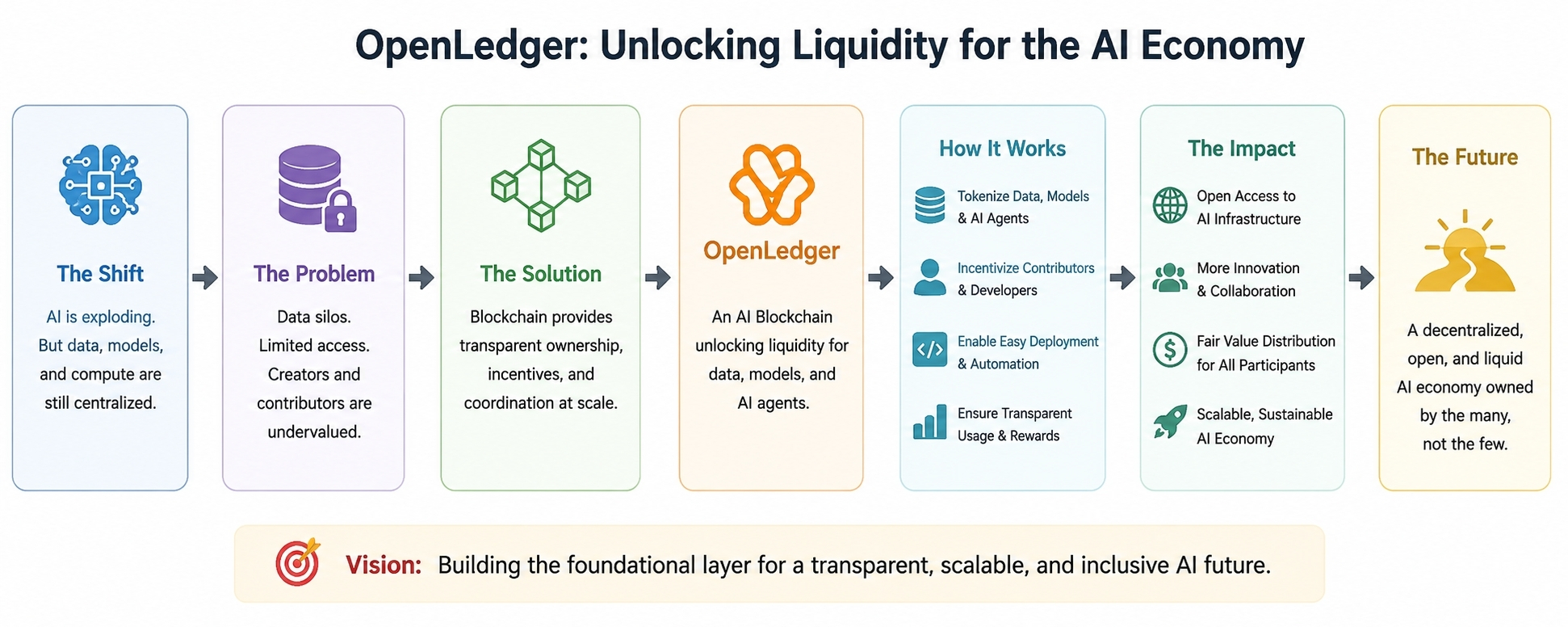
OpenLedger’s core idea revolves around unlocking liquidity around data, models, and AI agents themselves. In simple terms, it is attempting to create a system where AI-related assets and contributions can be monetized, exchanged, deployed, and coordinated more openly.
That sounds abstract at first, but the implications are practical.
Imagine a future where independent developers train specialized AI models for healthcare, logistics, gaming, or finance. Those models need access to datasets, validation systems, payment rails, deployment infrastructure, and usage tracking. Traditional systems can handle parts of that process, but they often struggle with transparent ownership and incentive alignment across decentralized participants.
Blockchain networks, when designed correctly, can solve coordination problems remarkably well.
That’s something experienced users understand differently now compared to earlier market cycles.
Back in 2021, many people treated blockchains like speculative casinos attached to unfinished products. Today, more developers are approaching them as settlement and coordination layers for machine-driven economies.
That shift matters.
---
Why “Data Liquidity” Is More Important Than Most People Realize
One phrase that stands out in OpenLedger’s positioning is “unlocking liquidity.”
In traditional finance, liquidity usually refers to how easily assets can move through markets. In AI infrastructure, liquidity increasingly applies to information, computation, and model accessibility.
Think about data for a moment.
Most valuable AI systems are built on enormous amounts of structured information. But the current ecosystem is fragmented. Data sits inside private silos. Contributors often receive little long-term value. Smaller developers cannot compete with companies that own massive proprietary datasets.
What stands out to me is that OpenLedger appears to be approaching this issue from an infrastructure-first perspective instead of purely a consumer application angle.
That distinction is important.
Infrastructure projects tend to ask questions like:
How do you make deployment easier?
How do you reduce friction for developers?
How do you automate coordination between systems?
How do you incentivize participation without creating unsustainable token economics?
Those are harder questions than simply launching another AI application.
If you’ve ever worked around backend systems or cloud infrastructure, you know adoption rarely comes from flashy interfaces alone. It comes from reliability, scalability, interoperability, and ease of integration.
The same logic applies here.
A decentralized AI economy cannot function if every interaction is expensive, slow, or technically inaccessible. Developers will simply return to centralized providers because convenience wins most of the time.
That’s one of the biggest lessons this industry learned after previous cycles.
Technology alone is never enough.
Usability matters just as much.
---
The Difference Between Narrative Projects and Structural Projects
Crypto markets often confuse narratives with foundations.
Narratives move fast. Foundations compound slowly.
During bull markets, almost every project claims to be building “infrastructure.” But if you’ve observed enough cycles, you start filtering projects differently. You look less at branding and more at architectural direction.
Does the project solve a real coordination issue?
Can developers realistically build on top of it?
Does it improve efficiency somewhere in the stack?
Is the economic model sustainable beyond speculation?
Those questions become more important over time.
From my perspective, OpenLedger’s focus on AI agents and monetizable model ecosystems aligns with where the broader market may eventually move. Not immediately, and certainly not in a straight line, but structurally.
AI agents are becoming increasingly capable of handling repetitive digital tasks autonomously. Over the next several years, these agents will likely interact with APIs, marketplaces, data layers, payment systems, and each other.
Once that happens, questions around ownership and economic participation become unavoidable.
Who owns the outputs?
Who gets paid when an agent uses a dataset?
How do contributors verify usage?
How are incentives distributed across decentralized networks?
Traditional infrastructure can answer some of these questions. Blockchain systems may answer others more efficiently.
That intersection is where OpenLedger seems to be positioning itself.
---
Scalability Is No Longer Optional
One of the harsh realities of crypto infrastructure is that most systems work beautifully in theory until real usage arrives.
Then everything breaks.
Fees spike. Networks slow down. Automation becomes unreliable. User experience deteriorates.
This is why scalability discussions matter more today than they did a few years ago.
In earlier cycles, many investors were satisfied with vision alone. Now developers and experienced users want proof of execution. They want systems capable of handling real deployment conditions.
That maturity is healthy for the industry.
OpenLedger’s long-term relevance will ultimately depend less on branding and more on whether it can create scalable environments for AI coordination. That includes transaction throughput, efficient automation layers, accessible developer tooling, and sustainable operational costs.
Because the reality is simple:
AI systems generate enormous activity volumes.
If autonomous agents become widely adopted, infrastructure networks may process machine-to-machine interactions at scales far beyond normal retail user activity. That requires a completely different level of architectural thinking.
And honestly, that’s where many blockchain projects still struggle.
The infrastructure challenge ahead is not just about speed. It’s about reliability under constant automated demand.
---
Experienced Market Participants Are Thinking Differently Now
One thing I’ve noticed after multiple cycles is that veteran users become less emotional over time.
They stop chasing every trend.
They pay more attention to systems that quietly integrate into broader technological shifts.
Years ago, many crypto investors focused almost entirely on token appreciation. Today, a growing portion of the market evaluates developer ecosystems, deployment utility, network participation, and infrastructure relevance.
That evolution reminds me of the early internet.
In the late 1990s, most people focused on websites they could see. Few paid attention to cloud architecture, backend protocols, or database infrastructure. Yet those invisible layers ultimately became trillion-dollar industries.
Crypto may be moving through a similar transition now.
The loudest narratives still dominate headlines, but the quieter infrastructure layers may end up carrying the most lasting value.
That does not mean every AI-blockchain project succeeds. Far from it.
In fact, many will fail.
Some will overpromise technical capabilities. Others will struggle with adoption. Some may never solve the balance between decentralization and efficiency.
Those risks are real and should be acknowledged honestly.
OpenLedger itself still faces the same fundamental challenge every infrastructure protocol faces: turning vision into active ecosystem usage.
That’s never guaranteed.
---
The Human Side of This Transition
What makes this cycle different is that AI feels personal to people in a way previous crypto narratives often did not.
Automation changes how people work, create, communicate, and earn income. That naturally creates both excitement and anxiety.
From my perspective, the most important infrastructure projects will be the ones that reduce friction while still allowing broader participation in the value creation process.
That’s ultimately why decentralized AI discussions matter.
Not because decentralization is automatically superior, but because concentration of intelligence infrastructure creates long-term systemic risks.
If only a small number of entities control the models, datasets, and economic rails powering AI systems, innovation eventually narrows.
Open ecosystems tend to produce more experimentation.
And experimentation is where meaningful breakthroughs usually come from.
---
Final Thoughts
What stands out to me about OpenLedger is not the short-term narrative surrounding AI tokens. Markets will always rotate through trends, and sentiment will always fluctuate.
The more important question is whether projects like this are contributing to a larger infrastructure transition.
If you’ve been in this space long enough, you learn that the strongest technologies are often the ones solving invisible problems before the broader market fully recognizes them.
OpenLedger’s attempt to build liquidity and coordination around AI data, models, and agents reflects a much deeper shift happening across both crypto and artificial intelligence.
The industry is gradually moving away from isolated applications and toward interconnected machine economies.
That transition will take time. It will involve failures, experimentation, and probably several more hype cycles along the way.
But beneath all the volatility, the infrastructure layer keeps evolving quietly in the background.
And in crypto, that’s usually where the most important stories begin.
