
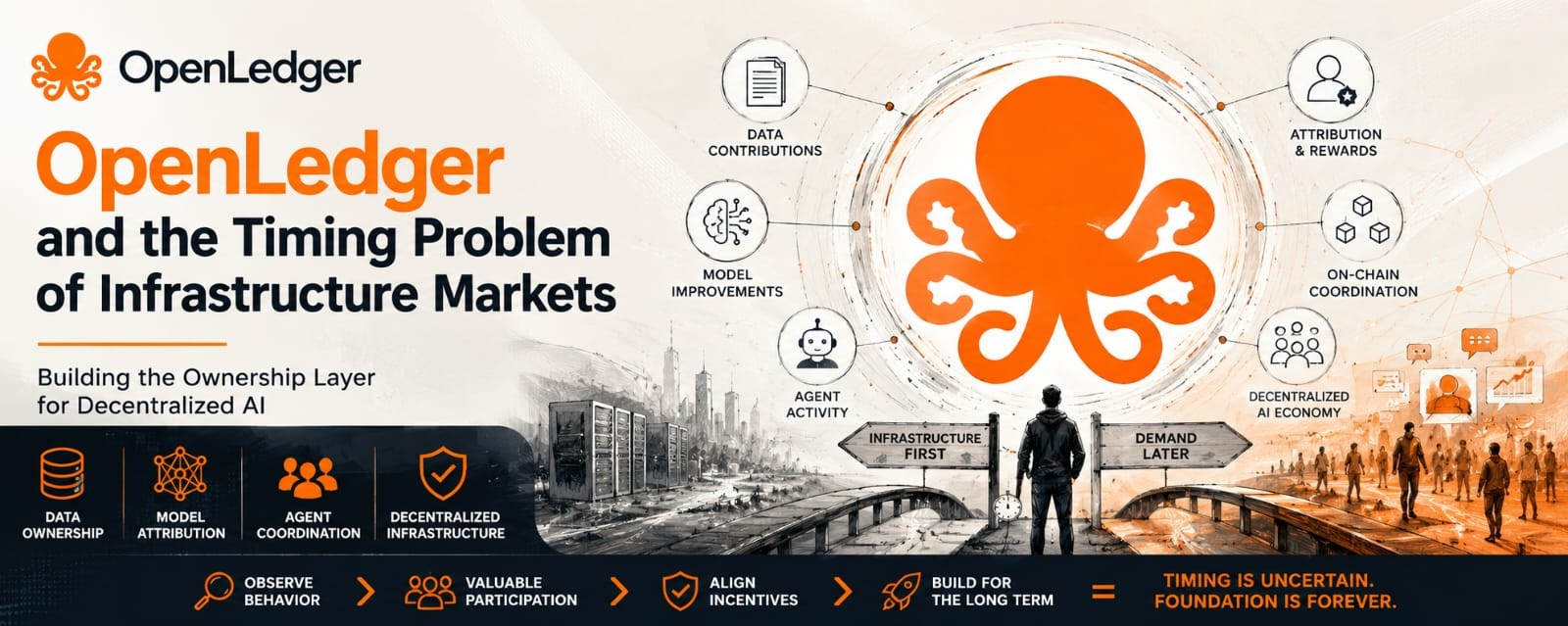
I stopped treating crypto narratives the way I used to sometime last year.
There was a period where I believed markets were mostly rational if you gave them enough time. A project launched, people debated fundamentals, utility emerged, and eventually price reflected something close to reality. That story became harder to believe after watching cycle after cycle reward confidence long before usefulness arrived.
Now I pay attention to different signals.
I watch what people still struggle to explain months later. I watch whether contributors stay once rewards cool off. I watch whether behavior changes or whether people just repeat better marketing language.
That shift is partly why I keep circling back to OpenLedger.
Not because I think it already solved decentralized AI. Honestly, I am not even convinced most people fully understand the problem it is trying to address. But sometimes markets identify pressure points before users can describe them clearly.
A few months ago, this happened to me in a way that felt strangely ordinary.
I was helping a friend organize research material for a small side project. Nothing dramatic. We spent days collecting information, refining prompts, correcting outputs, filtering bad responses, and improving workflows around different AI tools. Somewhere in the middle of that process, I noticed something uncomfortable.
We were creating value constantly.
Every correction improved outcomes. Every repeated workflow generated better structure. Every interaction became training-like behavior for systems we didn’t own.
My friend laughed when I brought it up and said, “Feels like unpaid labor with extra steps.”
It sounded dramatic at first, but the thought stayed with me.
That feeling matters because OpenLedger seems built around a simple observation: data, models, and AI coordination might eventually become assets instead of invisible background activity.
At a fundamental level, OpenLedger is trying to create infrastructure where fragmented contributions—datasets, model improvements, agent activity—can be organized and attributed inside a blockchain-based system. Instead of value disappearing into centralized black boxes, the theory is that contributors receive clearer ownership and participation.
The market understood this narrative almost immediately.
AI plus blockchain already carries enough momentum to attract attention. Add concepts like ownership, attribution, coordination, and decentralized intelligence, and people naturally start pricing future potential into present expectations.
Markets are unusually good at this.
They price abstractions early.
Sometimes painfully early.
But here is where I think the interesting tension appears.
Behavior changes much slower than narratives.
Most people still treat data casually. We leak information constantly without thinking about ownership. AI models are tools we consume, not systems we meaningfully contribute toward. Agents remain more discussion topic than daily necessity. Even inside crypto, participation often stops where complexity begins.
That gap matters.
OpenLedger’s structure assumes users will eventually care about data provenance, model attribution, and coordinated AI economies. Yet right now, many people simply want faster outputs and cheaper access.
There is a real possibility the infrastructure arrives before habits do.
Oddly enough, I do not see that as automatic failure.
History tends to move awkwardly.
I remember noticing something similar during early cloud infrastructure conversations. Back then, plenty of businesses insisted local servers were enough. Why move operations elsewhere if current systems worked fine? Yet over time, convenience quietly changed expectations. What felt unnecessary slowly became invisible infrastructure.
I am not saying OpenLedger follows that exact path.
Different technologies fail for different reasons.
But infrastructure projects often look premature until conditions suddenly make them feel obvious.
That said, skepticism matters here.
One thing I learned from following AI-related crypto projects is that compelling narratives can hide weak coordination. A strong idea does not guarantee user retention. Incentives can attract temporary attention while masking shallow engagement underneath.
When I look at OpenLedger, I keep asking practical questions.
Will contributors still participate if incentives shrink?
Will people genuinely value ownership over data contributions?
Can decentralized coordination compete with centralized systems already moving at scale?
Those are uncomfortable questions, but necessary ones.
Recent ecosystem developments suggest OpenLedger continues pushing toward building around decentralized AI coordination, attribution systems, and model ecosystems rather than chasing purely speculative attention. That consistency stands out because many projects quietly pivot once narratives cool down.
Still, consistency alone is not enough.
The hardest challenge may not be technology.
It may be patience.
Infrastructure projects often require users to care about problems before users actually feel the pain of ignoring them. That timing mismatch destroys plenty of good ideas.
Sometimes markets anticipate too early.
Sometimes they dismiss entirely.
And occasionally, they sit in that strange middle ground where conviction exists but behavior has not caught up.
That feels close to where OpenLedger sits today.
Visible enough to stay relevant.
Uncertain enough to remain misunderstood.
I noticed something else recently while watching conversations around decentralized AI.
People speak about inevitability as though repetition creates certainty.
“AI needs data.”
“Agents need coordination.”
“Models need distribution.”
All true in theory.
But theory does not automatically create demand.
Execution matters. Timing matters. User behavior matters even more.
For anyone watching projects like OpenLedger, my practical advice is simple: ignore polished narratives for a moment and observe participation patterns instead. Watch whether contributors return voluntarily. Watch whether builders keep shipping when attention fades. Watch whether the ecosystem solves friction instead of just describing it.
That usually reveals more than price charts ever will.
I still do not know whether OpenLedger becomes foundational infrastructure or simply another ambitious experiment that arrived too early.
Both outcomes remain possible.
But I keep watching because markets have a habit of making two expensive mistakes: dismissing uncomfortable ideas too quickly and confusing exciting narratives with certainty.
The distance between those mistakes is smaller than most people think.
So I am curious—when you look at projects like OpenLedger, do you think infrastructure should arrive before demand exists, or should markets wait until people actually feel the problem first? And what signals make you believe a system is early rather than simply unnecessary?
$OPEN @OpenLedger #OpenLedger $NIL $SUPER #TrumpSaysIranDealLargelyNegotiated #BitcoinRisesOnIranPeaceDeal #RussiaExpandsMinerInfoRequirements #StablRDepegsAfterAttack
