I keep noticing how markets keep rewarding intelligence narratives as if intelligence alone is the bottleneck.
Faster model. Bigger context window. Better reasoning benchmark. Cleaner demos.
And maybe that made sense for a while.
But when I actually look at where trust starts breaking in real usage, the failure rarely feels like raw intelligence failure anymore. It feels more like reliability decay.
That distinction keeps bothering me.
A smart AI that behaves unpredictably in production is a weird asset. Almost like owning a Formula 1 car that occasionally forgets how brakes work. The performance stats look incredible right until reliability becomes the only metric that matters.
Which makes me wonder whether OpenLedger is being framed incorrectly.
Most people seem to look at AI infrastructure and assume the economic layer should map directly to intelligence growth. More compute, more usage, more model demand, more token relevance. Clean story.
Too clean.
Because intelligence is becoming increasingly abundant, or at least increasingly commoditized. Models improve. Open-source alternatives compress margins. API competition pushes pricing lower. Even if frontier capabilities remain scarce, “good enough” intelligence keeps getting cheaper.
Reliability does not seem to follow the same curve.
Actually, reliability may become more expensive.
And I do not mean uptime in the boring infrastructure sense. Not server availability. I mean behavioral reliability. Provenance reliability. Decision reliability. Economic reliability.
Can this system explain why it produced something?
Can contributors be traced?
Can permission claims still be verified six months later?
Can a machine agent act without inheriting contaminated assumptions?
Can anyone audit what actually happened when something expensive breaks?
That starts looking less like intelligence infrastructure and more like trust infrastructure.
Different market.
I originally thought OpenLedger was mostly an attribution story. AI contributors get recognized, datasets become economically visible, builders can source verified inputs. Reasonable framing.
But attribution by itself can be decorative.
A beautiful receipt is not the same thing as operational reliability.
This is where the idea shifts for me.
What if attribution is not the product?
What if attribution is just the evidence layer required to sell reliability?
That changes how I think about $OPEN.
Because raw intelligence tends to monetize through access. Subscription fees. API usage. Compute it's contracts.
Reliability monetizes differently.
Reliability monetizes through repeated verification.
That repetition matters.
A one-time proof has weak economics. Ongoing trust checkpoints are a different machine entirely.
Imagine autonomous AI agents operating across commercial workflows. Procurement approvals. Financial analysis. Research synthesis. Automated negotiations.
Now imagine one of those agents makes a damaging decision.
The immediate question is not “How intelligent was the model?”
Nobody serious asks that first.
The question becomes uglier.
What data influenced this?
Who contributed that data?
Were permissions valid?
Was synthetic contamination introduced?
Did the agent inherit stale assumptions?
Who is economically accountable?
That sounds like legal infrastructure. Maybe compliance infrastructure.
But increasingly it may become transaction infrastructure.
Because repeated uncertainty creates recurring settlement demand.
And that may be where OpenLedger gets structurally interesting.
Not as AI horsepower infrastructure.
As AI reliability infrastructure.
Still, something feels incomplete here.
Because reliability only becomes economically valuable if someone actually pays for uncertainty reduction.
That sounds obvious. But crypto markets routinely price theoretical utility long before real buyers appear.
So who pays?
Developers?
Enterprise users?
Agent operators?
Auditors?
Insurance structures?
Machines paying other machines?
I can sketch multiple diagrams for this thesis, which usually means the idea is visually coherent. Economic flow map. Trust checkpoint loop. Reliability is on settlement stack.
Visual clarity is not business model of proof.
That distinction matters.
Another concern: reliability can be bypassed.
This happens constantly in infrastructure markets.
If verification becomes slow, expensive, or operationally annoying, participants route around it. Private agreements replace public settlement. Internal trust teams replace protocol rails. Legal contracts absorb ambiguity off-chain.
Then the token captures narrative, not necessity.
That risk feels real.
Because the strongest infrastructure is often invisible precisely because nobody notices the friction it removes. But if OpenLedger adds visible friction rather than removing operational uncertainty, adoption gets weird.
Then again... maybe friction is actually the product.
That sounds contradictory, but hear me out.
Cheap AI systems are increasingly flooded with low-quality synthetic data, duplicated training material, unverifiable outputs, probabilistic confidence theater.
Reliability might require introducing intentional economic friction.
A checkpoint.
A cost.
A reason to behave carefully.
In that model, $OPEN is not removing friction. It is pricing disciplined participation.
That is a very different token story.
Less “pay for access.”
More “pay to remain trusted.”
Interesting.
Potentially dangerous too.
Because systems that monetize trust can drift into gatekeeping. High-quality verification for those who can afford it. Lower-trust parallel markets for everyone else.
We already see versions of this in traditional finance.
Trusted actors borrow cheaply. Untrusted actors pay hidden penalties.
Would AI reliability markets replicate that structure?
Feels plausible.
And if autonomous agents become meaningful economic participants, reputation may behave like machine credit scoring.
That sounds futuristic until you realize ad auctions, recommendation systems, and fraud filters already make machine trust judgments constantly.
OpenLedger might simply formalize that economic layer.
Or maybe not.
Another issue sits underneath all this.
Reliability is difficult to measure before failure.
Intelligence can be benchmarked in demos.
Reliability reveals itself under pressure.
Production incidents. Edge cases. Economic disputes. Model drift. Data contamination.
Markets love measurable narratives.
Reliability is messy and slow.
Which means token markets might overprice the story long before real operational demand appears.
Seen that before.
Infrastructure narratives can trade beautifully while underlying economic loops remain mostly imaginary.
So I keep coming back to the same uncomfortable question.
If intelligence keeps getting cheaper, maybe reliability becomes the scarce asset.
But scarcity alone does not create token demand.
Only repeated economic dependency does.
And I am not fully convinced the market knows the difference yet.
Maybe $OPEN becomes infrastructure for machine trust settlement.
Or maybe reliability remains something enterprises prefer solving privately, far away from tokenized coordination.
That part is still unresolved.
Maybe that is exactly the real trade.

Artikel
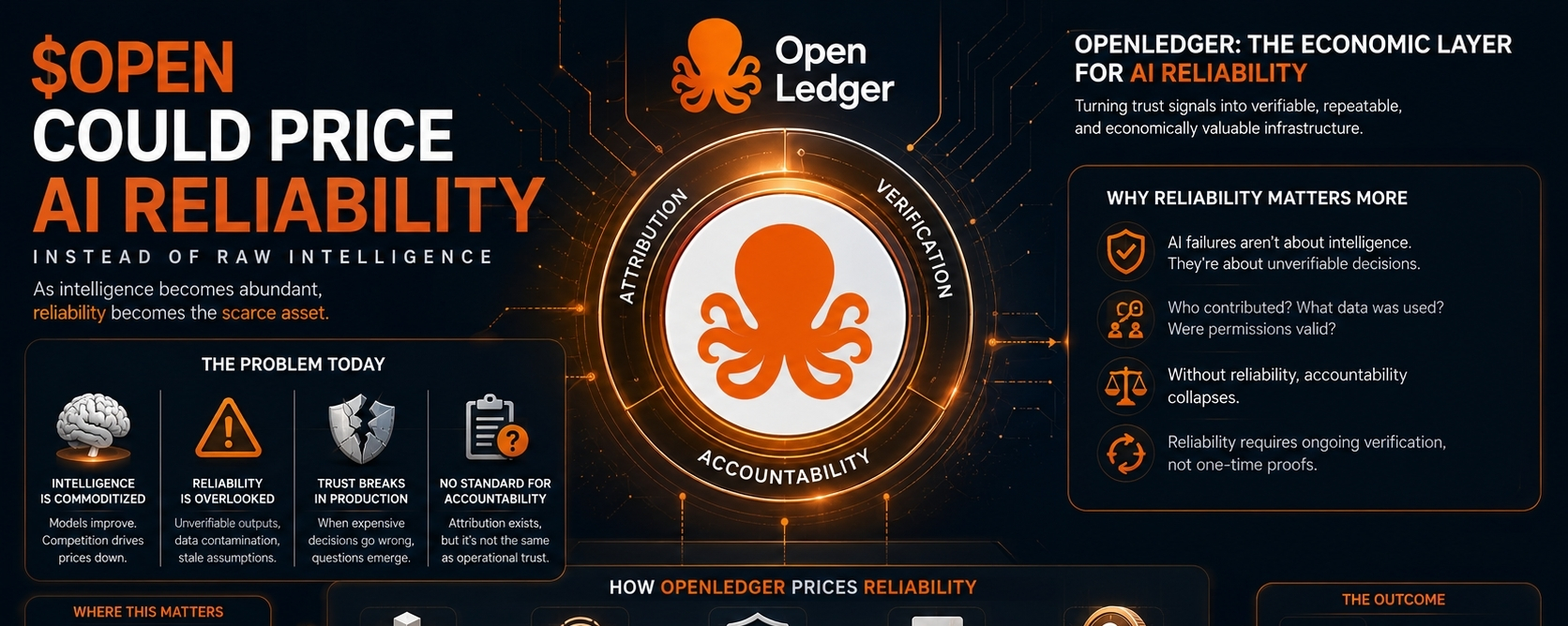
$OPEN Could Price AI Reliability Instead of Raw Intelligence
Haftungsausschluss: Die hier bereitgestellten Informationen enthalten Meinungen Dritter und/oder gesponserte Inhalte und stellen keine Finanzberatung dar. Siehe AGB.