
I’ve been noticing lately how difficult it’s become to take new crypto narratives seriously. The market moves so fast now that entire sectors appear out of nowhere, dominate conversations for a few weeks, and then quietly disappear when people move on to the next trend. One minute everyone is obsessed with meme coins, then it’s AI, then modular chains, then tokenized assets, then something else entirely. After watching this cycle repeat for years, you naturally become a little more cautious about projects claiming they’re about to change everything.
That’s honestly how OpenLedger (OPEN) first looked to me too.
At a glance, it felt like another protocol trying to combine AI and blockchain because those are the two biggest buzzwords in the industry right now. Crypto has a habit of attaching itself to whatever technology is attracting attention outside the space. Sometimes there’s real substance underneath it, and sometimes it’s just marketing dressed up as innovation. It can be hard to tell the difference early on.
But after spending a little more time looking into OpenLedger, the idea behind it started feeling more grounded than most of the projects floating around lately.
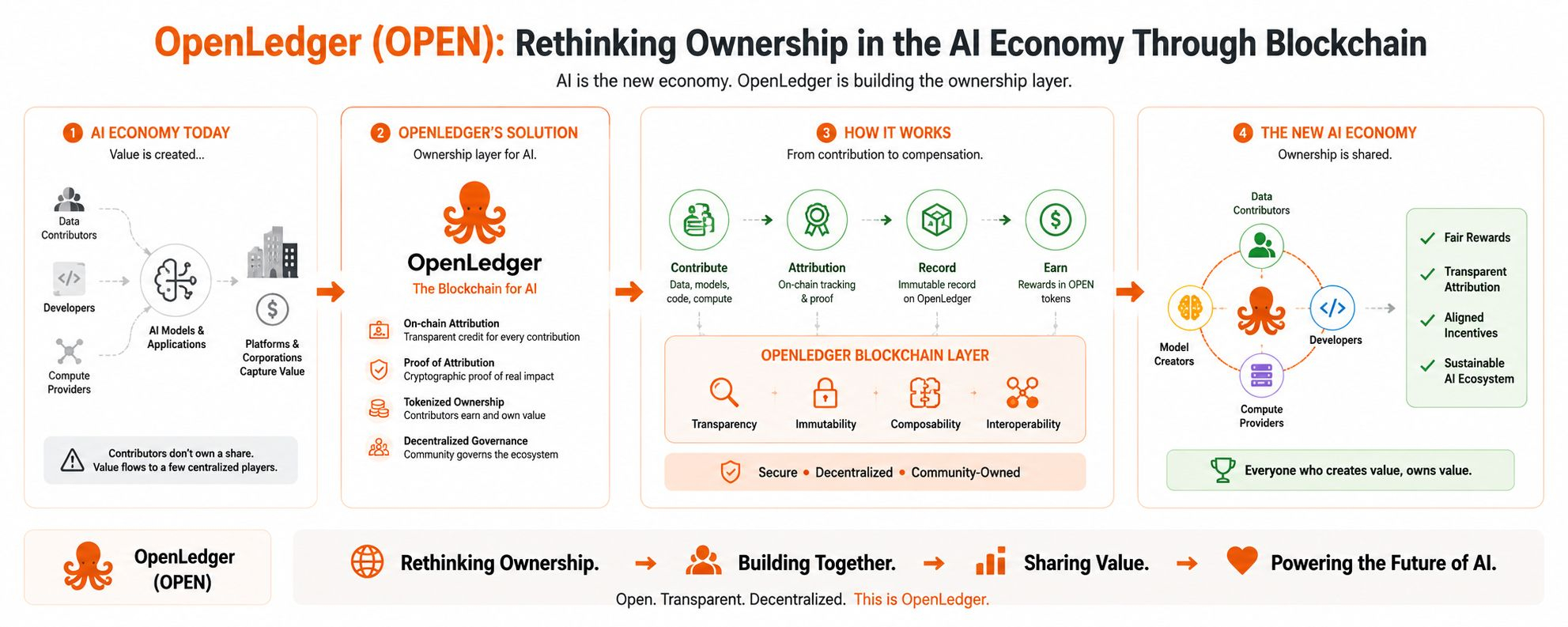
The basic concept isn’t actually that complicated. AI systems need massive amounts of data, models, and constant interaction to improve. Meanwhile, the people contributing value to those systems usually don’t own much of the upside. Large companies collect the data, build the infrastructure, and keep most of the economic rewards inside closed ecosystems. OpenLedger seems to be exploring the idea that maybe these AI resources — data, models, even AI agents themselves — could become assets people are able to monetize more openly instead of everything being controlled by a handful of centralized players.
When you strip away the crypto terminology, it’s really about ownership and participation. If people are helping train systems that eventually become valuable, should they have a way to benefit from that value too? That question feels more real than a lot of the artificial problems crypto projects try to solve.
At the same time, this is where the practical side of my brain starts asking harder questions.
Because crypto is very good at imagining future systems. It’s much less consistent at building products ordinary people or businesses actually adopt at scale. There’s a huge gap between a compelling idea and real-world implementation. Especially when AI, regulation, intellectual property, and enterprise infrastructure all collide together.
Traditional industries don’t move with the same speed crypto does. Crypto communities often expect adoption to happen almost instantly if the concept sounds exciting enough. But companies dealing with sensitive data and AI models tend to move carefully. Legal concerns alone can slow development for years. And outside crypto circles, most businesses still care more about reliability and simplicity than decentralization narratives.
That doesn’t mean OpenLedger can’t work. It just means the road is probably much harder than people on social media make it sound.
I also think the market itself has become conditioned to overreact to anything connected to AI. Sometimes it feels like projects barely need a working product anymore if they can attach themselves to the right narrative at the right moment. That creates a strange environment where speculation often moves faster than actual utility. You see tokens gain attention long before the underlying systems are proven.
Still, I can’t completely dismiss what OpenLedger is attempting either.
The idea of creating liquidity around AI-related assets does feel connected to where technology is heading. AI is becoming part of everyday business operations, content generation, automation, research, and software itself. Questions around ownership, incentives, and contribution probably become bigger over time, not smaller. In that sense, OpenLedger at least seems pointed toward a real conversation instead of inventing a completely fictional use case just to support a token economy.
Maybe that’s why it stayed on my radar longer than most projects do.
Not because it guarantees success. Not because it suddenly solves the problems crypto has struggled with for years. But because underneath the usual industry noise, there’s at least an attempt to address something tangible. Whether the execution ever fully matches the vision is another question entirely.
And honestly, that’s probably the healthiest way to look at projects like this now. Not with blind optimism, but not with total cynicism either. Maybe OpenLedger becomes important later on. Maybe it fades away like countless other protocols before it. But at the very least, it’s trying to explore a problem that actually exists, which already makes it more interesting than most of the empty narratives constantly passing through this market.