
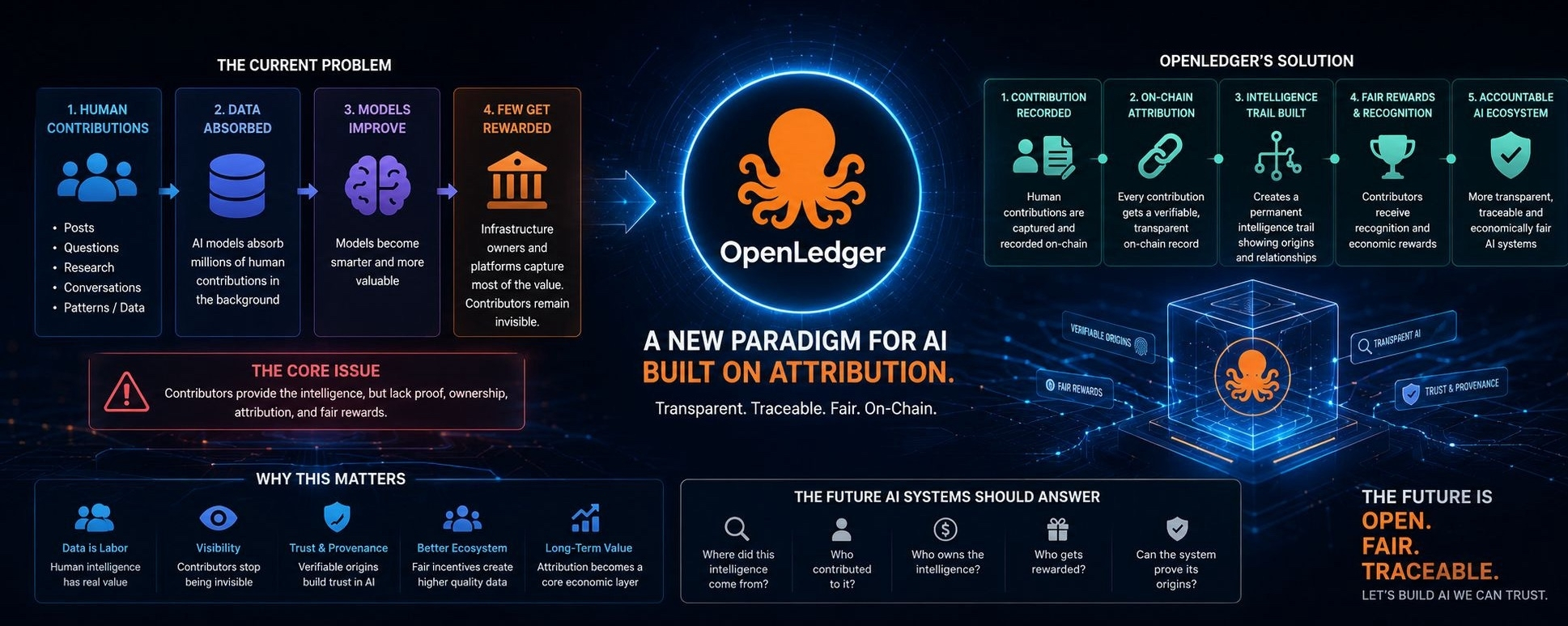
Most AI platforms hide attribution.
OpenLedger records it on-chain.
I saw someone ask a brutal question yesterday:
“If AI learns from millions of people… why do only a few companies get rich from it?”
And honestly?
I couldn’t stop thinking about it.
Because most of us are already feeding AI every single day without even realizing it.
We post.
We write.
We answer questions.
We create patterns.
We generate data.
Then giant models absorb everything quietly in the background… and somehow the original contributors become invisible.
No proof.
No ownership.
No attribution.
That part always felt strange to me.
And maybe that’s exactly why @OpenLedger started standing out differently from most AI projects in crypto.
Because while almost every platform keeps AI training hidden behind centralized systems, OpenLedger is trying to make contribution itself visible on-chain.
Not just the final AI output.
The actual intelligence trail behind it.
And the more I thought about that…
the bigger it started feeling.
Most people still treat data like some free resource floating around the internet forever.
But data is labor.
Human conversations are labor.
Research is labor.
Patterns are labor.
Knowledge is labor.
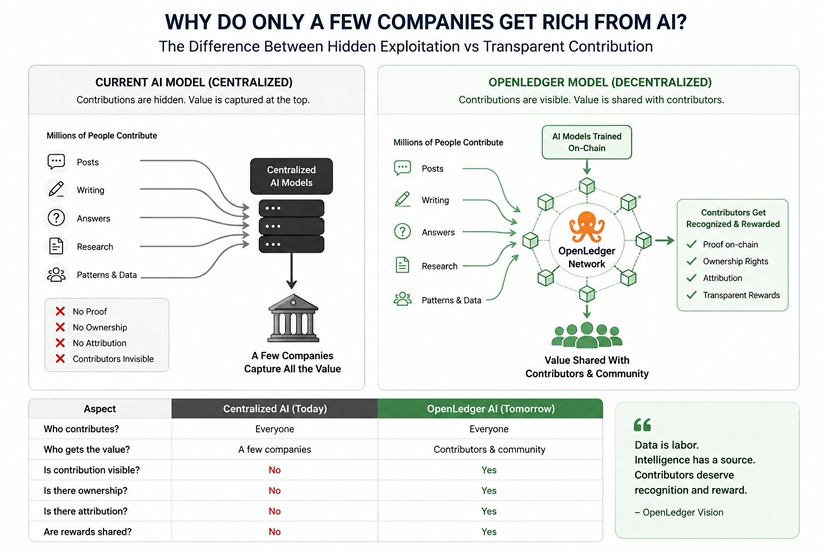
AI models become valuable because millions of humans unknowingly contribute pieces of intelligence over time.
Yet the current system rewards infrastructure owners far more than the contributors themselves.
That imbalance is becoming impossible to ignore.
And honestly, I think #OpenLedger is quietly building around one of the biggest problems AI will face in the future:
How do you prove where intelligence came from?
That question sounds simple right now…
But it could become one of the most important conversations in tech over the next few years.
Because once AI starts powering everything —
search,
finance,
content,
trading,
automation,
development,
agents,
even governance systems —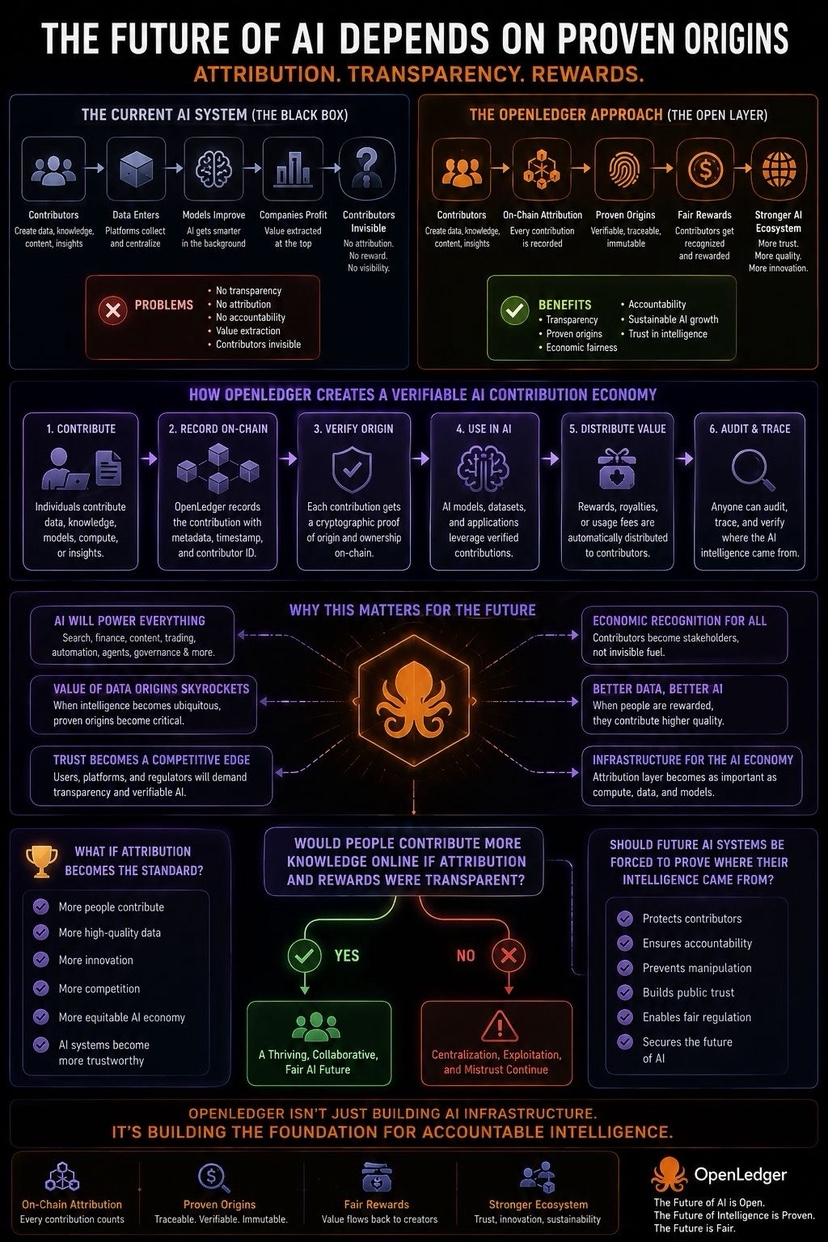
the value of verified data origins becomes massive.
OpenLedger’s approach feels important because it doesn’t just focus on making AI “smarter.”
It focuses on making AI ecosystems more accountable.
More transparent.
More traceable.
More economically fair.
That’s a huge difference.
Most AI systems today operate like black boxes.
Data enters.
Models improve.
Companies profit.
But nobody really sees the contribution layer underneath.
@OpenLedger flips that structure by bringing attribution and contribution records on-chain.
And weirdly…
that changes the emotional side of AI too.
Because contributors stop feeling invisible.
The internet spent years training people to create value for free while platforms quietly extracted it in the background.
OpenLedger feels like an attempt to redesign that relationship before AI scales even further.
And honestly?
That might matter more long term than model performance itself.
Because eventually people won’t only ask:
“How powerful is this AI?”
They’ll ask:
Who contributed to it?
Who owns the intelligence?
Who gets rewarded?
Can the system actually prove its origins?
That’s where OpenLedger feels early.
Not early in hype.
Early in architecture.
The project feels less like a normal AI token narrative and more like infrastructure for a future where data becomes a recognized economic asset.
And if that future actually happens…
on-chain attribution could become one of the most valuable primitives in AI.
Kinda crazy to think about honestly.
Would people contribute more knowledge online if attribution and rewards were transparent?
And do you think future AI systems should be forced to prove where their intelligence came from?
