
Honestly, this one keeps me up more than most things in crypto right now.
Not the price action. Not the macro. This.
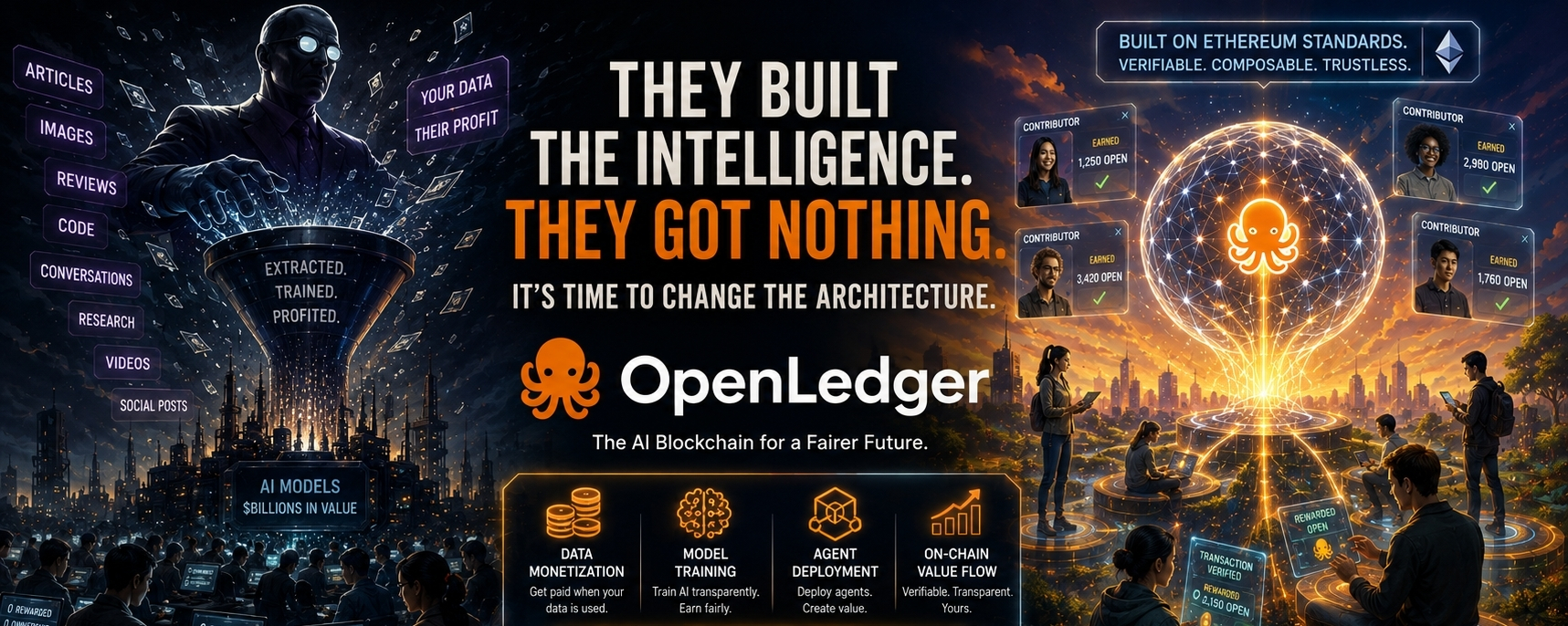
We are living through the largest extraction of human knowledge in history. Every time you label an image, correct a chatbot's mistake, write a review, post a take, teach something to someone online — that behavior becomes training data. It flows somewhere. It gets packaged. A model learns from it.
You see none of that value again.
Think about what that actually means. The doctors who wrote clinical notes for twenty years. The engineers who documented their code. The writers who published their thinking. The everyday people who just... existed online and created signal. All of that became the foundation of AI systems worth hundreds of billions of dollars.
None of them got equity. None of them got attribution. Most of them don't even know it happened.
And here is the uncomfortable truth underneath that: the people who built the intelligence didn't build the infrastructure to capture value from it. They just gave it away. Not because they chose to. Because there was no architecture that would have let them do anything else.
That is the real problem. Not that AI is powerful. Not that models are improving. The problem is that the entire stack was built to extract, not to return.
So I started asking myself — is anyone actually trying to fix the infrastructure problem instead of just talking about it?
Which is how I found @OpenLedger
I want to be careful here because I have been burned by projects that had a good whitepaper and a good pitch and then delivered nothing but disappointment and a worthless token. I have held bags that told a great story. I know how this can go.
But what caught my attention with OpenLedger wasn't a promise. It was a structural observation.
They are building an AI blockchain where data monetization, model training, and agent deployment happen entirely on-chain. Not off-chain with an on-chain layer on top. Not a hybrid where you have to trust some centralized server for the actual computation. The whole thing follows Ethereum standards completely, which matters because it means the tooling exists, the auditing exists, the composability exists. You are not starting from scratch with some proprietary runtime that nobody can verify.
The $OPEN token is how the system moves value — not as speculation on future promises but as the actual mechanism for contributors to be compensated when their data is used, when their models are accessed, when their agents run. The value capture is supposed to be structurally embedded, not added as an afterthought.
That distinction matters more than most people realize.
Most AI projects treat the token like a fundraising instrument. The actual product is somewhere else, built by a different team, running on infrastructure that the token never actually touches. The token is marketing. The product is separate. And when you zoom out, you realize the contributor — the person whose data or work made the model valuable — is still nowhere in the economic loop.
If the data monetization is actually on-chain, that changes something fundamental. It means the relationship between contribution and compensation can be verified. It means you don't have to trust a company's quarterly report. You can see what moved and when and to whom.
Can I prove it works yet? No.
Here is what I genuinely do not know. I don't know if the on-chain execution is fast enough to handle real AI workloads at scale without creating bottlenecks that make the whole thing unusable. I don't know if the contributor incentive model holds when you have millions of data points and thousands of agents competing for the same pool. I don't know if enterprises that need legal data compliance will trust a blockchain-based solution or if they will stick to their familiar walled gardens because the liability question is still unclear. I don't know if Open stays structurally connected to actual utility as the project matures or if it slowly drifts toward pure speculation the way most tokens do once the initial builders move on. These are not rhetorical questions. They are real gaps I am sitting with.
But I keep returning to the original problem.
Because even if OpenLedger doesn't solve it perfectly — even if it gets parts of this wrong, even if the execution is messier than the architecture suggests — the problem itself is not going away. The extraction is continuing. The people whose knowledge is feeding these systems are still getting nothing. And every day we spend building faster models without fixing who owns the value chain is a day we make that problem harder to reverse.
Someone taught the machine everything it knows.
The machine doesn't remember them.
That should bother more of us than it does.
$PLAY @Binance Square Official


#OpenLedger #TrendingTopic #Binance #MegadropLista #meme板块关注热点