
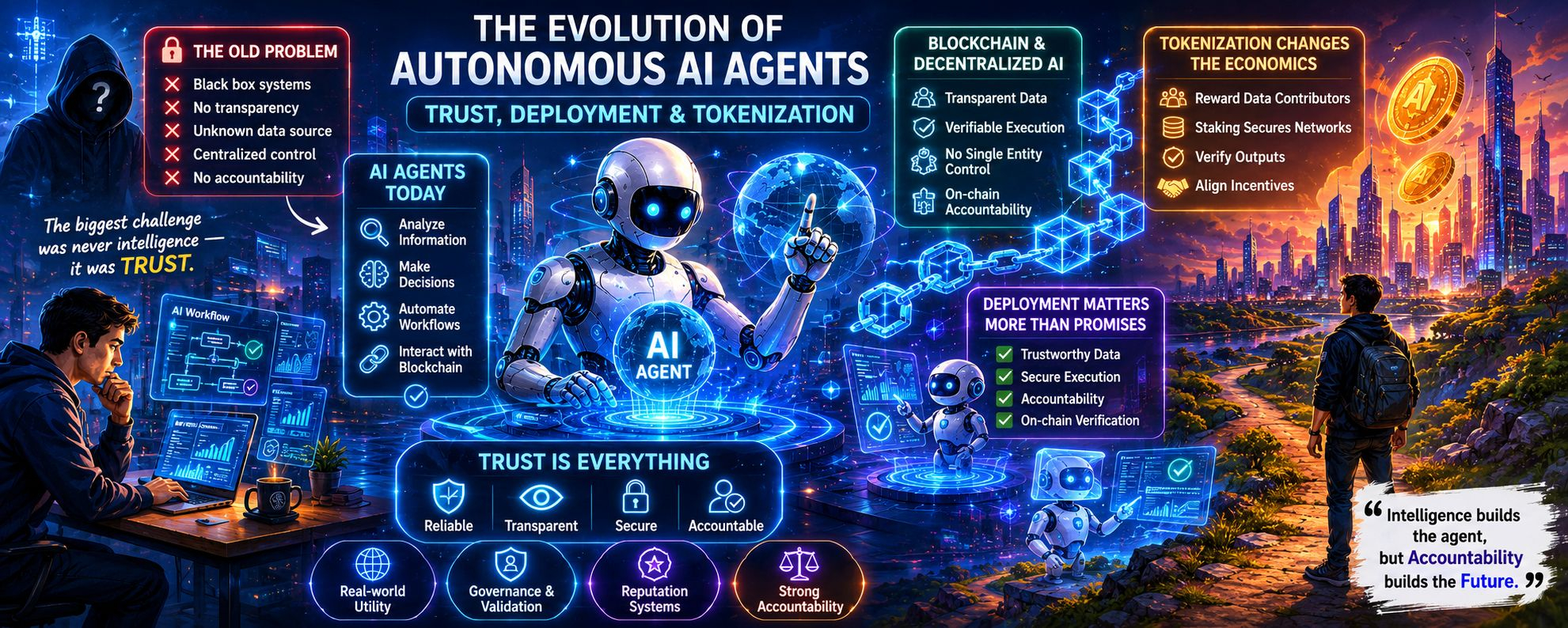
Autonomous AI agents are no longer just a futuristic concept that exists inside research papers or tech conferences. Over the last few months, I have personally spent time exploring and testing different AI tools and decentralized AI systems, and one thing I genuinely noticed is that AI agents are slowly evolving from simple assistants into independent digital workers. Earlier, most AI systems could only respond to prompts and perform limited tasks, but now these agents can analyze information, make decisions, automate workflows, and even interact with blockchain networks without constant human supervision. When I first tried using AI automation platforms connected with decentralized ecosystems, I realized that the biggest challenge was never intelligence alone — it was trust. People do not just want an AI that sounds smart; they want an AI system that is reliable, transparent, secure, and accountable when something goes wrong. That is exactly why the evolution of autonomous AI agents feels so important today.
I have noticed that centralized AI systems often operate like black boxes. You use them every day, but you rarely know where the training data came from, how decisions are being made, or who benefits financially from your interactions. This becomes an even bigger issue once AI agents start handling sensitive tasks like financial decisions, automated trading, healthcare assistance, customer support, or business analytics. During my own experience testing AI-driven workflows, I felt that convenience alone is not enough anymore. If autonomous agents are going to become part of real-world economies, users need proof that these systems can be trusted. That is where blockchain integration and decentralized AI infrastructure become extremely interesting. Instead of relying completely on one company, decentralized systems allow data, validation, and execution to become transparent and verifiable.
One thing I personally found fascinating is how tokenization is changing the economics behind AI agents. Earlier, AI development was mostly controlled by large corporations with massive computing resources and private datasets. But now, decentralized ecosystems are experimenting with a different model where contributors, validators, developers, and even users can participate economically through tokens. I tried exploring some of these AI ecosystems, and it became clear that tokenization is not just about speculation. In many cases, tokens are being used to reward useful data contributions, secure networks through staking, verify outputs, and align incentives between developers and users. This creates a system where AI agents are not isolated software products anymore; they become part of a living digital economy.
Another thing I noticed while following these projects is that deployment matters more than promises. Many AI projects talk about building intelligent agents, but very few explain how these agents will operate safely at scale. In practical environments, autonomous agents need access to trustworthy data, secure execution layers, and clear accountability mechanisms. I personally feel that this is where decentralized AI infrastructure could eventually outperform traditional systems. If every action, validation, or model update can be tracked transparently on-chain, then users gain more confidence in the system. Trust no longer depends entirely on marketing claims; it depends on verifiable activity. I think this shift is extremely important because the future of AI will likely depend on whether people trust autonomous systems enough to integrate them into daily life.
At the same time, I also realized that there are still serious risks and limitations. Autonomous AI agents are powerful, but they are not perfect. During testing and research, I noticed how easily low-quality data or manipulated outputs can affect performance. If incentives are designed poorly, some participants may prioritize rewards over accuracy. This is why governance, validation, and reputation systems are becoming essential in decentralized AI networks. I genuinely believe that the projects which survive long term will be the ones that create strong accountability structures rather than simply chasing hype. AI agents need environments where bad behavior becomes expensive and useful contributions become valuable.
What makes this evolution even more interesting is how naturally AI and blockchain seem to complement each other. AI brings automation, prediction, and decision-making, while blockchain provides transparency, ownership, and economic coordination. When combined properly, autonomous agents could eventually manage digital assets, negotiate contracts, analyze markets, or even operate online businesses with minimal human intervention. A few years ago this idea sounded unrealistic to me, but after spending time exploring these technologies myself, I can honestly say it feels much closer than most people realize.
In the end, I think the evolution of autonomous AI agents is not only about technology. It is about creating systems people are willing to trust. Intelligence alone does not build adoption; accountability does. The future will likely belong to AI ecosystems that can prove their reliability through transparent deployment, secure incentives, and real economic utility. I have personally started feeling that we are entering a stage where AI agents are slowly transforming from experimental tools into active participants in digital economies. Whether this transformation succeeds or fails will depend on one thing above everything else: can these systems earn long-term trust from real users once the excitement and hype disappear?