
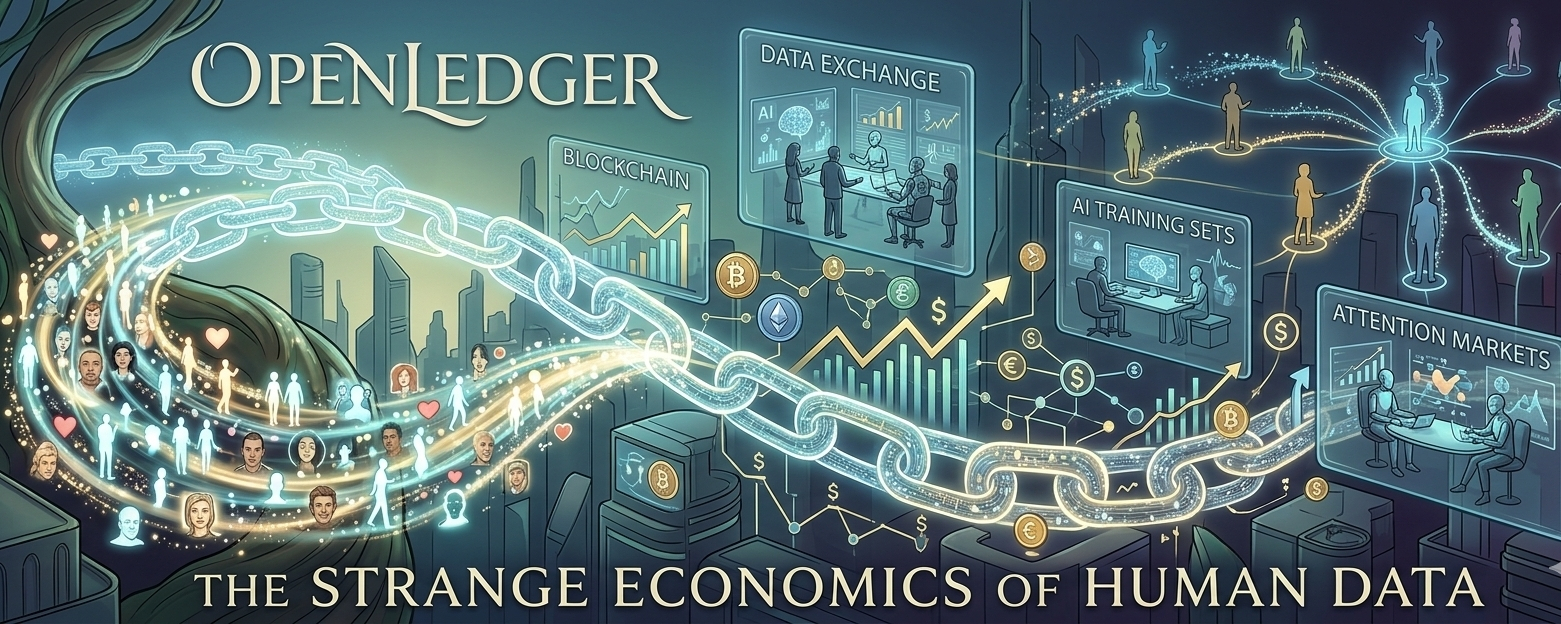

There’s something strange happening in crypto lately that I can’t stop thinking about. For years blockchains mostly revolved around moving value. Tokens moved from one wallet to another liquidity moved between protocols and attention moved wherever the next narrative appeared. But now another kind of asset is quietly entering the conversation: data itself.
Not just data as analytics or dashboards, but data as something closer to raw economic material. Something that can be owned priced reused licensed and potentially fought over.
That shift feels important because AI has changed the way people think about infrastructure. A few years ago, most discussions around AI were centered on models. Bigger models faster models, smarter models. But eventually people started realizing that models are downstream from data. The quality of an AI system often depends less on the architecture and more on the information flowing into it. Training data behavioral data feedback loops specialized datasets. Suddenly the pipeline matters as much as the machine.
Projects like OpenLedger seem to be emerging from that realization. What caught my attention wasn’t the usual AI + blockchain framing because honestly that phrase has already been stretched to the point of meaninglessness. Almost every protocol now claims some relationship to AI. What feels more interesting here is the attempt to treat data contribution and AI coordination as an economic system instead of just a technical one.
I keep wondering whether Web3 was always moving toward this direction without fully realizing it.
In earlier crypto cycles ownership mostly referred to financial assets. You owned tokens NFTs governance rights maybe some yield-bearing position inside a protocol. But AI introduces a different layer. If a model becomes valuable because millions of people unknowingly contributed behavioral patterns, conversations, images, or specialized expertise, then who actually created the value? The company training the model? The user? The infrastructure layer? Maybe all of them in uneven ways.
Traditional platforms solved this question by ignoring it. Data gets absorbed into centralized systems monetization happens elsewhere and users participate passively because the product is convenient enough. That model worked incredibly well for Web2 companies but AI increases the scale of extraction so dramatically that people are starting to notice it more clearly.
What OpenLedger seems to explore is the idea that data flows could become native economic activity on-chain rather than invisible background processes. Not just storing data on a blockchain which usually becomes impractical very quickly but creating systems where datasets AI models and autonomous agents can interact with transparent incentives attached to them.
In theory, that sounds elegant. In practice, it becomes messy almost immediately.
The first challenge is quality. Data is not interchangeable. A thousand random internet posts are not equal to one highly specialized medical dataset or years of expert financial analysis. So if a blockchain tries to reward data contribution it somehow needs mechanisms to evaluate usefulness without relying entirely on centralized gatekeepers again. Otherwise the network risks turning into a giant farming exercise where quantity overwhelms quality.
That problem reminds me a little of early DeFi liquidity mining. Protocols discovered very quickly that incentives attract participation but not necessarily meaningful participation. Capital flowed wherever rewards existed then disappeared when incentives dried up. If AI data markets follow similar patterns networks could end up flooded with low-value synthetic input simply because participants are optimizing for rewards.
And honestly distinguishing human generated insight from AI-generated noise may become one of the defining infrastructure problems of this decade.
There’s also the deeper question of whether blockchain actually improves coordination here or simply adds another economic layer around existing systems. I don’t think the answer is obvious yet. Some parts genuinely make sense. Transparent attribution programmable licensing shared ownership structures interoperable incentives. Those feel difficult to implement cleanly inside closed corporate ecosystems.
But there’s friction too. AI systems move fast, while blockchains tend to prioritize verification and consensus. One side values speed and iteration. The other values transparency and persistence. Combining them sounds powerful conceptually, though operationally it can feel like trying to merge two completely different philosophies of computing.
I’ve noticed that many AI-blockchain discussions also underestimate how dependent AI remains on centralized infrastructure. Even if ownership becomes decentralized training large-scale models still requires enormous compute concentration. Data marketplaces may become open while the actual intelligence layer stays heavily controlled by a small number of entities with access to GPUs and capital. That imbalance matters.
Still I think there’s a reason people keep returning to these ideas despite the contradictions.
The internet was built around publishing information freely, but not necessarily around compensating the creation of that information fairly. Social platforms amplified contribution while capturing most of the economic upside themselves. AI intensifies that imbalance because models can continuously remix human output at industrial scale. At some point people start asking whether the architecture of the internet itself needs updating.
Maybe protocols like OpenLedger are early attempts at answering that question, even if imperfectly.
I also find the idea of AI agents interacting economically with one another strangely fascinating. Not in the dramatic sci-fi sense, but in smaller practical ways. Imagine specialized agents purchasing access to datasets licensing model outputs temporarily or paying micro-fees for highly specific inference tasks. That starts looking less like a traditional application and more like a machine economy operating quietly underneath the visible internet.
Whether blockchain is the correct settlement layer for that economy is still unclear to me. But I can at least see why people are experimenting with it.
What makes this moment interesting is that nobody fully understands the shape of the infrastructure being built. AI people often speak as if intelligence itself is the product. Crypto people sometimes assume ownership mechanics alone solve coordination. Reality probably sits somewhere in between. Intelligence without aligned incentives centralizes quickly. Incentives without useful systems collapse into speculation.
The uncomfortable truth is that most of these models are still untested socially, not just technically. We don’t yet know how people will behave when data becomes financialized more directly. We don’t know whether open contribution systems can resist manipulation at scale. We don’t know if users genuinely want ownership or if they mostly want convenience and low friction.
And maybe that uncertainty is the most honest part of this entire sector right now.
A lot of Web3 infrastructure used to feel like it was searching for real economic gravity. AI might finally provide some of it, though perhaps not in the way people originally expected. Not through token speculation or abstract decentralization narratives, but through something simpler and more fundamental: the growing realization that human knowledge itself has become valuable infrastructure.
The strange part is that we’re only beginning to notice it after machines learned how to use it.
