
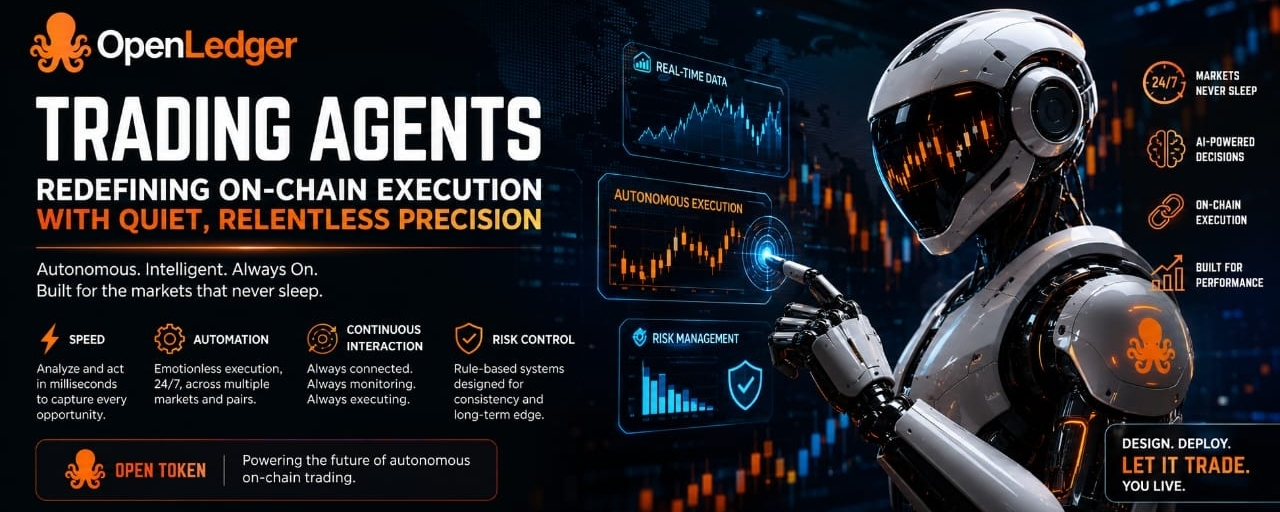
In the fast-paced world of crypto, it’s easy to overlook how the market never stops moving, and opportunities rarely wait for a human to catch up. The shift toward autonomous trading agents, exemplified by OpenLedger’s vision with the OPEN token, feels less like a novelty and more like a practical evolution in how traders engage with on-chain markets. At its core, a trading agent is a system that can study market conditions and act—without constant human input. This concept isn’t entirely new; bots have existed for years, sometimes promising much and delivering little. What’s different today is the convergence of smarter technology, robust infrastructure, and a renewed emphasis on real-time interaction that makes these agents genuinely capable of operating in a live, 24/7 ecosystem.
Speed stands out as the first benefit. Crypto markets don’t pause for analysis, and the window of opportunity can close within minutes. Humans pause—checking, rechecking, waiting for confirmation—and as a result, the edge evaporates. An autonomous agent doesn’t hesitate. It processes streams of data and acts according to a defined logic in the blink of an eye. This isn’t a guarantee of success, but it eliminates the latency that human decision-making inherently carries, which in a market where timing is everything can be a decisive factor.
Automation is the next turning point. Instead of manually scanning countless charts, monitoring multiple trading pairs, and chasing setups around the clock, an automated system handles these tasks relentlessly. It doesn’t tire, it isn’t swayed by fear or greed, and it doesn’t skip opportunities because of emotional bias. Over time, the consistency of automated execution can become more valuable than any single fortunate trade. The real magic, though, lies in how automation complements human strategy by providing a stable backbone that can run continuously.
The third element is continuous market interaction. Crypto never sleeps, and price movements can emerge from macro shifts in Bitcoin’s behavior, narrative-driven altcoin moves, or liquidity spikes in smaller tokens. No single trader can monitor every corner of the market in real time. Even the most disciplined human will miss something. A trading agent, by design, remains connected across multiple markets, tracking changes, and responding instantly. It won’t always be right, but it does maintain a level of presence and responsiveness that human traders cannot sustain over long horizons.
This relevance isn’t accidental. Between 2024 and 2026, AI tools have matured beyond hype, becoming more usable and integrated into everyday workflows. Simultaneously, blockchain infrastructure has improved—execution speeds are faster, APIs are more reliable, and accessing on-chain data has become smoother. When you bring together smarter analytics, faster execution, and continuous on-chain interaction, the idea of agents that can both analyze and execute starts to feel not just plausible but practical.
How traders think about the process is also changing. The older model leaned toward reactive strategies—look for setups, ride trends, and hope to catch the next big move. The new paradigm focuses on building systems that can operate in the background, tirelessly and without interruption. It’s less about chasing every candle and more about designing a robust process that can run in the periphery while you live your life and respond to the insights it surfaces.
From personal experience, the toughest part of trading isn’t finding opportunities; it’s staying consistent. Emotions tend to muddy judgment, leading to hesitation, overtrading, or premature exits. Automation doesn’t erase risk, but it can diminish emotional noise, which, over time, translates into meaningful performance improvements. That said, it’s crucial to stay grounded in realism: automation amplifies the right processes, but it can also amplify a flawed strategy if the underlying logic isn’t sound. Clear rule sets, defined risk management, and a deep understanding of how the system behaves across diverse market conditions are essential.
There are larger questions that remain to be explored as these systems scale. How do autonomous agents respond to sudden shocks or extreme volatility? How will they interact with one another in a densely automated market ecosystem? These are active areas of research and discussion within the crypto space. Adoption will take time, especially for traders accustomed to manual control. Yet as tools improve and results become more consistent, hesitations tend to dissolve into curiosity and then into routine practice. History suggests a familiar pattern: early adopters experiment, results improve, and more participants follow as the value becomes evident.
The impact on investors goes beyond individual trades. If automation drives more market activity, the structural dynamics of the market can shift. Reactions to news can accelerate, inefficiencies may close quicker, and liquidity could reorganize in response to faster, more persistent trading pressures. These shifts are subtle but consequential, shaping market behavior over time and redefining what “speed” and “efficiency” mean in an on-chain context.
Ultimately, the value of OpenLedger’s trading agents isn’t pinned to a single feature. It’s the synergy of speed, automation, and continuous, real-time interaction—elements that have existed separately for some time but, when combined, create a new approach to trading. It may not feel like a watershed moment yet, but it’s part of a broader movement: moving away from manual, hands-on trading toward systems you design, monitor, and refine. As the mesh of tools, data, and execution continues to tighten, this shift could redefine what it means to participate in the crypto markets and how you engage with on-chain opportunities.
If you’re curious about how this kind of automation could fit into your strategy, you’re not alone. The conversation around autonomous trading agents is evolving, with practical deployments, performance improvements, and ongoing experiments all contributing to a future where traders leverage continuous, intelligent interaction with the market rather than relying solely on moment-to-moment intuition. OpenLedger’s trajectory suggests a world where speed, resilience, and unattended execution aren’t just advantages—they’re becoming practical norms for on-chain activity.