Look, I’ll be honest.
Something started bothering me when I kept watching AI conversations repeat themselves over and over again.
Bigger models.
More GPUs.
Faster inference.
Higher benchmark scores.
Same discussion. Different day.
And I kept getting this feeling that everyone was staring at the dashboard while completely ignoring the engine underneath it.
Because here's the thing.
I don't think the real story sits in model sizes or compute power.
I think it's sitting somewhere deeper, in this weird economic layer nobody seems excited enough to talk about.
People don't talk about this enough.
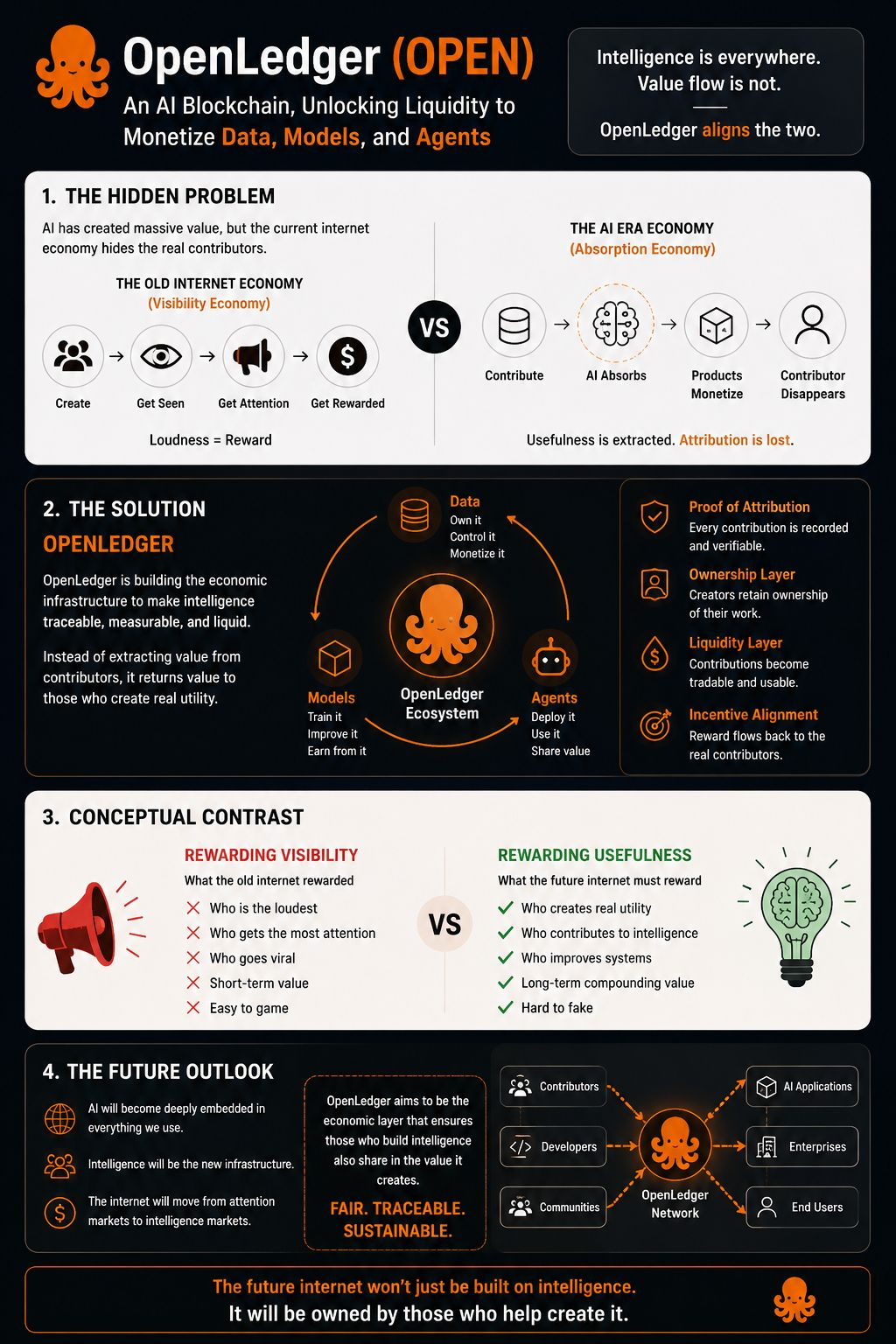
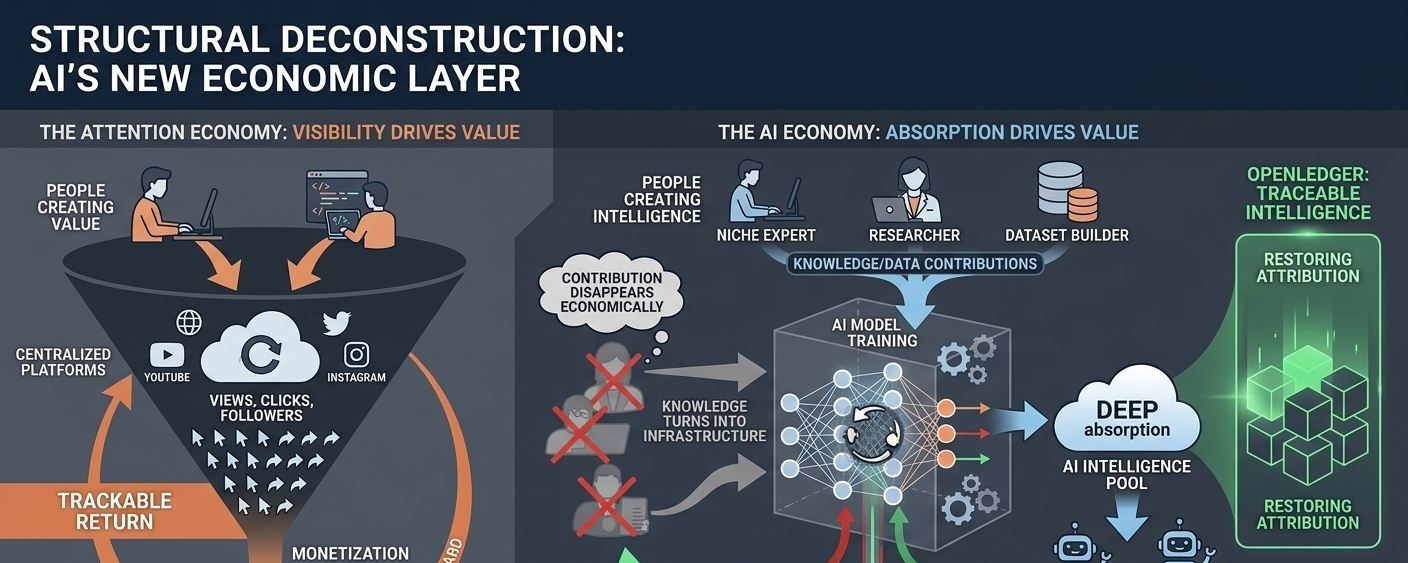
The internet built an entire system around visibility.
That's basically been the deal for years.
Get views.
Get clicks.
Get followers.
Get attention.
You make videos, write threads, build communities, create tutorials, answer questions online, and if enough people notice you, value eventually circles back somehow.
Ads.
Subscriptions.
Partnerships.
Whatever.
Messy system? Sure.
Perfect? Not even close.
But at least you could usually point at where value came from.
Then AI showed up and quietly changed the rules.
And this is where things get tricky.
AI doesn't really care about visibility.
AI cares about absorption.
Big difference.
Actually... huge difference.
Imagine someone spends years becoming ridiculously good at some niche topic. Maybe they write detailed tutorials nobody else wants to write. Maybe they build datasets. Maybe they spend late nights answering questions online while everyone else scrolls memes and moves on.
Five years later, those patterns, explanations, and pieces of knowledge start shaping machine behavior.
AI gets smarter.
Users get value.
Companies build products.
Money moves around.
But wait.
What happened to the original person?
Seriously.
Where did they go in that equation?
Because something strange happens.
Their contribution doesn't disappear physically.
Their contribution disappears economically.
That's the part that feels weird to me.
Knowledge slowly turns into background infrastructure.
People stop seeing where it came from.
And once people stop seeing something, good luck assigning value to it.
I've seen this before.
Different technology. Same pattern.
Platforms extract value quietly until someone finally notices the imbalance.
That's where OpenLedger started catching my attention.
Not because I saw another token.
Crypto already has enough tokens.
Trust me.
Not because I saw another AI project either. We get those every week.
What actually pulled me in was the angle.
OpenLedger doesn't seem to start from the usual question:
"How do we build another AI thing?"
It seems to start somewhere else.
How do we build systems where intelligence itself becomes traceable?
Because eventually someone has to ask an uncomfortable question:
Who actually owns the value AI creates?
For years we've treated data and contributions almost like free raw material lying around on the internet.
People create.
Communities contribute.
Developers build.
Models consume.
Products monetize outputs somewhere higher up the chain.
And everyone acts like that's normal.
Honestly... is it?
Because economies eventually break when value keeps flowing in one direction.
Always.
People stop contributing.
Quality starts dropping.
Systems become dependent on taking more than they give back.
We've watched this happen with content platforms.
We've watched this happen with social media.
We've watched this happen with attention itself.
Extract first.
Deal with consequences later.
Same movie.
Different actors.
OpenLedger seems to look at the whole thing differently.
Instead of pretending intelligence magically appears out of nowhere, it treats intelligence like something people assemble piece by piece.
Data contributes.
Models contribute.
Agents contribute.
Humans contribute.
Tiny pieces stack together.
And if intelligence comes from assembled contributions, then contributors probably shouldn't vanish halfway through the process.
Seems obvious, right?
Apparently not.
Because contribution and visibility aren't the same thing.
Not even close.
Visibility rewards whoever people notice.
Usefulness rewards whoever creates actual value.
Those people aren't always the same people.
Honestly, they usually aren't.
Some of the most useful people online barely exist publicly.
The researcher with fifty followers.
The developer maintaining critical infrastructure.
The person organizing information nobody else wants to spend three hours sorting.
The quiet contributors.
The internet historically hasn't rewarded those people very well.
AI might make that problem bigger.
Or weirdly enough... AI might force people to finally fix it.
Because once intelligence becomes reusable and deployable through agents, attribution stops becoming some philosophical debate people throw around on podcasts.
It becomes economics.
Simple as that.
Because why would people keep contributing long term if contribution itself slowly becomes invisible?
People follow incentives.
They always have.
Technology changes.
Human behavior doesn't move nearly as fast.
And honestly, I think that's the bigger thing happening here.
Most people think AI changes software.
Maybe.
But I think AI changes what people decide has value.
The old internet rewarded attention.
The next version might reward useful intelligence itself.
Small sentence.
Big shift.
Because attention burns out fast.
Useful knowledge compounds.
Now look, maybe OpenLedger succeeds.
Maybe it doesn't.
Crypto has a pretty long history of taking beautiful ideas and introducing them directly to reality. Reality usually punches back.
Hard.
But I keep coming back to the same question.
As AI becomes part of daily life, people eventually have to ask where intelligence actually came from and who deserves value from creating it.
And honestly?
I don't think that's just a blockchain question anymore.
I think it's a people question.
Because the future internet might not belong to whoever talks the loudest.
It might belong to whoever quietly built something useful while everyone else fought over attention.