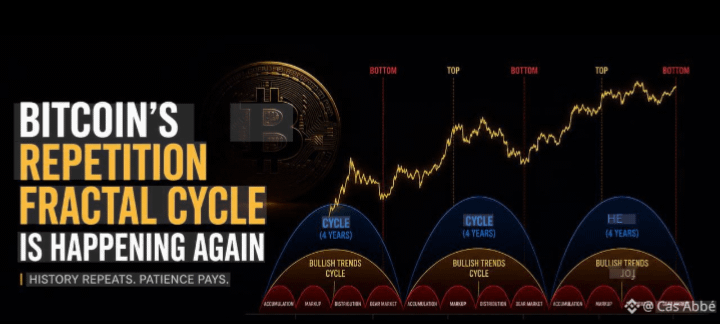
Every market cycle leaves behind a pattern. In crypto, traders call these repeating structures “fractals” — price behaviors that continue appearing across different years under similar market conditions. Bitcoin has gone through multiple boom-and-bust phases since its creation, and many analysts now believe the market may once again be entering a familiar stage of the cycle.
The current structure is drawing attention because several indicators resemble earlier Bitcoin expansion periods. From post-halving supply pressure to rising institutional participation and liquidity returning to risk assets, the market is showing signals that historically appeared before major bullish phases. However, repetition in financial markets never guarantees identical outcomes. Understanding the reasons behind these similarities is more important than blindly expecting history to repeat itself.
Understanding Bitcoin’s Fractal Cycles
Bitcoin has historically moved in cycles tied closely to market liquidity, investor sentiment, and most importantly, its halving mechanism. Every four years, Bitcoin mining rewards are reduced by half. This lowers the rate of new BTC entering circulation and creates a long-term supply shock.
In previous cycles, the pattern often followed this structure:
Bear market accumulation phase
Bitcoin halving event
Gradual institutional and retail re-entry
Strong bullish expansion
Extreme speculation and overheating
Sharp correction and market reset
The reason many traders are discussing fractals again is because the current market behavior resembles the transition stage seen before earlier breakout periods.
Why Analysts Believe The Pattern Is Repeating
1. Post-Halving Supply Dynamics
Historically, Bitcoin’s strongest rallies happened after halving events. Reduced miner selling pressure combined with increasing demand created major upward momentum in past cycles.
The recent halving has once again reduced daily Bitcoin issuance. At the same time, large investors, ETFs, and long-term holders continue absorbing available supply. When fewer coins are available on exchanges, even moderate buying pressure can create aggressive price movement.
This tightening supply environment resembles conditions seen during previous cycle expansions.
2. Institutional Participation Is Growing Again
Unlike earlier cycles dominated mainly by retail investors, the current market includes stronger institutional involvement. Spot Bitcoin ETFs, corporate treasury exposure, and growing acceptance from traditional finance are changing market structure.
Institutional capital tends to move more slowly but with greater size. This creates deeper liquidity and can strengthen long-term trend stability compared to purely speculative rallies.
Many analysts believe this institutional layer is one of the biggest differences between the current cycle and older Bitcoin runs.
Market Psychology Is Following Familiar Stages
Crypto markets are heavily driven by psychology. Fear, greed, disbelief, and euphoria repeat in nearly every cycle.
Right now, investor behavior resembles the “early disbelief” stage seen before previous major expansions:
Retail participation is returning gradually
Social media interest is increasing again
Long-term holders remain confident
Corrections are being bought aggressively
Traders are watching old all-time highs closely
Historically, this stage often appears before broader public attention enters the market.
The Role Of Liquidity In Bitcoin Cycles
Bitcoin does not move in isolation. Global liquidity conditions strongly affect crypto markets.
When interest rate pressure eases, risk appetite often improves across financial markets. Capital begins flowing toward growth sectors including technology, AI, and digital assets. Bitcoin has historically benefited during periods where investors seek higher-return opportunities.
This is why macroeconomic conditions matter when analyzing fractal cycles. A repeating chart pattern alone is not enough. Liquidity and investor confidence are what usually fuel the larger move.
Important Differences From Previous Cycles
Even though similarities exist, the current cycle also has major differences:
Regulatory Pressure Is Higher
Governments worldwide are increasing oversight of crypto markets. Regulations around exchanges, stablecoins, taxation, and compliance are shaping how capital enters the industry.
This creates both risks and long-term legitimacy for the sector.
Market Maturity Has Increased
Bitcoin is no longer viewed as an unknown internet experiment. Major financial institutions, hedge funds, and public companies now participate in the ecosystem.
This maturity could reduce extreme volatility over time, although large corrections still remain possible.
Retail Speculation Is More Selective
Previous bull markets saw aggressive speculation across nearly every crypto asset. Current investors appear more cautious and research-focused. Capital is concentrating more heavily into established assets like Bitcoin rather than spreading blindly across the market.
Can History Repeat Exactly?
No market cycle repeats perfectly. Fractals are tools for probability, not certainty.
Bitcoin’s historical patterns can provide insight into investor behavior and market structure, but external events can always change momentum. Regulatory decisions, macroeconomic shocks, geopolitical tensions, or liquidity tightening can interrupt even the strongest bullish setups.
This is why experienced investors focus on risk management rather than emotional predictions.
What Smart Investors Usually Watch During These Phases
Instead of chasing hype, disciplined investors often monitor:
Exchange supply levels
Long-term holder activity
ETF inflows and institutional demand
Global liquidity trends
Federal Reserve policy direction
Bitcoin dominance
Market sentiment indicators
These factors provide a clearer picture than social media excitement alone.
Final Thoughts
Bitcoin’s current structure is showing multiple similarities to earlier market cycles, which is why discussions around repeating fractals are growing rapidly again. Reduced supply issuance, rising institutional demand, improving sentiment, and macro liquidity conditions are creating an environment that resembles previous expansion phases.
Still, crypto markets remain highly volatile and unpredictable. Historical patterns can guide analysis, but they should never replace proper research, patience, and risk management.
If the fractal continues developing as previous cycles did, Bitcoin could remain one of the most closely watched assets in the global financial market over the coming months. But as always in crypto, opportunities and risks move together.