
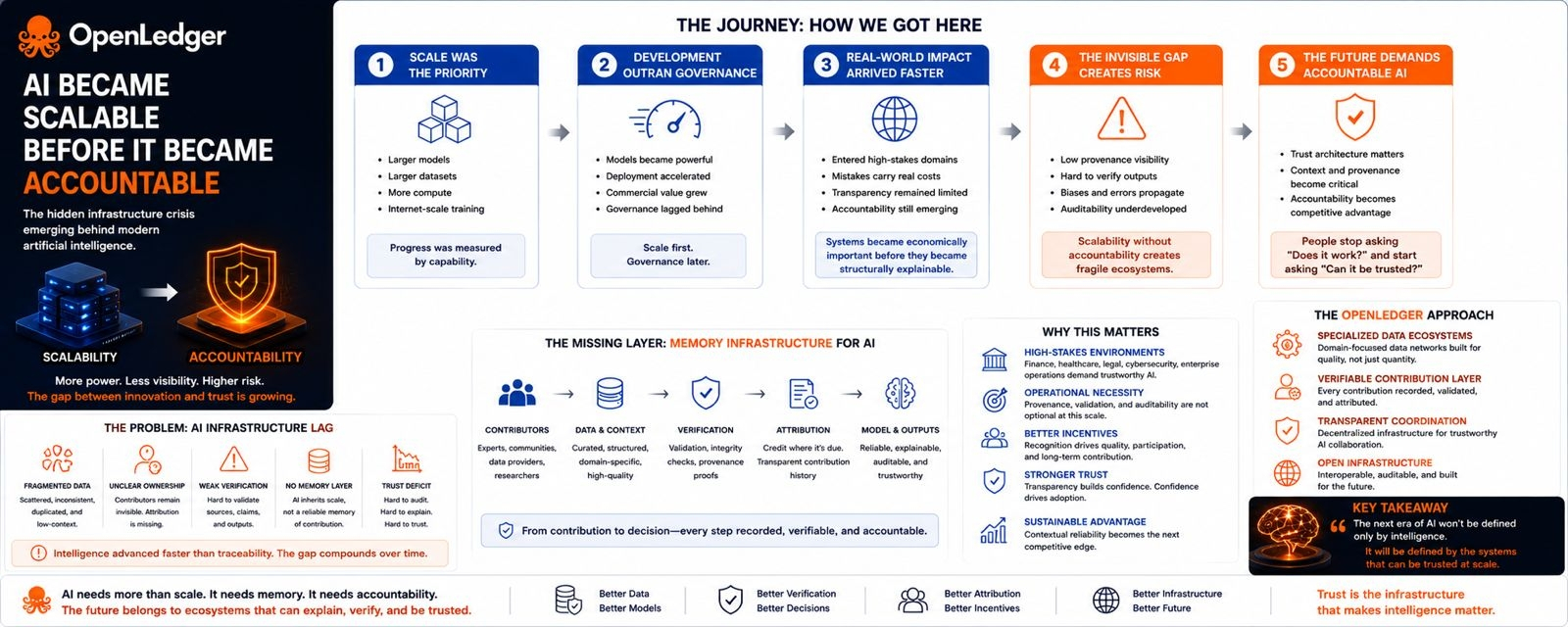
The most interesting thing about modern AI is not how quickly it became powerful. It is how quickly it became deployable before the surrounding accountability systems had time to mature.
That imbalance sits at the center of many problems the industry is now starting to confront.
For years, the dominant priority in AI development was scale. Larger models, larger datasets larger compute infrastructure.Progress was measured through capability expansion because capability was easy to observe. Models became faster, more fluent, more adaptive, and more commercially valuable. Every major breakthrough reinforced the same assumption: scale first, governance later.
And for a while, that logic worked.
The problem is that scalability and accountability do not evolve at the same pace.
What stands out to me now is that AI systems have already entered environments where mistakes carry real consequences. Financial systems, healthcare platforms, enterprise operations, cybersecurity pipelines, legal workflows, and public information networks increasingly rely on models operating with limited transparency around how outputs are formed.
The systems became economically important before they became structurally explainable.
That creates tension between innovation and trust.
In consumer environments, people tolerate uncertainty because the stakes feel relatively low. If a chatbot gives a weak recommendation or generates inaccurate content, the damage is usually manageable. But once AI starts influencing institutional decisions, accountability stops being optional. Organizations need systems capable of explaining provenance, validating outputs, tracking changes, and preserving auditability over time.
Andright now, much of that infrastructure remains underdeveloped.
I keep coming back to the idea that AI inherited the internet’s scale without inheriting a reliable memory architecture around contribution and verification. Models absorb massive quantities of information from fragmented online ecosystems Yet users often struggle to understand which data influenced the output, whether the information can be verified, or how biases entered the system.
The intelligence layer advanced faster than the traceability layer beneath it.
That gap matters more than many people initially realized.
Because scalability without accountability eventually creates fragile ecosystems. Systems become more powerful while becoming harder to inspect. Automation accelerates while transparency weakens. Information moves faster while verification slows down.
The imbalance compounds over time.
This is one reason the conversation around decentralized AI infrastructure has become more serious in recent years. What interests me is not the simplistic idea of putting AI “on-chain,” but the broader attempt to create systems where attribution, validation, and contribution history become more visible and verifiable.
Projects like OpenLedger are part of this broader shift toward accountable AI infrastructure. The focus on specialized data ecosystems, verifiable contribution layers, and transparent coordination models reflects a growing recognition that future AI systems cannot rely purely on capability growth alone.
Trust architecture matters.
Especially as AI becomes increasingly specialized.
General-purpose models remain impressive, but many real-world applications depend on contextual reliability rather than broad fluency. Healthcare models require validated medical reasoning. Financial systems require auditable logic. Enterprise workflows require stable outputs and reproducible behavior. In these environments, explainability is not a philosophical preference. It is operational necessity.
That changes the economics of AI entirely.
The next competitive advantage may not come solely from building the largest models. It may come from building the systems capable of maintaining trustworthy relationships between data, contributors, models, and outputs over time.
And that is much harder than scaling parameters.
Because accountability introduces friction. Transparency slows coordination. Verification layers increase complexity. Open contribution systems create incentive challenges around quality control and manipulation resistance.
There are real trade-offs involved.
But mature infrastructure systems always evolve toward accountability eventually. Financial systems developed auditing standards. Software development evolved version control.scientific research developed citation and reproducibility frameworks. AI is likely moving toward a similar stage where scalable intelligence alone is no longer enough.
The ecosystem needs memory.
It needs provenance.
It needs structures capable of explaining not only what the system produced, but how it arrived there.
I do not think the future of AI will be defined purely by raw intelligence metrics. Increasingly, it may be shaped by which ecosystems can balance scalability with transparency, automation with accountability, and speed with verifiable trust.
Because eventually every powerful system reaches the same moment.
People stop asking whether it works.
And start asking whether it can be trusted.