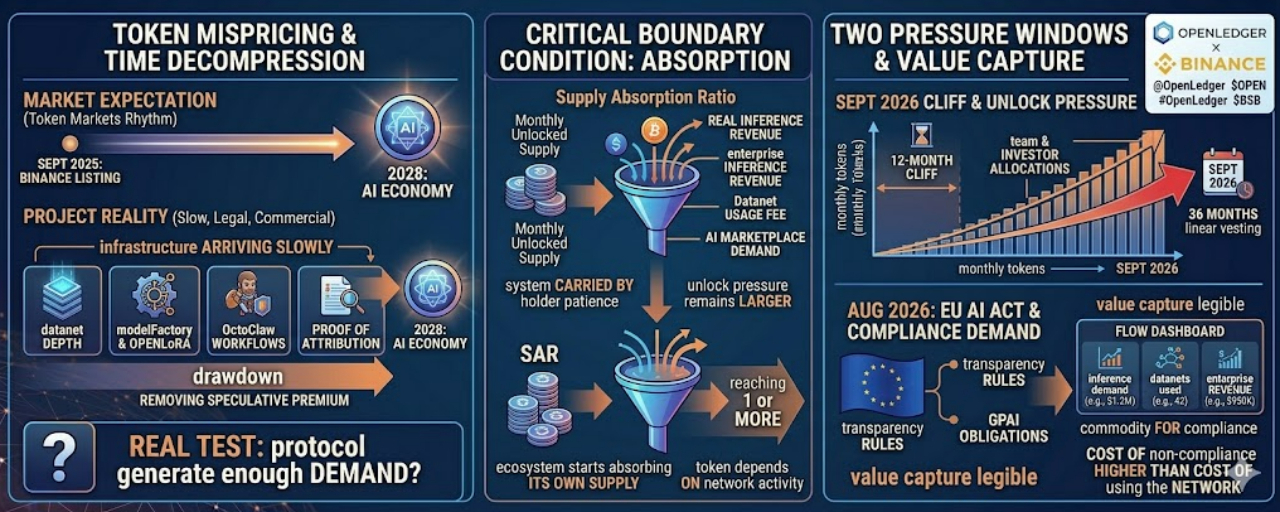
The most honest way I can frame OpenLedger is this: the project is building infrastructure for an AI economy that is arriving slowly, legally, and commercially, not in the two-week rhythm that token markets prefer.
That mismatch matters.
OpenLedger is not just trying to make another AI token. Its core idea is that AI data, models, and agents should leave a trace. Datanets organize domain-specific datasets. ModelFactory and OpenLoRA help turn those datasets into specialized models. Proof of Attribution tries to connect AI outputs back to the data and contributors that shaped them. Binance Academy describes the project exactly in that direction: a blockchain for AI where users can create, share, and use datasets to train specialized AI models, with interactions traceable back to sources and contributors.
That is a serious architecture.
But markets did not price it like slow infrastructure.
Open listed on Binance on September 8, 2025, with multiple trading pairs opened at once. That kind of listing creates immediate liquidity and narrative pressure before the full demand side of a protocol is visible. The market priced OpenLedger like the 2028 thesis had already compressed itself into 2025.
It had not.
Mainnet usage, AI Marketplace demand, enterprise inference revenue, OpenCircle IAOs, Datanet depth, OctoClaw workflows, these are not decorative milestones. They are the actual absorption engines for the token. Without them, Open is mostly trading on expectation. With them, Open starts to become closer to a commodity for AI usage and compliance.
This is where I think the price chart should be read differently.
The drawdown is not simply “the market lost faith.” It is the market removing the speculative premium from a system whose architecture is long-term but whose token became liquid early. That does not prove OpenLedger is failing. It proves the timeline was mispriced.
The real test is not whether the thesis sounds right.
The real test is whether the protocol can generate enough demand before the supply curve becomes heavier.
Here is the boundary condition I would use:
Supply Absorption Ratio = Real inference revenue captured by the network / Monthly unlocked token supply
If that ratio stays below 1, the system is still being carried by narrative, listings, and holder patience. Unlock pressure remains larger than organic demand. Even a strong EU AI Act tailwind will not save price structure if enterprise usage does not turn into measurable inference value.
If that ratio reaches or exceeds 1, the picture changes. At that point, the ecosystem starts absorbing its own supply through usage. The token stops depending only on speculative buyers and begins depending on network activity.
That is the line.
Not vibes. Not “community strength.” Not “AI narrative.”
Absorption.
The September 2026 cliff matters because OpenLedger’s official token unlock schedule says team and investor allocations have a 12-month cliff followed by 36 months of monthly linear vesting. Since Open listed in September 2025, the market will naturally treat September 2026 as the first major unlock pressure window. That does not mean everyone sells. It means the system must be ready to absorb a different supply regime.
This is why the AI Marketplace is not just a product milestone.
It is a liquidity event in disguise.
If the Marketplace is live and generating real inference demand before unlock pressure becomes meaningful, then Open has a pathway toward organic absorption. If it is not, the token is exposed to a supply cliff without a demand engine strong enough to meet it.
The EU AI Act creates a second pressure window. The EU says transparency rules come into effect in August 2026, while GPAI obligations already became applicable earlier for certain providers. This matters because OpenLedger’s strongest commercial angle is not “AI hype.” It is auditability. Companies will need cleaner records of what data touched their models, how AI systems were trained, and how outputs can be explained when procurement, compliance, or regulation asks.
That is where Open can be reframed.
Not as a meme.
Not even only as an AI infrastructure token.
At its strongest, Open becomes a commodity for compliance.
If enterprises need access to auditable Datanets, attribution trails, model provenance, or verified AI interaction records, then demand for the network can come from actual operational necessity. Not retail hope. Not exchange momentum. Actual usage.
But this only works if OpenLedger makes the value capture legible.
An enterprise does not buy a token because the chart is down 88%. It buys infrastructure because the cost of non-compliance, bad audit trails, or untraceable AI outputs is higher than the cost of using the network. That is the commercial bridge OpenLedger has to build.
The strongest version of the thesis is clear:
AI regulation creates the need for provenance.
OpenLedger provides the attribution and audit layer.
The AI Marketplace converts that layer into inference demand.
Inference demand creates network revenue.
Network revenue absorbs unlock pressure.
If any link breaks, the token remains stuck between a beautiful 2028 thesis and a painful 2026 supply schedule.
That is the part I think the community should focus on.
Not whether OpenLedger has good backers. It does. Not whether the architecture is coherent. It is. Not whether the long-term idea makes sense. It does.
The question is whether the project can convert architecture into measurable flow before the vesting calendar starts asking harder questions.
A useful update from the team would not be another broad roadmap. It would be a flow dashboard.
How much inference demand exists?
How many Datanets are being used by real models?
How much enterprise or developer revenue is flowing through the system?
How much Open demand is connected to actual usage rather than trading activity?
What is the projected monthly unlock, and what level of inference revenue is needed to absorb it?
That is the only way to judge the gap honestly.
Because OpenLedger is not being measured against an ordinary AI token standard. It is being measured against its own ambition. The project says AI data, models, and agents can become monetizable infrastructure. Fine. Then the market needs to see the conversion path from audit trail to inference revenue to token absorption.
Until then, the token market will keep doing what it always does.
It will price time as risk.
It will price silence as supply pressure.
And it will treat a 2028 infrastructure thesis as unfinished inventory in 2026.
So the question is not whether OpenLedger is building something real. I think it is.
The question is sharper:
Can OpenLedger turn AI provenance into enough real demand before the unlock curve turns patience into sell pressure?
@OpenLedger $OPEN #OpenLedger $BSB