A lot of important shifts in markets begin quietly. They do not arrive with fireworks. They arrive as a change in what people are willing to pay for. First the obvious thing gets cheap, then the more difficult thing becomes valuable. In technology, that pattern shows up again and again. The software gets easier to copy. The hardware gets faster and cheaper. The model gets normalized. And then, almost without warning, the scarce part is no longer the thing everyone was obsessing over last year. It becomes something more ordinary, more administrative, and more overlooked.
That is usually when the real money starts moving.
We have seen this in different forms before. When the internet made distribution easy, attention became scarce. When cloud infrastructure made servers less visible, reliability became scarcer. Now AI is moving through a similar change. Model capability is no longer the rarest ingredient in the room. A lot of teams can rent intelligence now. Some can build it. Some can fine tune it. Some can buy it in pieces. The harder question is what feeds those systems, and whether the source of that feed can survive real scrutiny. That is where the conversation becomes less glamorous and more important.
Because data is not just data anymore. Not in AI. Not for enterprises. Not when legal teams are reading the same headlines as engineers.
A company can tolerate a model that is a bit slower. It can tolerate a vendor that is a bit more expensive. It can even tolerate a product that is still finding its shape. What it cannot tolerate as easily is uncertainty around where training data came from, whether the rights were clear, whether users consented, whether the source can be defended, and whether tomorrow’s lawsuit will turn into a board level problem. That kind of risk changes behavior. It slows buying decisions. It pushes teams toward caution. It makes them pay for reassurance, not just performance.
That is partly why OpenLedger caught my attention.
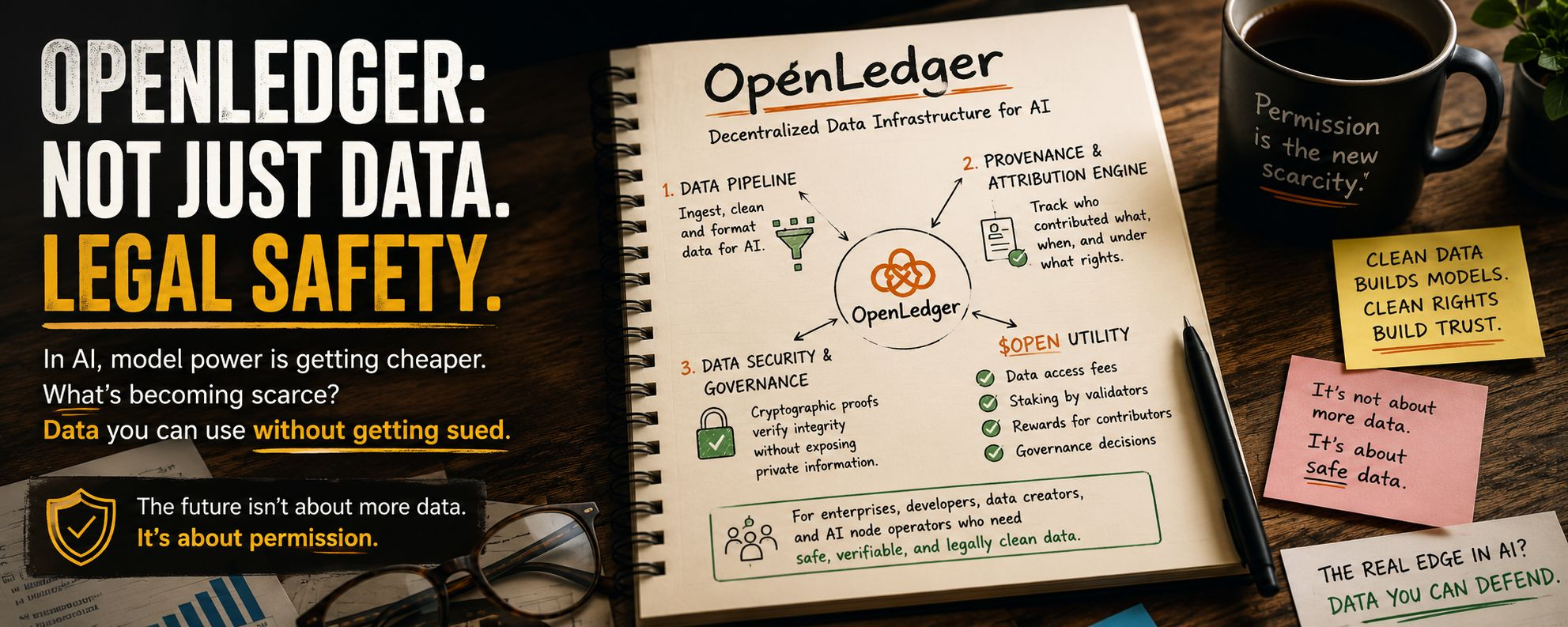
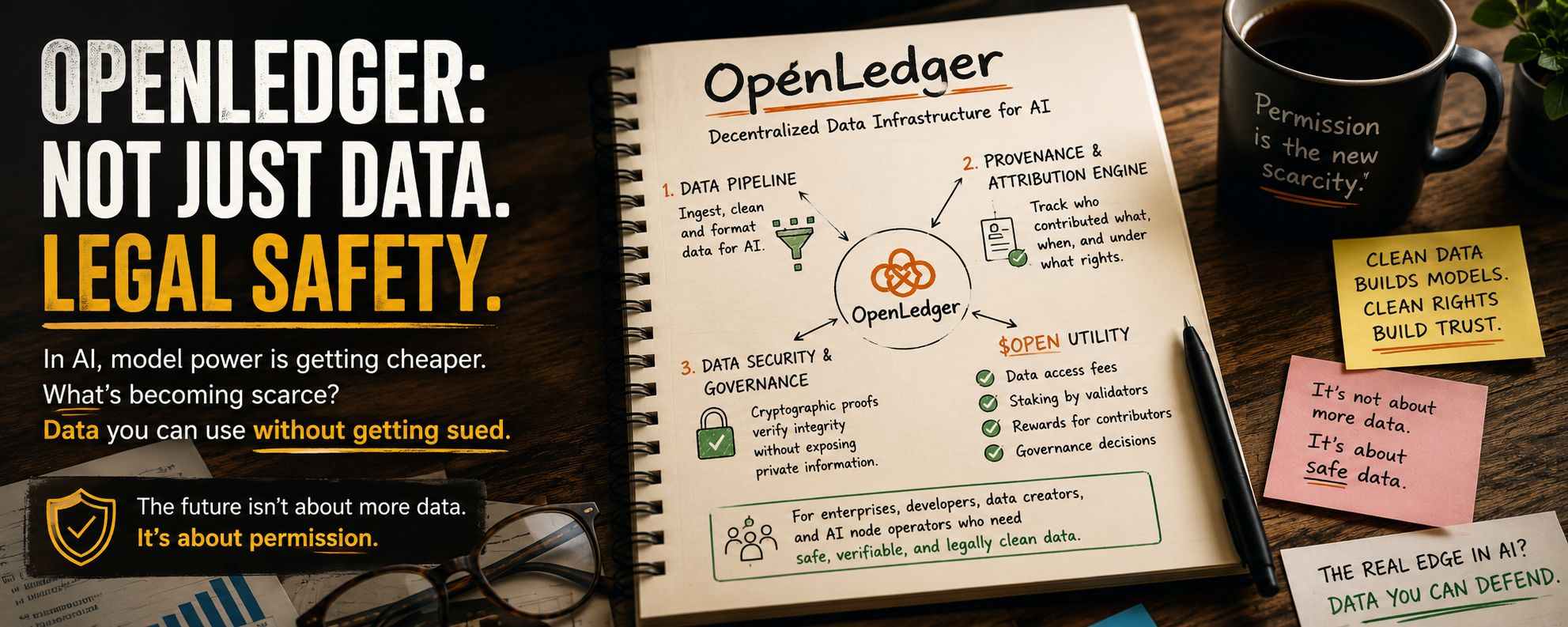
Most people describe it as a decentralized data infrastructure for AI. But I think that framing may be incomplete. The more interesting idea is that OpenLedger is trying to make data not only usable, but usable without fear. That may sound like a small difference, but it is not. In enterprise AI, the real premium may not sit in raw access to more data. It may sit in access to data that has a clean trail, a visible origin, a record of rights, and a structure that lets a buyer say, with a straight face, that they know what they are using.
That is a different product than the usual crypto pitch. It is less about abundance and more about permission.
And permission is scarce.
Scarcity changes how a market behaves. When something is abundant, buyers become lazy. They compare on volume, speed, and price. When something is scarce, they compare on trust, credibility, and the ability to defend the decision later. In AI, the scarce thing is increasingly not the dataset itself. It is the dataset that will not get a serious enterprise into trouble. That is the opening OpenLedger seems to be aiming at. It wants to sit in the gap between raw data collection and enterprise compliance, and that gap is probably wider than many people admit.
The project description makes that pretty clear. It is building a data pipeline that can ingest, clean, and format data for AI models. It is building a provenance and attribution engine so every contribution can be tracked. It is building data security and governance systems that rely on cryptographic proofs to verify integrity without exposing private information. Those are technical components, yes, but underneath the technical language is a simple economic idea. If you can make data more traceable, more auditable, and more governable, then you are no longer selling just access. You are selling confidence.
And confidence has a market price.
That does not mean the opportunity is easy. It means the opportunity is real but messy. Enterprise buyers are slow for a reason. They are not trying to be difficult. They are trying not to make mistakes that later become expensive. A serious AI buyer will want to know who contributed the data, under what terms, how attribution works, what happens when there is disagreement, and how the network handles sensitive material. They will ask whether the provenance record is strong enough to satisfy internal review. They will ask whether the governance model is too fragmented. They will ask whether the token is a genuine utility or just a financial layer sitting on top of a product that could have existed without it.
Those are fair questions, and they matter.
There is always a temptation in crypto to talk about infrastructure as if structure itself is the answer. But structure is only useful if people actually use it. OpenLedger will have to prove that its decentralized design does not become a layer of complexity that slows adoption. It will have to prove that legal clarity is not just a slogan. It will have to prove that enterprise buyers care enough about provenance to change their behavior, and that data creators care enough about rewards and attribution to participate honestly. None of that is automatic.
Still, there is something compelling about the direction. AI has already made compute more visible as a commodity. The next battlefield may be data rights. If a company can buy models, rent compute, and outsource orchestration, then the thing that remains strategically sensitive is the feedstock. What data is legitimate. What data is licensed. What data is clean enough to defend. What data is safe enough to train on. Those are not abstract concerns. They are the questions that determine whether AI stays in experimentation or becomes part of regular enterprise operations.
And that is where OpenLedger begins to look less like a data project and more like an economic filter.
The token, $OPEN, is interesting in that context because it is not supposed to stand alone as a generic speculation vehicle. Its stated role is functional. It is meant to handle data access fees, staking for validators, rewards for honest contributors, and governance around quality and compliance standards. That matters because networks like this only work if the incentives are real and not decorative. If validators have something to lose, their judgments matter more. If contributors are rewarded for clean, rights aware input, then quality becomes more than an aspiration. If governance actually shapes the compliance rules, then the community is not just voting on branding. It is deciding what kind of data economy it wants to allow.
But here again, the hard part is capture. In theory, the token connects all the moving pieces. In practice, enterprises often prefer simplicity. They would rather pay one invoice than navigate a tokenized system unless the benefits are obvious and the process is frictionless. That is a serious challenge. A lot of promising infrastructure gets stuck in the middle because it is technically elegant but commercially awkward. It solves a problem that customers say they have, but it solves it in a way that requires too much explanation.
So the question becomes not only whether OpenLedger is useful, but whether it is useful in a way that a cautious buyer will actually adopt.
That is why I keep coming back to legal safety. It is not a flashy phrase, but it may be the real unlock. Legal safety is what converts a promising pilot into a deployed system. It is what lets a company scale without feeling like it is hiding a problem inside its stack. If OpenLedger can help make data traceable, permissioned, and defensible, then it is not just offering a better pipe. It is offering a better excuse to move forward.
And in corporate life, excuses matter more than people think. Not the flimsy kind. The defensible kind. The kind a legal team can accept, a procurement team can document, and an executive can explain in a meeting without sounding reckless. That is what trusted infrastructure often really sells. Not speed. Not novelty. Not ideology. It sells a narrower range of anxiety.
Of course, the skepticism should stay. Decentralized systems often promise fairness and transparency, then discover how difficult governance is in practice. Incentives can get messy. Standards can drift. Participation can be uneven. A network can claim to reward contributors while still leaving most of the economic value in the hands of a few operators or early participants. Those are real risks here. So is the possibility that the market talks about clean data long before it is willing to pay enough for it.
But the direction feels meaningful. When model power becomes cheaper, the inputs become more important. When inputs become more scrutinized, permission becomes scarce. When permission becomes scarce, systems that can prove provenance and manage rights begin to matter in a more serious way than they did before. That is the place OpenLedger seems to be aiming for.
Not data for its own sake. Not another abstract layer of infrastructure. Something more practical than that. A way to make AI training feel less like a legal gamble and more like a managed process.
Maybe that is the real question OpenLedger is asking the market. Not how much data can be gathered, but what kind of data can still be used with a clear conscience. And once that question matters, who gets to decide what clean really means?