
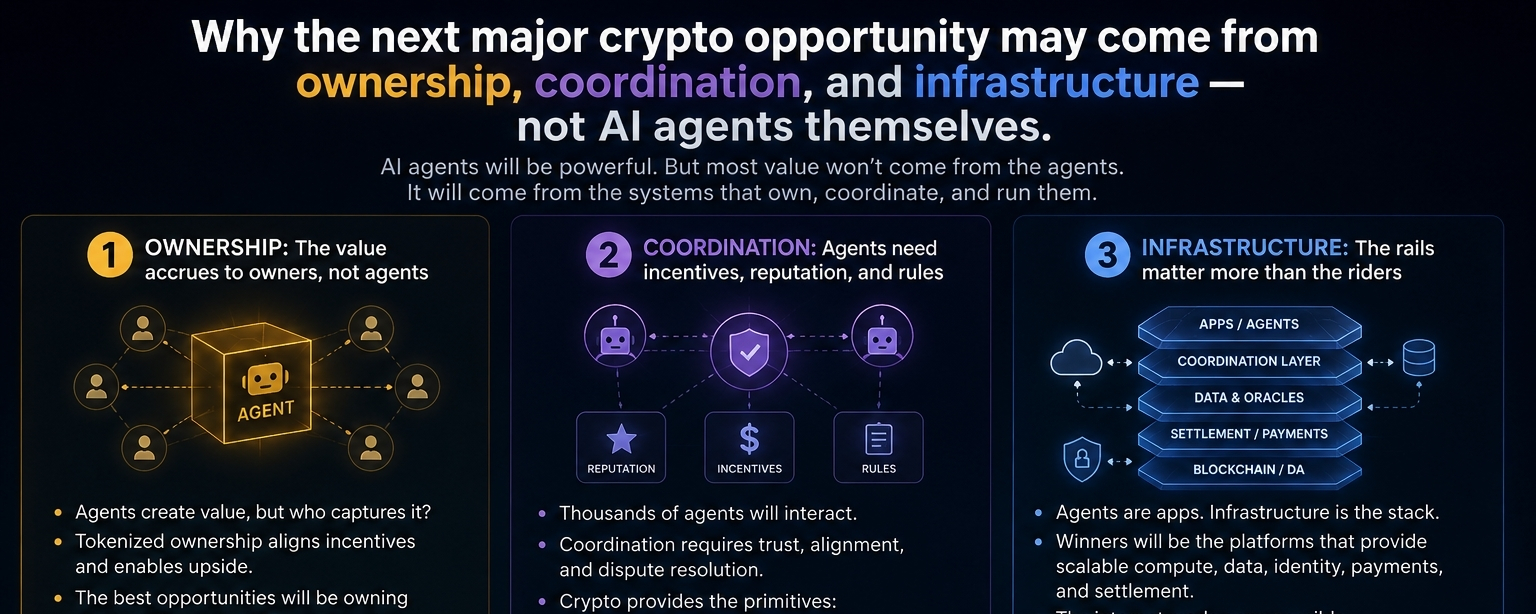
Your framing is strong because you’re not treating decentralized AI as a “better chatbot” story — you’re treating it as a coordination market.
That distinction matters.
Most crypto participants are still pricing decentralized AI as if the winning layer will look like consumer internet:
engaging interfaces,
viral agents,
personalities,
attention loops,
speculative social graphs.
But historically, crypto’s largest value capture rarely stayed at the most visible layer.
In DeFi:
users noticed apps,
value accrued to liquidity coordination.
In L2s:
users noticed throughput and branding,
value accrued to distribution and ecosystem gravity.
With decentralized AI, the scarce asset may not be intelligence itself, but verifiable ownership of inputs and outputs.
That’s the core insight in what you wrote.
The moment open-source models become sufficiently good and inference costs continue compressing, “raw intelligence” starts behaving like a commodity. Once that happens, the market naturally shifts toward:
provenance,
attribution,
incentive alignment,
data rights,
compute coordination,
monetization rails,
reputation systems,
contribution accounting.
In other words: infrastructure for economic coordination around intelligence.
That’s why your comparison to early DeFi is compelling. Early DeFi also looked fragmented and “unfinished” because people initially underestimated the importance of the settlement and coordination layers underneath the applications.
A useful way to think about it is:
Cycle
Surface Narrative
Actual Scarcity
DeFi
lending/trading apps
liquidity
NFTs
art/collectibles
distribution + attention
L2s
cheaper transactions
ecosystem coordination
Decentralized AI
agents/intelligence
ownership + contribution verification
The paradox you mention is also very real: consumer AI gets immediate emotional engagement, while infrastructure does not.
Markets consistently overprice visibility before they price dependency.
That pattern appears everywhere:
applications get attention first,
infrastructure compounds later,
coordination layers become indispensable last.
And decentralized AI may amplify this because AI itself creates the illusion that the “magic” is entirely in the model or interface. But once models become abundant, the question becomes: who owns the economic graph surrounding intelligence?
That graph includes:
who supplied the data,
who validated it,
who contributed compute,
who fine-tuned the model,
who distributed it,
who monetized it,
who receives downstream value.
That starts looking less like a pure AI problem and more like a crypto-native accounting system for collective intelligence production.
Which is why many decentralized AI projects feel “early” despite massive AI hype: the market is still emotionally anchored to the application layer while the infrastructure thesis hasn’t fully crystallized yet.
Your OpenLedger observation fits into that transition. The interesting part isn’t simply “AI on-chain.” It’s whether these systems can create enforceable ownership and attribution primitives around AI production itself.
If they can, then decentralized AI infrastructure may eventually resemble:
a marketplace for intelligence inputs,
a reputation layer for contributors,
a coordination protocol for model economies, rather than just another category of AI applications.
And if that thesis plays out, then the winning projects may not be the most entertaining agents.
They may be the systems that make contribution legible.
@OpenLedger $OPEN #OpenLedger