
For the last few years the world has been obsessed with artificial intelligence.
Every week there is a new AI model.
A new breakthrough.
A new company claiming it will change the future.
People are amazed by what AI can create.
Images. Code. Research. Videos. Entire conversations.
But almost nobody stops to ask a much deeper question.
Who actually owns this new economy being built around artificial intelligence
Because right now the answer is uncomfortable.
The internet created the data.
Ordinary people created the knowledge.
Millions of users trained the system without even realizing it.
Yet the rewards mostly flow to centralized corporations.
That imbalance is becoming impossible to ignore.
And this is exactly where OpenLedger enters the picture.
Not as another chatbot.
Not as another temporary AI hype coin.
But as an attempt to rebuild the foundation underneath AI itself.
OpenLedger is trying to create something the AI industry still lacks.
A real ownership layer.
The Hidden Problem Inside Modern AI
Most people see AI as magic.
Type a question.
Get an answer.
Generate an image.
Automate a task.
Simple.
But behind every AI system is an enormous amount of human knowledge.
Articles written by people.
Research uploaded by communities.
Code written by developers.
Creative work shared online for years.
Modern AI feeds on this information constantly.
The problem is that the people who contribute the raw intelligence rarely receive anything in return.
No ownership.
No attribution.
No participation in the value being created.
The system quietly extracts knowledge while profits concentrate at the top.
OpenLedger is built around the idea that this model eventually breaks.
Because intelligence without accountability creates imbalance.
And imbalance never lasts forever.
Proof of Attribution Changes Everything
This is the most important part of OpenLedger.
Proof of Attribution.
At first the name sounds technical.
But the idea behind it is deeply human.
Imagine contributing valuable data to an AI network and actually being recognized for it.
Not emotionally.
Economically.
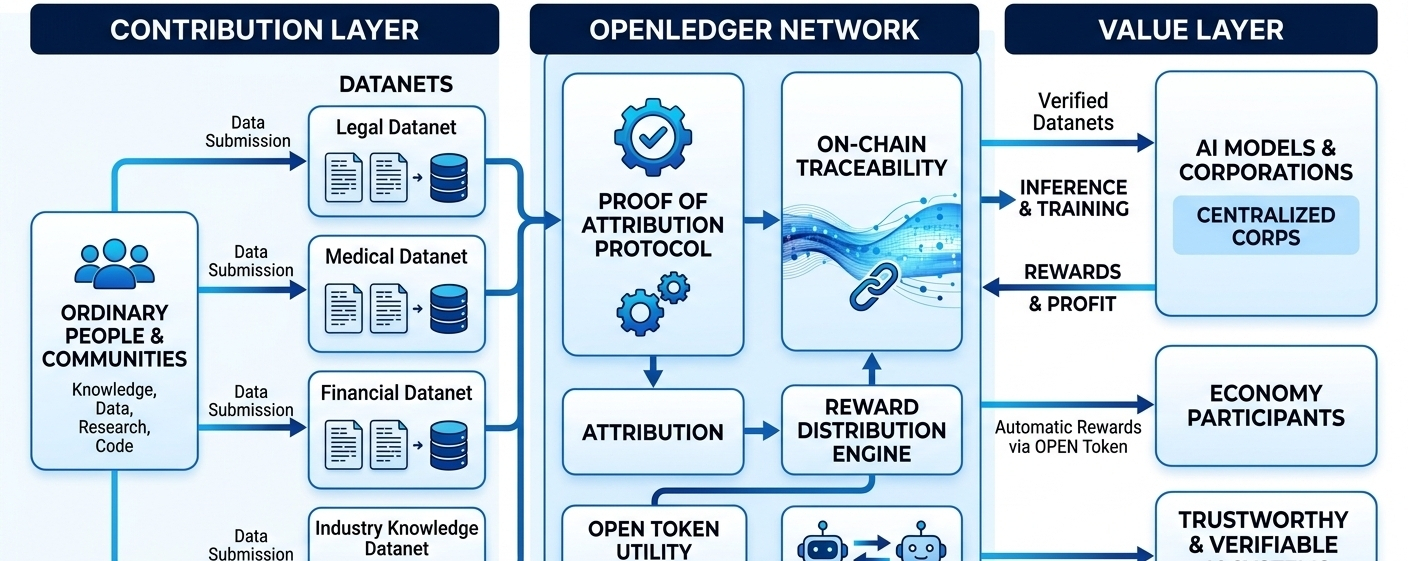
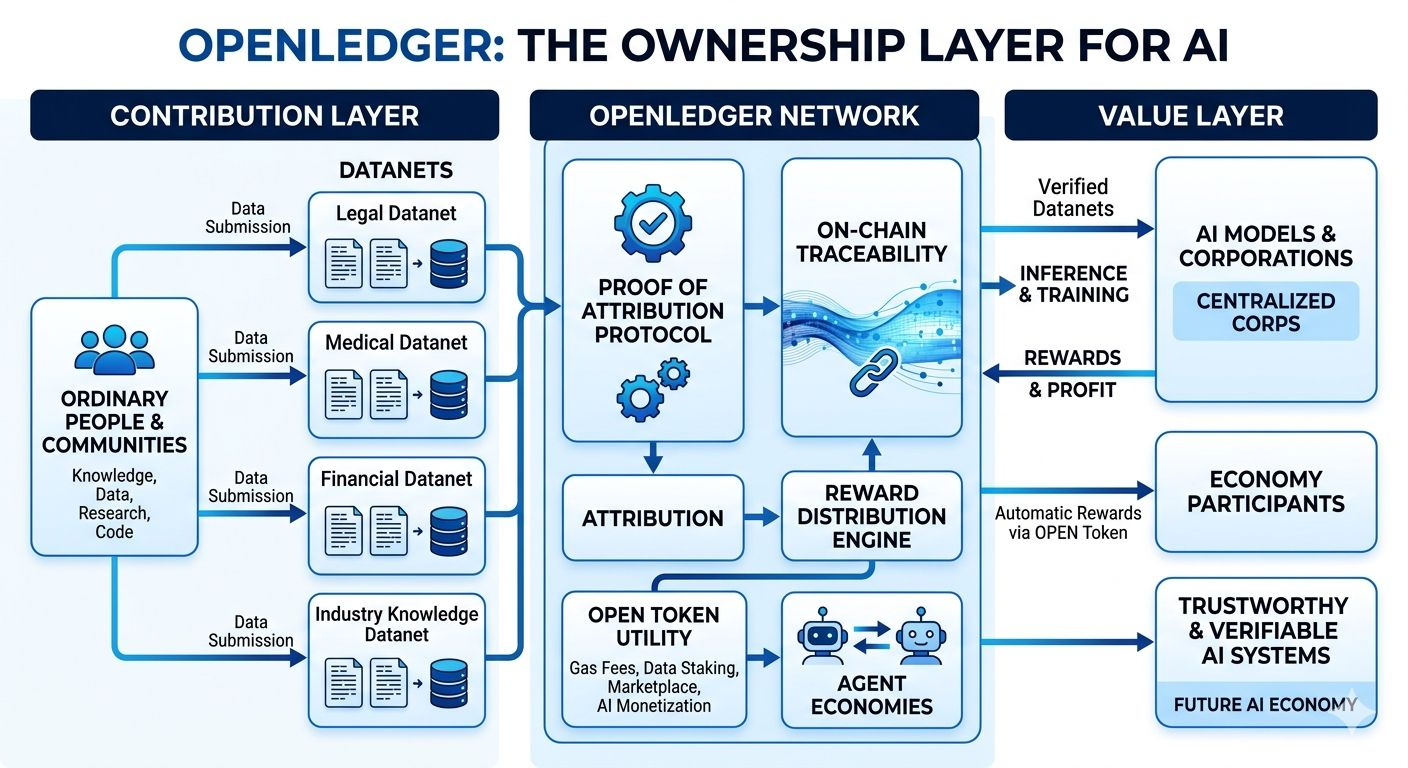
OpenLedger wants every dataset submitted into the network to be traceable on chain. If AI models use that data during training or inference the contributor can potentially receive rewards automatically through OPEN.
For the first time the people helping build intelligence systems may finally become participants instead of invisible resources.
That changes the relationship between humans and AI completely.
Because ownership creates responsibility.
Ownership creates alignment.
Ownership creates trust.
And trust is becoming one of the rarest things in the AI industry
Why This Matters More Than People Realize
The current AI race is obsessed with power.
Bigger models.
Bigger funding rounds.
Bigger compute clusters.
But the next phase of AI may not belong to whoever builds the biggest system.
It may belong to whoever builds the most trustworthy system.
As AI enters finance healthcare law research and autonomous automation the world will demand answers.
Where did this data come from
Who contributed to it
Can the output be verified
Who gets rewarded when AI creates value
Right now most AI systems cannot answer these questions clearly.
OpenLedger is trying to build an infrastructure where those answers already exist from the beginning.
That is a much bigger vision than simply launching another AI application
Datanets Feel Like the Beginning of Community Owned Intelligence
One of the most interesting ideas inside OpenLedger is Datanets.
These are specialized data ecosystems built around real subjects.
Legal information.
Medical research.
Financial intelligence.
DeFi exploit tracking.
Industry knowledge.
Instead of data being controlled quietly behind closed corporate systems communities can contribute directly into open structured networks.
That creates something powerful.
A future where knowledge itself becomes collaborative infrastructure.
And honestly this feels emotionally important in a world where people increasingly feel disconnected from the systems they help create.
Most users today contribute value online every single day while owning almost nothing.
OpenLedger is trying to reverse that feeling.
The Bigger Vision Is Not About AI Tools
This is where many people misunderstand the project.
OpenLedger is not trying to become another version of ChatGPT.
It is trying to build the economic rails underneath future AI ecosystems.
That distinction matters.
The internet became valuable because of infrastructure.
Cloud computing became valuable because every platform needed backend systems.
AI may evolve the same way.
The real long term winners may not just be the companies creating flashy consumer products.
The winners may be the networks that solve ownership attribution coordination and economic participation.
That is the territory OpenLedger is trying to enter.
And if this vision works the implications become massive.
AI Agents Are Coming Faster Than Most People Expect
One part of the roadmap stands out immediately.
Agent economies.
The idea sounds futuristic today but the direction already feels visible.
AI systems are slowly moving beyond simple assistance.
Soon many of them may operate independently.
Executing tasks.
Paying for services.
Hiring other AI agents.
Managing workflows.
Distributing revenue automatically.
OpenLedger wants to create infrastructure for this machine driven economy before it fully arrives.
That may sound ambitious.
But every major technological shift initially sounds unrealistic before it becomes normal
OPEN Token Actually Has a Real Role
One reason many crypto projects collapse is simple.
Their tokens are unnecessary.
OpenLedger appears to understand this problem better than most.
OPEN is designed to function across the ecosystem itself.
Gas fees.
Data staking.
Marketplace transactions.
AI model monetization.
Contributor rewards.
The token is not positioned only as speculation.
It is designed as economic fuel inside the network.
That does not remove risk.
Nothing in crypto is guaranteed.
Execution still matters.
Adoption still matters.
Competition still matters.
But utility gives a project stronger foundations than pure narrative alone.
And right now much of the AI crypto sector still runs almost entirely on narrative.
What Makes OpenLedger Feel Different
The deeper I studied the project the more one thing became clear.
OpenLedger is not chasing short attention spans.
It is trying to solve a structural problem that the AI industry has quietly ignored for years.
Who owns the value created by intelligence
That question will become more important every single year from now.
Because artificial intelligence is no longer just technology.
It is becoming infrastructure for the global economy.
And infrastructure without transparency eventually creates distrust.
Infrastructure without ownership eventually creates resistance.
OpenLedger is betting that the future AI economy cannot survive forever under closed systems where users contribute everything while owning nothing.
Honestly that thesis feels difficult to dismiss.
Maybe the project succeeds.
Maybe it struggles.
Maybe the timeline takes longer than expected.
But the direction itself feels real.
People want participation.
People want transparency.
People want ownership over the systems they help build.
And for the first time one project is trying to turn those ideas into actual infrastructure instead of just marketing language.
That is why OpenLedger deserves attention right now.
Not because of hype.
Because the problem it is trying to solve is becoming impossible to ignore.