
A few days ago, I heard a story that felt small at first, but the more I sat with it, the more it exposed a much bigger problem.
A friend of mine works with open-source NLP tools. Two years ago, he uploaded a tiny script to GitHub that cleaned and prepared a niche language corpus. Nothing dramatic, no big announcement, no expectation of reward. Just a useful tool left on the shelf for anyone who needed it. Then recently, he came across a large company’s technical post, and something about it felt deeply familiar. The workflow, the logic, even the structure of the data handling looked almost like his old script. The post got attention. People praised the solution. His name never appeared.
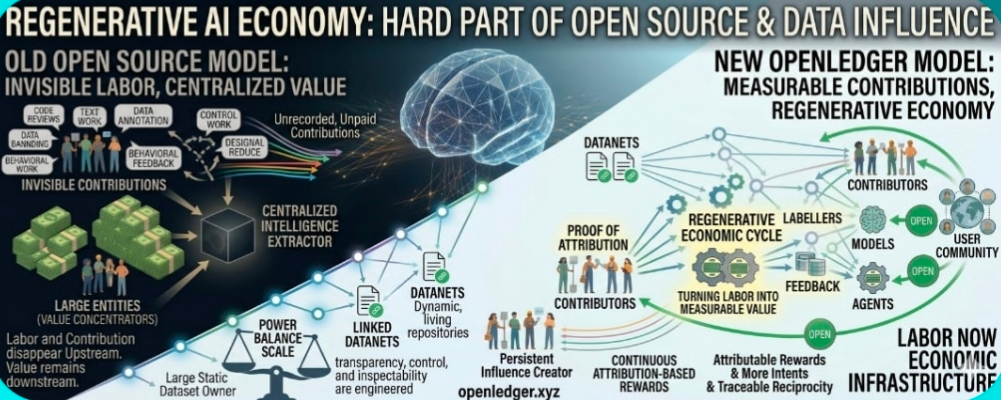
He was not furious. That was not the point. What bothered him was more complicated than simple credit. It was the feeling that open-source work can disappear into the system that benefits from it. A person can contribute something real, something useful, something that saves others time and effort, and still end up invisible the moment the work is absorbed into a larger machine. That is the tension that kept coming back to me while reading section 1.1.1 of the @OpenLedger whitepaper.
The section is titled “Collaboration and Ownership,” and on the surface it sounds almost obvious. But the longer I thought about it, the more I realized the phrase is carrying a much heavier question: what happens when collaboration becomes so common that ownership starts to blur? In the open-source world, people talk a lot about sharing, reuse, and remixing. Those ideas are valuable. But they also create a blind spot. A contribution can travel far, shape something important, and still leave no economic trace behind for the person who started it.
That is where OpenLedger seems to be trying something different.
Instead of treating contribution as a one-time act that ends with attribution, the whitepaper suggests a system where contribution stays attached to its source in a durable way. That is a meaningful shift. It means recognition is not just social or symbolic. It can also become structural. The creator is not only remembered; the creator remains connected to the value that follows.
To me, that changes the whole conversation.
In most digital ecosystems, the gap between creation and reward is huge. Someone makes a tool, someone else scales it, and the value often gets captured somewhere in between by the platform, the distributor, or the company that packages it better. The original contributor may get a mention, a star, or a quiet thank-you, but not much else. OpenLedger is trying to narrow that gap by making contribution trackable inside the economic layer itself.
What makes this idea more interesting is that the whitepaper does not define contribution too narrowly. It includes data, models, and insights under the same umbrella. That matters because real AI systems are built from many kinds of labor, not just one. A developer may write code. A researcher may tune a model. A community member may provide useful feedback. A data worker may help shape the quality of the inputs. In the old internet model, these contributions are often treated very differently. In this one, they are placed into a shared framework of value.
That is the deeper idea I take from OpenLedger: it is not only trying to reward work. It is trying to make different forms of work legible to the system.
Section 5.2.2 pushes that idea further by stating that contributors earn token rewards based on the impact of their data. That word, “impact,” is the real anchor. It suggests that the reward is tied to what the contribution actually does in the system, not just to how much effort someone claims to have spent. That is a much harder standard, but also a fairer one. It moves the focus away from noisy reputation and toward real utility.
I think that is why the OPEN token becomes more than just a payment unit in this framework. It starts to look like a mechanism for keeping value close to the source of the work. If a dataset helps improve a model, and that model continues to be used, then the contributor is not completely cut off from the outcome. Their role does not vanish once the work is uploaded. It can keep echoing through the system.
That said, this is not a clean or effortless idea. It introduces new questions that are just as important as the old ones.
The first problem is definition. What counts as a real contribution? A clean dataset is easy to measure. A model update is easier to track. But what about a useful suggestion in a discussion thread? What about a bug report that saves a project from failure later on? What about all the soft, informal labor that keeps open communities alive? Those things matter, but they are difficult to encode. Any system that only rewards what is simple to capture risks missing the human side of collaboration.
The second problem is cultural. Open source has always had a moral layer to it. People contribute for many reasons: learning, community, experimentation, generosity, reputation, or just the pleasure of building something useful. Once you attach a measurable reward to every contribution, the atmosphere changes. That is not necessarily bad, but it does shift the spirit of participation. The question is whether a system can reward fairness without turning every act into a transaction.
That is what makes OpenLedger interesting to me. It is not pretending that contribution is easy to define. It is trying to make contribution visible in a world where it often becomes invisible the moment it is reused. That is a real problem, and one that open-source culture has never fully solved.
So my reading of section 1.1.1 is not just about ownership. It is about visibility, durability, and fairness in a digital economy that has gotten very good at consuming value without always remembering where it came from.
If my friend’s script helped shape a larger model, then maybe the next question should not be whether he got a nice mention. Maybe the better question is whether the system is capable of acknowledging that his work still matters after the moment of creation has passed.
That, more than anything, feels like the real challenge OpenLedger is trying to answer.