
If you’ve been in crypto long enough, you start noticing a pattern. Every cycle begins with speculation, but the projects that survive are usually the ones building invisible infrastructure. Not the loudest narratives. Not the tokens with the most aggressive marketing. The systems that quietly become useful.
That’s the lens I’ve been using lately when looking at the intersection of AI and blockchain.
Over the past few years, AI has moved from being a niche technical field into something deeply integrated into everyday digital life. Models are generating code, writing research, automating workflows, and increasingly acting as decision-making layers for software systems. But underneath the excitement, there’s a structural issue most people still underestimate: AI is extremely dependent on data, computation, coordination, and ownership.
And that’s where blockchain infrastructure starts becoming relevant again in a more mature way.
Not because decentralization is automatically better, but because AI systems are creating entirely new questions around who owns data, who gets compensated, how models are verified, and how value flows between contributors. From my perspective, this is one of the first times blockchain technology feels naturally aligned with a real infrastructure problem instead of searching for one.
That broader shift is part of what makes projects like OpenLedger interesting to watch.
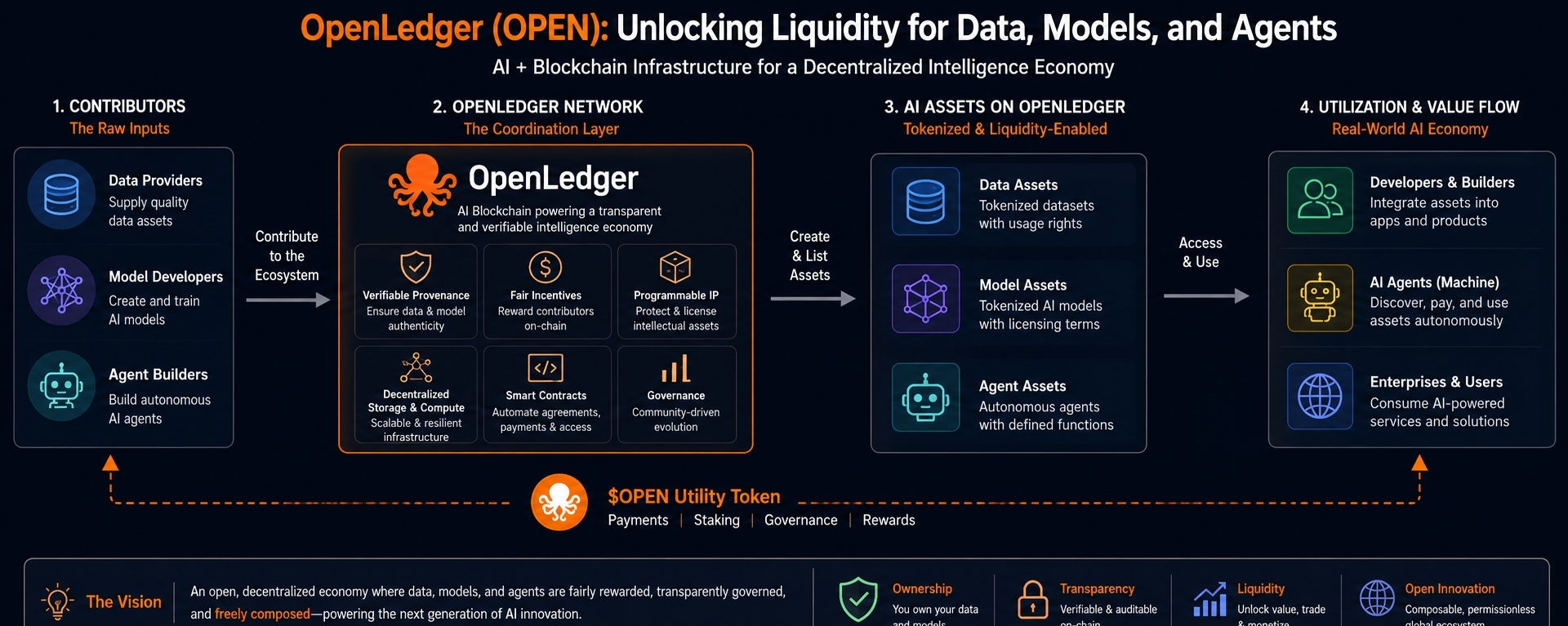
OpenLedger positions itself as an AI-focused blockchain designed to unlock liquidity around data, models, and autonomous agents. On the surface, that sounds like another familiar crypto pitch. But if you slow down and look deeper, the underlying idea reflects a direction the industry has been gradually moving toward for years.
The crypto market used to obsess almost entirely over financial primitives. Exchanges, lending protocols, liquidity farming, perpetuals. Everything revolved around capital efficiency. But now there’s growing attention on computational infrastructure and digital production itself.
In simple terms, AI systems need inputs to function. They need training data. They need models. They need ongoing optimization. And increasingly, they need autonomous coordination between systems that may not belong to a single company.
That changes the equation.
What stands out to me is that OpenLedger is attempting to treat these AI components almost like economic assets. Data providers, model creators, and agents are not just passive participants; they become contributors inside a programmable ecosystem where value can theoretically move more transparently.
Whether the execution succeeds is another question entirely, but conceptually, this is far more aligned with where the industry is heading compared to the shallow “AI token” trend that dominated parts of the previous cycle.
If you remember the last major crypto bull market, a lot of projects simply added “AI” to their branding without solving anything meaningful. Most of it was narrative trading. Experienced users can usually recognize the difference now. The market has become harsher, but also more educated.
Developers especially think differently today.
A few years ago, many blockchain applications were designed around speculation first and utility second. Now, serious builders are increasingly focused on deployment environments, interoperability, scalability, and automation. They care less about temporary attention and more about whether systems can actually function under real-world demand.
That’s an important distinction because AI infrastructure is fundamentally an operational challenge.
You’re not just building an app. You’re coordinating computation, identity, incentives, data pipelines, and sometimes machine-to-machine interactions at scale. That requires reliability more than excitement.
This is where infrastructure-level thinking matters.
For example, one of the biggest misconceptions people have about AI is assuming the model itself is the entire product. In reality, the surrounding infrastructure often matters more. Data availability, verification layers, execution environments, payment systems, access control, and orchestration pipelines are what determine whether AI systems can operate sustainably outside centralized platforms.
A useful comparison might be cloud computing in its early days.
Most users never think about the servers, routing layers, or storage architecture powering modern applications. But those backend systems created the conditions for the internet economy to scale. AI may be entering a similar phase now, where the next generation of infrastructure becomes more valuable than the consumer-facing interface itself.
OpenLedger appears to be positioning around that idea.
The emphasis on monetizing data and models reflects a growing realization that AI economies need better incentive coordination. Right now, a handful of large corporations control enormous amounts of training data and computational power. Decentralized systems are attempting to introduce alternative frameworks where contributors can participate more directly in the value creation process.
That sounds idealistic in theory, but there are legitimate practical reasons this matters.
Take autonomous AI agents as an example. If agents eventually perform tasks across decentralized environments — trading, coordinating logistics, managing digital services, or executing workflows — they will need payment rails, identity systems, and transparent execution logic. Traditional infrastructure is not always designed for that kind of machine-native interaction.
Blockchain networks, despite their flaws, are naturally programmable coordination systems. That’s why the overlap with AI is becoming increasingly difficult to ignore.
Still, it’s important to stay grounded.
The biggest risk in this sector is that the technology narrative can outrun actual adoption. We’ve seen this happen repeatedly in crypto. Infrastructure gets built years before meaningful demand arrives. Sometimes that patience pays off. Sometimes it doesn’t.
From my perspective, one of the real challenges for projects like OpenLedger will be usability.
Building technically sophisticated systems is one thing. Creating environments developers genuinely want to deploy on is something else entirely. Adoption usually comes from reducing friction, not increasing complexity. If onboarding becomes difficult or the economic model feels forced, even strong technology can struggle.
Scalability is another critical issue.
AI systems generate enormous computational and data demands. Any blockchain attempting to support AI-related workflows must find practical ways to handle throughput, costs, and execution efficiency without sacrificing reliability. This is where many ambitious decentralized infrastructure projects run into reality.
And then there’s the human side of the market.
If you’ve lived through multiple cycles, you become more cautious about timelines. Crypto tends to overestimate what can happen in one year and underestimate what can happen in ten. Real infrastructure adoption is usually slow, uneven, and frustrating. But once useful systems become embedded, they often become incredibly difficult to replace.
That’s why I think the most important conversations around AI and blockchain are no longer about hype cycles or token charts.
They’re about ownership.
Who owns the data feeding intelligent systems? Who benefits economically from model contributions? How are autonomous systems coordinated across open environments? How do developers build applications without becoming completely dependent on centralized gatekeepers?
Those are infrastructure questions. And infrastructure questions tend to matter long after speculative narratives disappear.
What makes OpenLedger worth observing is not necessarily short-term market excitement, but the direction it represents. The project reflects a broader transition happening across crypto itself — away from purely financial experimentation and toward programmable digital economies where intelligence, automation, and coordination become native internet layers.
Whether OpenLedger becomes a dominant player is impossible to know right now. The space is still early, fragmented, and highly competitive. Execution risk remains enormous. Regulatory uncertainty still exists. And AI itself is evolving faster than most infrastructure providers can adapt.
But from my perspective, the deeper significance is that projects like this indicate crypto is maturing beyond simple transactional systems.
The industry is slowly moving toward becoming a coordination layer for digital activity itself.
And if that evolution continues, the long-term winners probably won’t be the loudest projects. They’ll be the ones building systems capable of supporting how AI, data, and automation actually function in the real world.