
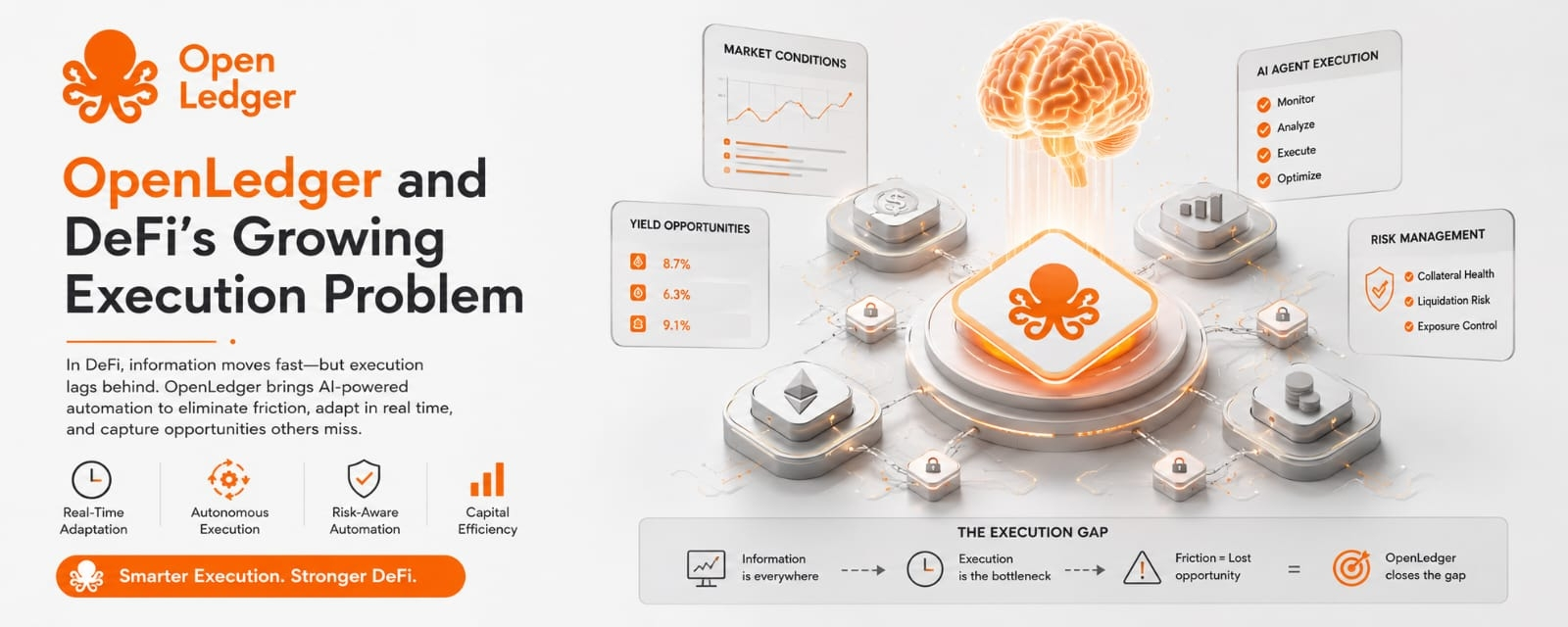
Most people still talk about DeFi as if the biggest risks are exploits, collapses, and token crashes.
And sure, those things matter.
Every cycle creates a new disaster. A bridge gets drained. A lending protocol spirals into liquidations. A governance vote turns into chaos. Crypto almost behaves like a city addicted to emergency sirens. Everyone runs toward whatever is exploding that week.
But lately I’ve been thinking about a quieter problem that almost nobody discusses seriously enough.
Operational inefficiency.
Not dramatic failure. Just constant friction.
A few months ago, I spent an entire weekend trying to actively manage positions across multiple chains during a volatile market rotation. Nothing extreme. Some stablecoin lending, a perpetual hedge, a restaking position, and a few yield strategies spread between ecosystems because rates kept shifting aggressively.
At first it felt manageable.
Then the market started moving faster.
One lending pool suddenly became overcrowded and yields collapsed within hours. Funding rates flipped on a perp position I was monitoring. Gas fees spiked at the exact moment I needed to rebalance collateral. One bridge slowed down during congestion, which delayed capital movement long enough to miss the opportunity entirely.
By Sunday night, I realized something uncomfortable.
I had spent more time maintaining positions than actually thinking strategically.
That stuck with me.
Because I don’t think information is the bottleneck in DeFi anymore.
Everyone already sees the same dashboards, analytics pages, whale trackers, AI scanners, and on-chain alerts. Opportunities spread through the market almost instantly now. Alpha itself has become increasingly compressed.
Execution is becoming the real edge.
And honestly, most humans are terrible at maintaining consistent execution once systems become fragmented enough.
That is why OpenLedger caught my attention recently.
At first glance, I assumed it was another project attaching AI branding to automated yield systems because the market currently rewards almost anything connected to artificial intelligence. We have seen enough shallow “AI plus crypto” narratives already.
But the more I looked into it, the more it felt less focused on prediction and more focused on coordination.
That distinction matters.
DeFi today reminds me less of traditional finance and more of managing traffic inside a massive city during rush hour.
The roads exist.
The vehicles exist.
The destinations are visible.
Yet everything still becomes inefficient because movement itself is poorly coordinated. One blocked intersection slows down every nearby street. Tiny delays compound across the entire system.
Crypto increasingly behaves the same way.
Capital exists everywhere, but repositioning it efficiently across fragmented environments has become exhausting.
I notice this constantly in lending markets.
A stablecoin pool offering attractive yields in the morning can become mediocre by evening once enough liquidity crowds into the same trade. Incentives rotate aggressively. Utilization ratios change rapidly. Reward programs lose effectiveness almost immediately after attention arrives.
Most users simply cannot adapt fast enough manually.
And the hidden cost is not always catastrophic losses.
It is underperformance.
Idle balances sitting unused for hours. Rewards left unclaimed. Delayed rebalancing. Excess collateral earning nothing. Positions becoming inefficient simply because people cannot monitor everything continuously.
Those small leaks compound quietly over time.
I think this is one of the least appreciated structural weaknesses in modern DeFi.
Everyone obsesses over maximizing yield, but fewer people calculate how much capital efficiency disappears through operational drag alone.
That is where automation starts becoming more interesting beyond the marketing layer.
If systems like OpenLedger work properly, the value is probably not about replacing human judgment entirely. It is about reducing the coordination burden humans are increasingly unable to handle manually.
And that becomes more important as markets accelerate.
Five years ago, opportunities sometimes stayed open for weeks. Today, conditions can shift within minutes. The market adapts almost in real time now because information spreads instantly across social feeds, analytics tools, and algorithmic systems.
The edge increasingly belongs to whoever responds fastest and most consistently.
But I am still cautious about this entire direction.
Because autonomous financial coordination sounds cleaner in theory than it behaves in reality.
Crypto infrastructure still breaks under pressure constantly.
Gas spikes distort execution timing. Bridges fail during volatility. Liquidity disappears unexpectedly. Oracles lag when markets move aggressively. Smart contracts behave unpredictably during edge-case conditions.
Automation systems may appear brilliant during calm periods while quietly accumulating hidden vulnerabilities underneath.
That reminds me of old electrical grids during summer heat waves.
Everything works normally most of the year. Then demand suddenly spikes and weaknesses appear everywhere at once. Transformers fail. Bottlenecks emerge. Entire neighborhoods lose stability because the system was optimized for efficiency instead of resilience.
DeFi behaves similarly during stress.
And unfortunately, stress is exactly when execution quality matters most.
That is why I do not think projects like OpenLedger should be evaluated through hype cycles or projected yields alone.
The real questions are operational.
Can automation maintain efficiency during volatility instead of only during stable conditions?
Can it reduce unnecessary transaction costs during congestion?
Can it rebalance collateral intelligently without increasing liquidation exposure?
Can it navigate fragmented liquidity safely across chains without introducing new bridge risks?
Those are infrastructure questions.
And historically, crypto has been far better at selling infrastructure stories than delivering durable infrastructure itself.
Still, I think the direction makes sense.
DeFi is gradually evolving into an environment where operational consistency matters more than raw intelligence. The winning systems may not be the loudest or most complex. They may simply be the ones that coordinate capital more efficiently than humans can manually over long periods of time.
That feels like a very different stage of crypto than the one most people are still discussing.
And honestly, I think the execution problem is only becoming more visible from here.
Curious how others see this.
Do you think automation eventually becomes necessary survival infrastructure in DeFi?
Or does adding autonomous coordination simply create a new layer of systemic risk the market has not fully experienced yet?
$OPEN @OpenLedger #OpenLedger $POND $PHA #USConsumerSentimentThirdMonthDecline #HassettOilDropFedRateCutRoom #HassettIranDealLinkedToFedRateCuts #EthereumSpotETFs216MWeeklyOutflow
