
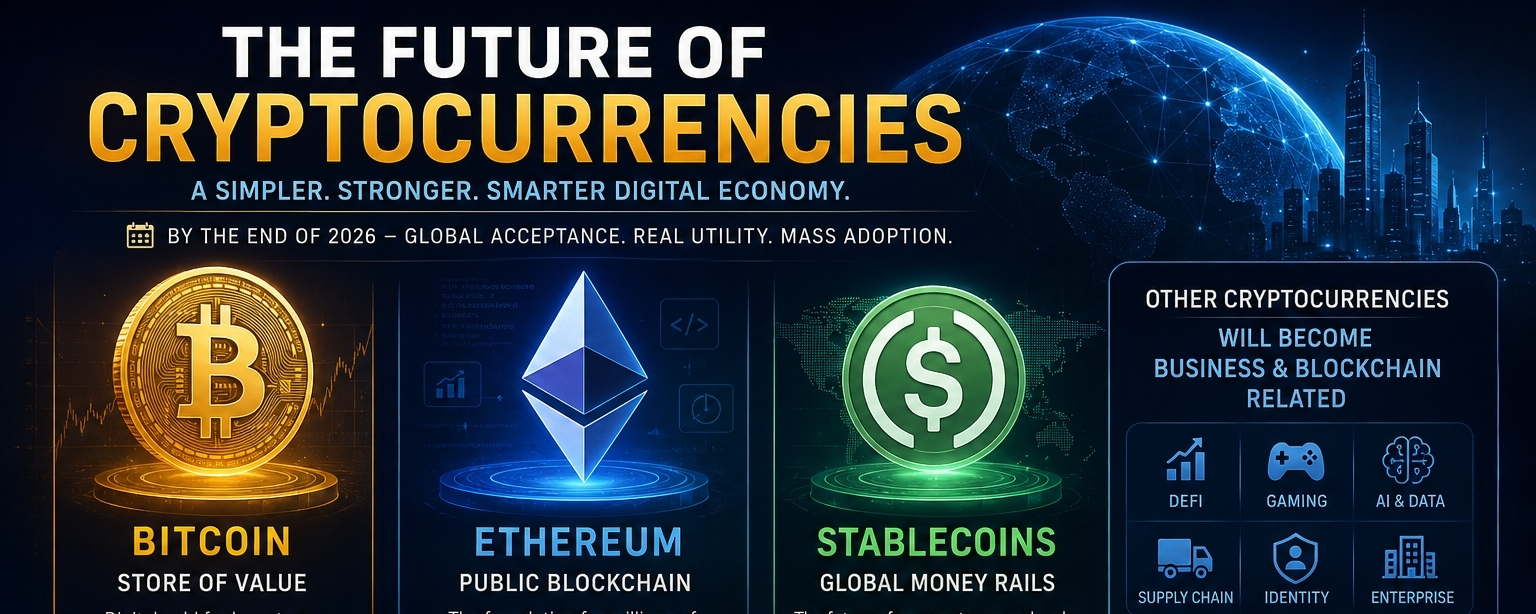
The cryptocurrency industry is moving toward a major transformation. By the end of 2026, the market is expected to become more structured, utility driven, and globally regulated. The era of thousands of speculative digital coins dominating public attention is gradually fading. In its place, a more practical and institutionally accepted ecosystem is emerging.
Bitcoin is increasingly being recognized as digital gold — a long term store of value designed for wealth preservation, global accessibility, and financial sovereignty. Its scarcity, decentralization, and strong network effect continue to position it as the primary reserve asset of the digital economy.
Ethereum, on the other hand, has evolved into the foundation layer for public blockchain innovation. Millions of decentralized applications, smart contracts, tokenized assets, AI integrations, financial systems, and enterprise solutions are being built on Ethereum and Ethereum compatible ecosystems. Its role extends far beyond currency; it is becoming digital infrastructure.
At the same time, stable coins are rapidly becoming the preferred medium for global settlements, cross border payments, treasury movement, and digital commerce because of their price stability and operational efficiency. Governments, institutions, fintech companies, and businesses increasingly view stable coins as practical tools rather than speculative assets.
The broader crypto market is also maturing. Many remaining cryptocurrencies are likely to transition into platform specific, business specific, or ecosystem utility assets. Their value will increasingly depend on the actual services, infrastructure, governance, settlements, AI integration, gaming, finance, logistics, or enterprise solutions they support rather than hype alone.
The future strategy for individuals and businesses may therefore become simpler and more disciplined:
• Hold Bitcoin for long term value preservation.
• Use Ethereum for exposure to blockchain infrastructure and innovation.
• Maintain stable coin reserves for liquidity, settlements, and operational flexibility.
• Keep selective allocations in utility based digital assets only when required for platform oriented services, ecosystems, or strategic participation.
The next phase of crypto is not merely about speculation. It is about infrastructure, compliance, digital ownership, programmable finance, and intelligent global systems. The market is shifting from “thousands of coins” toward a smaller number of globally trusted assets supported by highly specialized blockchain ecosystems.